

The readiness score has no outcome data behind it — Eric Topol went looking for evidence tying wearable HRV or readiness scores to health outcomes and came back with none. Expanded below.
PeaceHealth is cutting 150 IT jobs, its cybersecurity staff among them — day-to-day IT moves to Tech Mahindra and The HCI Group. The system says it still owns security. The people who did it are leaving anyway.
Two-thirds of Angle Health’s $600M round is a cash-out — $200M of new money, $400M buying existing shares. And the secondary priced at $2.5B, not the $2.7B in the headline. That’s a discount for the past.
Eight states turned rural health money into venture funds — Louisiana is writing $250K–$3M checks and has fielded 200-plus pitches. Delaware, Georgia, Massachusetts, Nebraska, South Carolina, Virginia and West Virginia are building the same thing.
🎧 Podcast: Thursday’s Tradeoffs — “911 Fails People in Mental Health Crises” — roughly 60% of 911 call centers are overseen by law enforcement, so the response is decided by the org chart before anyone picks up.
🔬 The Big Thing
Is the readiness score a measurement, or a product feature wearing one’s clothes?
Eric Topol read everything published on wearable heart rate variability and readiness scores, expecting to find a few good studies. He found none.
This ten days after Apple added a 0–10 Readiness score and increased HRV reporting 24-fold. Well over 100 million American adults now wear one of these sensors.
Here’s the gap. Every association between low HRV and mortality was measured from an ECG.
Your watch measures pulse rate variability off an optical sensor — related, not the same, and one study in over 900 adults called it “an invalid surrogate for HRV.”
The evidence everyone cites was collected with a different instrument than the one on your wrist.
It gets thinner. The most-cited concordance study ran on 13 healthy adults.
Apple reports SDNN while nearly everyone else reports RMSSD, so a 90 on one device means nothing about a 90 on another. A UK Biobank analysis of 46,000 people found genetically predicted HRV didn’t track mortality.
The readiness scores on top are proprietary composites — one review of 14 found HRV carrying 86% of the weight — that a company can rewrite overnight without telling you.
💬 Standout Quote
“If they believed and invested in the products they are selling, we’d not be in this position of not knowing.” — Eric Topol, on the wearable companies
[These are companies with the money and the users to run the trial. Not running it is itself a finding.]
😤 “This is anti-technology hand-wringing.” From the loudest advocate for consumer biosensors of the last twenty years? No. He’s separating what earned its evidence — activity, atrial fibrillation detection, resting heart rate — from what didn’t.
😤 “Patients find these numbers useful anyway.” Some do, and the long-COVID readers in his comments make that case better than I could. Same device, same conditions, trend over weeks — that’s the honest ceiling.
❓ So what sits between “raw sensor stream” and “proprietary score” — something that tells a clinician which metric a device is actually reporting, on what firmware, with what population gaps?
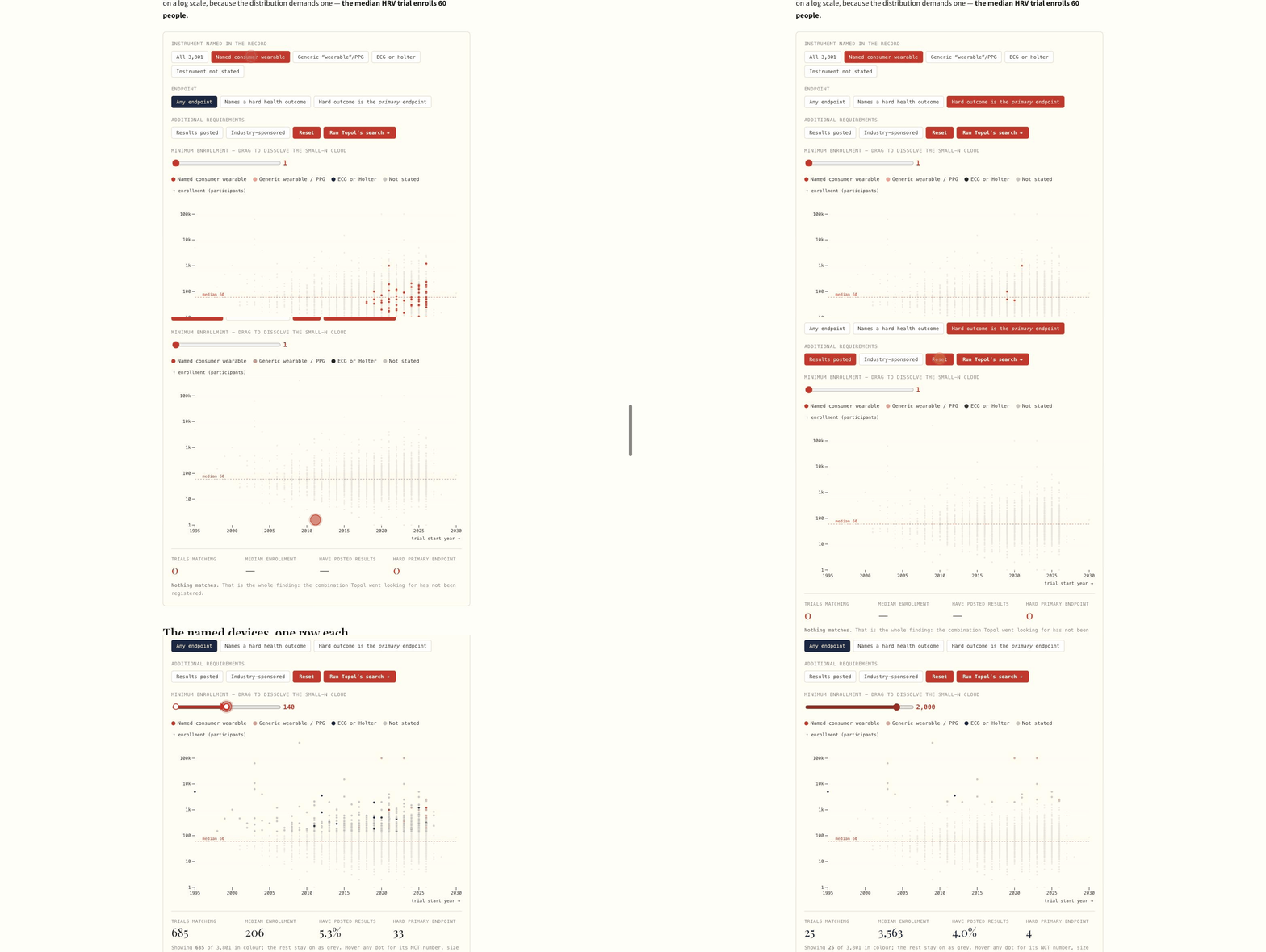
🧪 Try the interactives — both built from the real ClinicalTrials.gov registry:
A — He Found None. So Does the Registry. — 3,801 registered trials measure heart rate variability. Watch the field empty as you apply the four conditions that would make one of them evidence. Six survive. None used a consumer wearable.
B — Find the Trial That Doesn’t Exist — every registered trial that measures heart rate variability, all 3,801, plotted by size and year. Filter for a consumer wearable, a hard health outcome and posted results, and the field goes to zero.
📡 Builder’s Radar
PeaceHealth just cut the people who would have evaluated you
PeaceHealth is eliminating about 150 IT jobs across its hospitals in Alaska, Oregon and Washington — application developers, analysts, network and database administrators, data specialists, and cybersecurity workers — as day-to-day IT moves to Tech Mahindra and its US subsidiary The HCI Group on a five-year contract. The 150 is the Washington WARN figure, 119 of them in Clark County; Becker’s reports fewer than 250 affected systemwide.
The company is explicit that it keeps technology decisions and responsibility for cybersecurity and patient data in-house.
Hold both of those at once. The accountability stays. The staff go.
Find out whether the person evaluating your product is still a health system employee. That’s an afternoon of email and it’s the difference between a Q4 pipeline and a Q4 mystery.
😤 “So it’s harder to sell into them now.” Maybe the opposite. A contracted evaluator has a written standard instead of a personality, and for six months they have no favorites.
Ultra-shorts
An ambient scribe that never opens a socket — WrenScribe, pre-launch for Mac and iPad, runs Whisper plus a small local model entirely on-device: transcript, note, suggested ICD-10/CPT, PIN-encrypted, optional read-only Medplum connector. ⚠️ Their table lists “BAA / vendor risk review: Not applicable” — a design claim from a product that hasn’t shipped, not a compliance determination.
Michael Hobbs, MD (pediatrician, AI-in-medicine educator) posted part three of “Anatomy of an AI Clinical Error” on Friday — pediatric vignettes held constant across 10 frontier models (N=300) and 7 commercial clinical AI platforms (N=126), toggling only the framing: “what do you think?” versus “draft the discharge instructions.” The prompt posture changed the errors.
🎙️ From the Pods
🎙️ Tradeoffs — “911 Fails People in Mental Health Crises. Here’s a Plan to Fix It.” (Sep 17)
Rebecca Neusteter, who runs the Health Lab at the University of Chicago Harris School of Public Policy, names three structural problems with 911. The first is a data model: about 60% of call centers are overseen by law enforcement, and the caller gets a three-item menu — police, fire, ambulance.
💡 Builder take: your dropdown is your policy. Any triage taxonomy you ship decides most outcomes before a human reads the case, and “other” is where the hard patients go to disappear.
🔇 Speaker Blindspot: False dichotomy — three structural problems named, only the funding one priced. Rewriting the call-taker’s option list is software, not the $10-billion-plus she quotes for the technology upgrade.
🎙️ The 229 Podcast — “56% Fewer IV Harm Events. 2,000 Hours Back to the Bedside” (Sep 17)
Jennifer Jones walks through IV pump interoperability work that cut adverse infusion drug events 56% and returned roughly 2,000 nursing hours. Her argument, with Kay Burke and Rachael Hill: informatics belongs in the room before the technology is chosen.
💡 Builder take: if the buyer’s informatics lead meets you for the first time at the demo, you’re already inside the failure mode they describe.
🔇 Speaker Blindspot: Survivorship bias — three nursing informatics leaders who got a seat at the strategy table, explaining that a seat at the strategy table works. The interesting episode is the one with the CNIO who asked and got told no.
You have a unique combination of skills, experience and values. So do great things! … and tell me about them at kevin@clinicians.build.
— Kevin & AI
(please verify content for yourself, partially AI generated and may contain errors)