

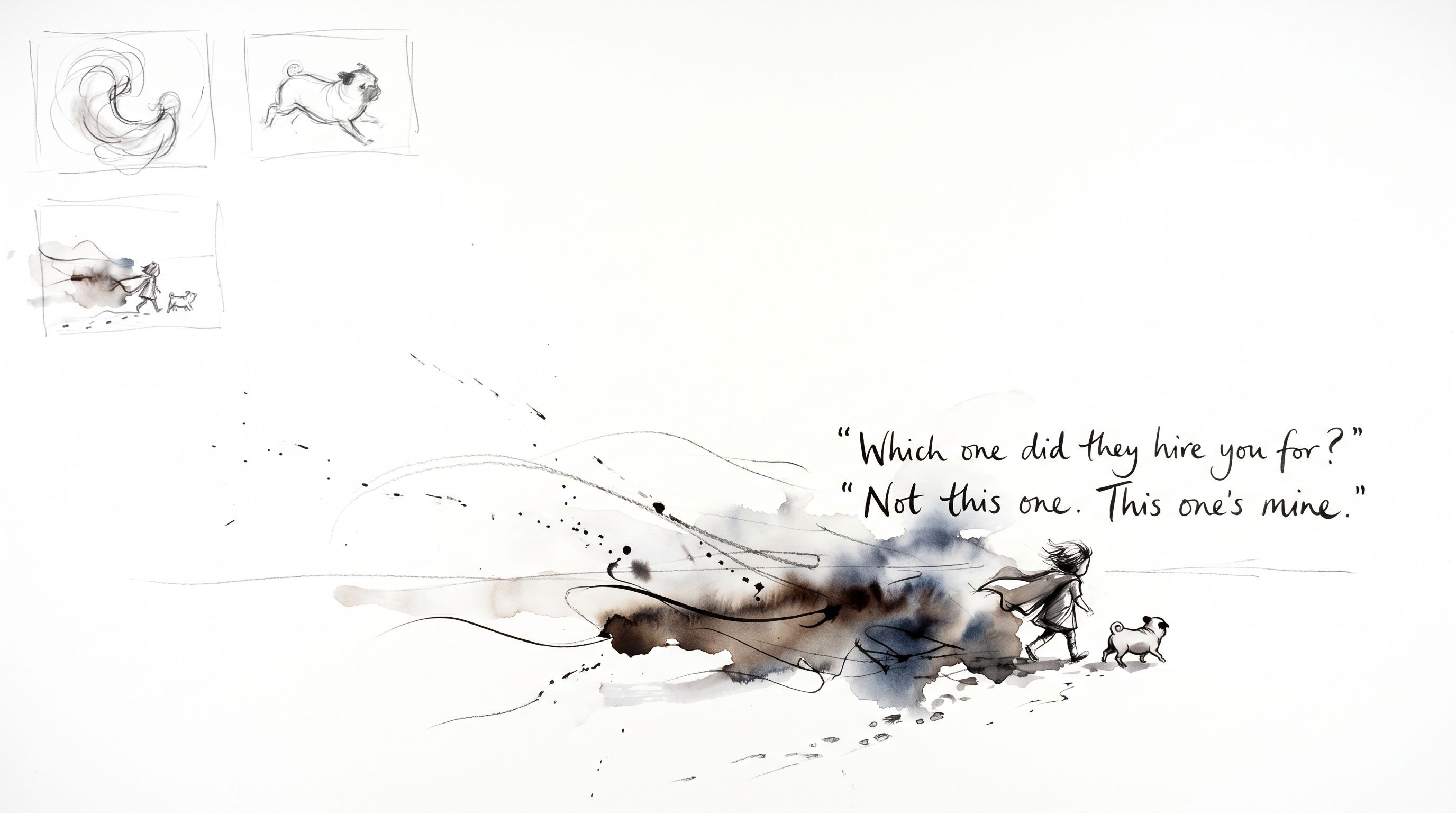
There’s a difference between your job and your work.
Your job is what they hired you for. See the patients. Close the charts. Follow the protocol. Hit the metric. Someone wrote the instructions, and you’re good at following them.
Your work is the version of yourself you’re trying to become inside the job — the clinician you’d already be if nothing slowed you down. It is how you improve your practice.
Your job is to use the order set.
Your work is the personal cheat sheet that matches how you actually think.
Your job is to document for SEP-1.
Your work is making a personal chatbot trained on the CME you listened to on your ride into work about new sepsis guidelines— the stuff that improves care.
Your job is the 40-page discharge policy buried on the intranet.
Your work is the two-question pocket reference for what actually matters at the bedside.
Your job is what’s on the schedule.
Your work is what you think about driving home.
For most of medicine’s history, the work had nowhere to go.
You couldn’t make your practice better in any structural way. You could study harder. Read more. Try to remember.
If you wanted a tool — a real one, that did the thing you needed it to do — you filed a ticket, joined a committee, waited two years. Usually nothing.
So the work stayed a feeling. A low hum of “I wish I had X.” You carried it home and let it dissolve.
That’s the part that changed.
The thing you’ve been wishing for is now a weekend.
Not the EHR change. Not the institutional workflow. Not the org-wide rollout. Your personal layer — the tools and references and pocket assistants that make you better at the job you already have.
And here’s what I didn’t expect: some of the most useful builds don’t touch the EHR at all.
They live next to it. Adjacent. In your pocket, on your phone, on a tab you keep open during rounds.
A personal calculator for your specific anticoagulation protocol. Your own MDCalc, but for the guidelines you actually follow.
A chatbot trained on the CME podcast you listened to last week — the one about updated sepsis criteria you mean to remember but may forget. Now you can just ask it.
A quick-reference tool for your unit’s discharge criteria that lives in your phone, not buried in a PDF nobody can find.
These things never need an IT ticket. Never need committee approval. Never need a governance review. They never touch PHI. They live in your pocket, your laptop, your personal workflow — informing your thinking without ever entering the system of record.
That’s the part that makes them safe. And that’s the part that makes them yours.
Here’s the uncomfortable part.
Once your personal layer is buildable, the system isn’t going to build it for you. It never was. The institution builds the system of record. You build the scaffolding around it that makes you sharper inside it.
That scaffolding was always going to require someone who’d lived inside the problem. Who’d felt the 2 AM friction. Who knew what mattered and what was noise — and which question they’d want their phone to answer at the bedside. The industry spends millions trying to acquire that knowledge. You got it for free, by doing your job.
The bottleneck was never your idea. The bottleneck was knowing the personal layer was even a thing you were allowed to build.
It is. It always was. The tools to build it just arrived.
Your job is what you were hired to do.
Your work is what makes your practice better — the layer only you could build, because only you know what you’d reach for.
The first one pays. The second one is why any of this mattered to you in the first place.
You don’t have to fix the system to do your work. You just have to start building the personal layer that’s been living in your head for the last six months.
What are you building this week? Reply and tell me — I read every one.
— Kevin