

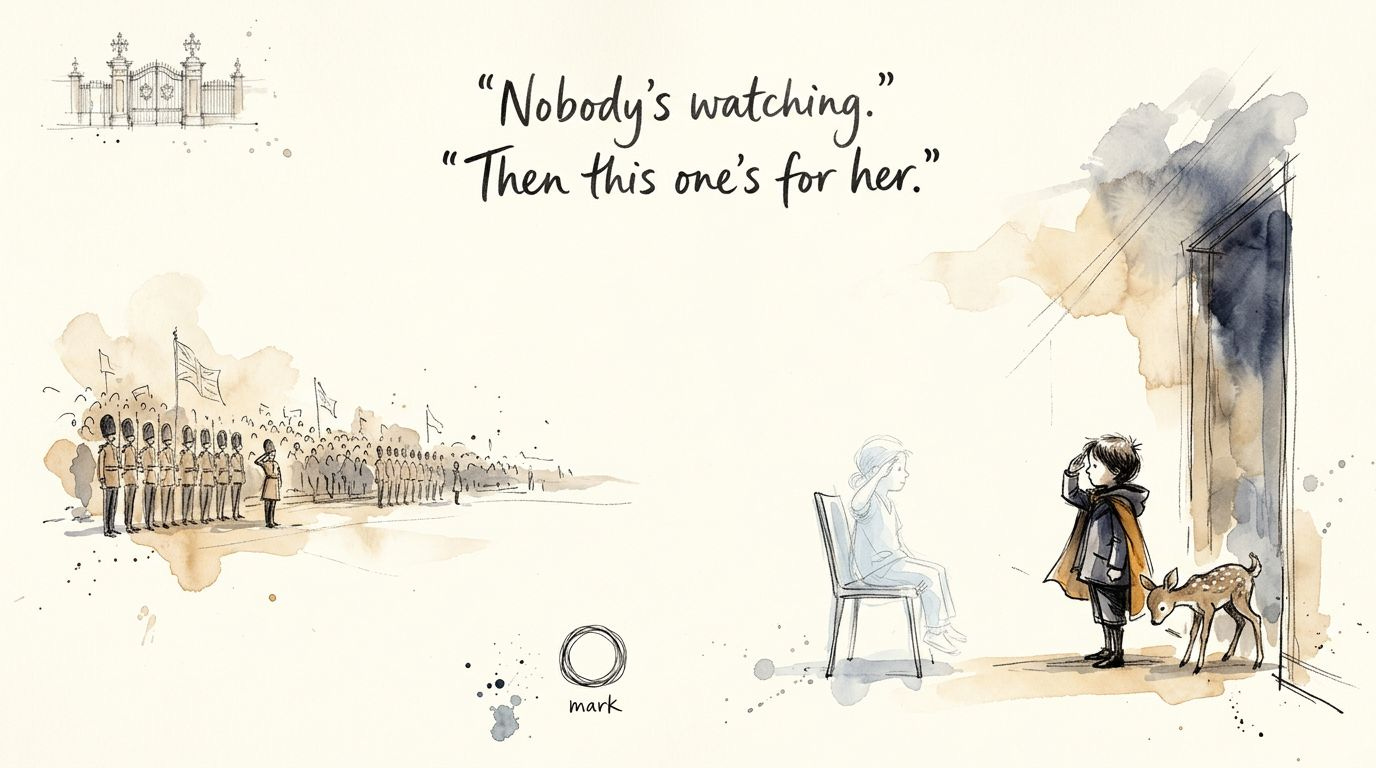
A colleague I’d trusted on a hundred hard shift worked her last shift a while back.
No cake. No email. Five second mention at the meeting.
The next morning the board was full, triage was doing its thing, and a name sat in the same slot on the schedule.
The place ran fine. That was the strange part.
A fellow EM doc and I talked it over and landed on something we’d both watched for years. In emergency medicine, people rarely leave with a bang. They leave with a whimper. Sometimes just a schedule update.
The room goes on without you, and that’s freeing. The other half: that’s by design. How it lets you go is the culture.
📜 History rhymes: At Buckingham Palace, the Old Guard doesn’t just walk off. The New Guard marches in, both present arms, and responsibility is handed over in the middle of the forecourt, in front of everyone. The job is fully interchangeable. They honor the handoff anyway.
Most of our departures aren’t that. They’re the changing of the cog.
The guard leaves, and the place says so.
The cog leaves, and the place says nothing.
The guard hands over what they knew.
The cog’s knowledge walks out to the parking lot.
The guard is succeeded.
The cog is backfilled.
Emergency medicine is the purest cog machine we have, partly on purpose. Shift work means no single point of failure. Groups and staffing companies sell exactly that: a credentialed doc in every slot, any name. The schedule is the product.
😤 “Good. I want the overnight doc to be swappable.”
So do I. When nine pediatric residency programs standardized sign-out with I-PASS, preventable adverse events fell about 30%. Make the role interchangeable. Then honor the person who filled it.
Resilient systems run on interchangeable roles. Good cultures refuse to treat people that way.
And your meaning was never stored in the org’s memory of you. It’s in the patient who went home, the resident who now asks your question first, the nurse who still uses your trick for ultrasound guided IVs.
You don’t control whether they throw the party.
You control whether your best workaround is written down.
You don’t control whether leadership notices you left.
You control whether three people can now do what only you could.
You don’t control the farewell email.
You control the one you send when someone else leaves: their name, one thing they built, five minutes at huddle.
Next interview, for a group, a leadership position, a clinical AI role, ask:
“The last person who left this team: was it a changing of the guard, or the cog?”
A name and what they built: guard. A pause, then how fast the slot got filled: cog. A laugh and “we don’t really do that here”: believe them.
Companions:
“What still works here because of someone who’s gone?” A name plus a thing means the team remembers.
“When someone leaves, who writes down what they knew?” A person or process: good. “The new hire figures it out”: cog.
“Who was the last person promoted from inside, and what got them noticed?” Tells you whether contribution is visible.
“If I left in two years, what would you want still standing?” Legacy answers beat coverage answers.
😤 “I can’t ask that. I’ll look difficult.”
Ask it warmly, at the end. Anyone who flinches has already answered.
TL;DR
Roles should be interchangeable. People shouldn’t be.
Ask which one the last goodbye was.
As AI takes on more of the work, more of every job looks like a slot. What can’t be backfilled is the judgment you taught the next person.
Your clinical judgment is the scarce input. Hand it over on purpose.
Be the guard. Build teams that salute on the way out.
— Kevin & AI