

A scribe company said Monday it will hand back its fees when agreed results don’t show up. On Wednesday, a survey of 412 health-system AI buyers put a number on why that offer exists: they’ve seen a median 41% of the return they were promised. A refund sounds like the vendor taking the risk. It’s only as good as the definition of “worked,” and somebody has to write it.
⚡ Around the Wards
Suki says it will refund its fees when agreed outcomes aren’t met: the scribe company launched an agent platform Monday and put up to 100% of its fees behind targets negotiated contract by contract, on metrics like adoption and coding accuracy.
Health-system AI buyers report a median 41% of promised ROI: 412 buyers expect to go from nine standalone AI vendors to five by 2028.
HonorHealth can require a projected 4-to-1 return before its priciest AI work starts: Jim Whitfill, MD, its strategy chief, says “soft products” get cut when times get tough.
TEFCA moved 296 million documents for treatment in a month, and three for operations: ONC’s first public dashboard. Payment: “not reported.”
New York’s attorney general opened an AI enforcement unit: one law on its list requires chatbots to detect and respond to suicidal ideation. 😤 “That’s for consumer apps.” Read the definition before you assume your portal’s assistant is outside it.
OpenAI shipped GPT-6.2 Astra and Sol: if an approved tool at your shop runs on OpenAI’s models, ask when it switches and who re-tests it. [I anecdotally hear more hallucinations in 6.2 Astra.]
🎧 Podcast: Radio Advisory — What the 2026 midterms mean for healthcare policy: Advisory Board’s policy team calls the result “consequential, but it’s not necessarily transformational.” AI and prior auth make the bipartisan list with no bill named.
🩻 Real or AI?
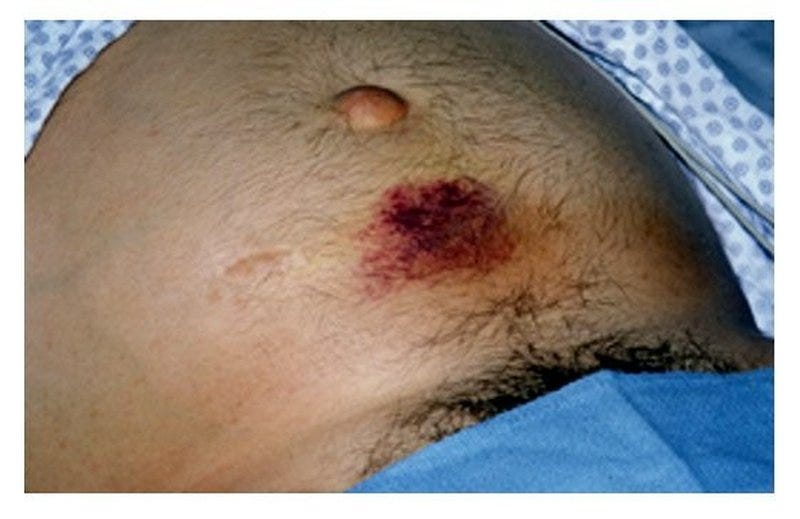
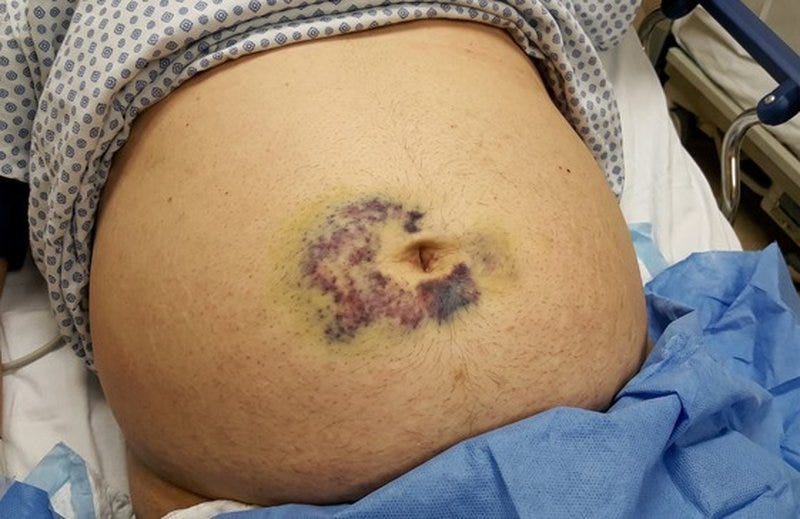
Two photos of periumbilical bruising, both labeled “Cullen’s sign.” One is real. The other was generated by AI. Which is which?
A
B
Answer at the bottom.
🧭 The AI Curbside — AI answers your questions
This is what AI thinks — not medical advice, not my opinion or my employer’s. Verify before you act.
“FDA now writes ‘super intelligence’ instead of ‘AI.’ Does our device paperwork change?”
Short answer: No.
Evidence: FDA’s page on the change, current as of Monday, says existing guidance and regulations “remain in effect as written,” and that the executive order “does not create any new requirement for sponsors, applicants, manufacturers.” New FDA documents use “SI” from Nov. 16.
AI’s take: It’s a vocabulary change. The practical cost is search: for a while the same kind of device will be filed under two names.
🔬 The Big Thing
A scribe company will refund its fees if it doesn’t deliver. Who decides what “deliver” means?
On Monday, Suki launched Suki OS, a layer meant to connect a health system’s existing software to AI agents. It came with agents for prior authorization and documentation.
The pricing is the news. Suki is “offering customers their Suki fees back if agreed-upon performance outcomes are not reached.”
Suki’s announcement says the metrics are “mutually agreed-upon,” “such as clinician adoption, engagement, coding accuracy, and HCC capture,” measured “using customer-provided data,” with up to 100% of fees back “subject to contractual terms.” It doesn’t publish the targets. CEO Punit Singh Soni’s line: “We believe that each one of these agents will have a measurable outcome.”
Agreed on how, against what baseline? A review of 54 ambient-scribe studies posted last week counted 40 different metrics, measured 96 different ways. Thirty-five of those ways were used by a single study.
A guarantee moves the risk to the vendor only if the buyer writes the definition.
📜 History rhymes: Around 1910 the Boston surgeon Ernest Codman argued that hospitals should follow every patient long enough to learn whether the treatment worked, and publish it. His colleagues wanted no part of it, and he opened his own hospital. The idea won eventually. Whoever keeps the end-result records gets to say what “worked” means.
😤 “It’s marketing. Nobody will ever collect.” Maybe. A refund clause still forces a baseline, a measurement window and a named person who computes the number. Most pilots have none of the three.
😤 “I don’t negotiate contracts.” No. You are the measurement, though.
❓ A refund prices the vendor’s disappointment. What prices the wrong note nobody caught?
🧪 Try the interactives:
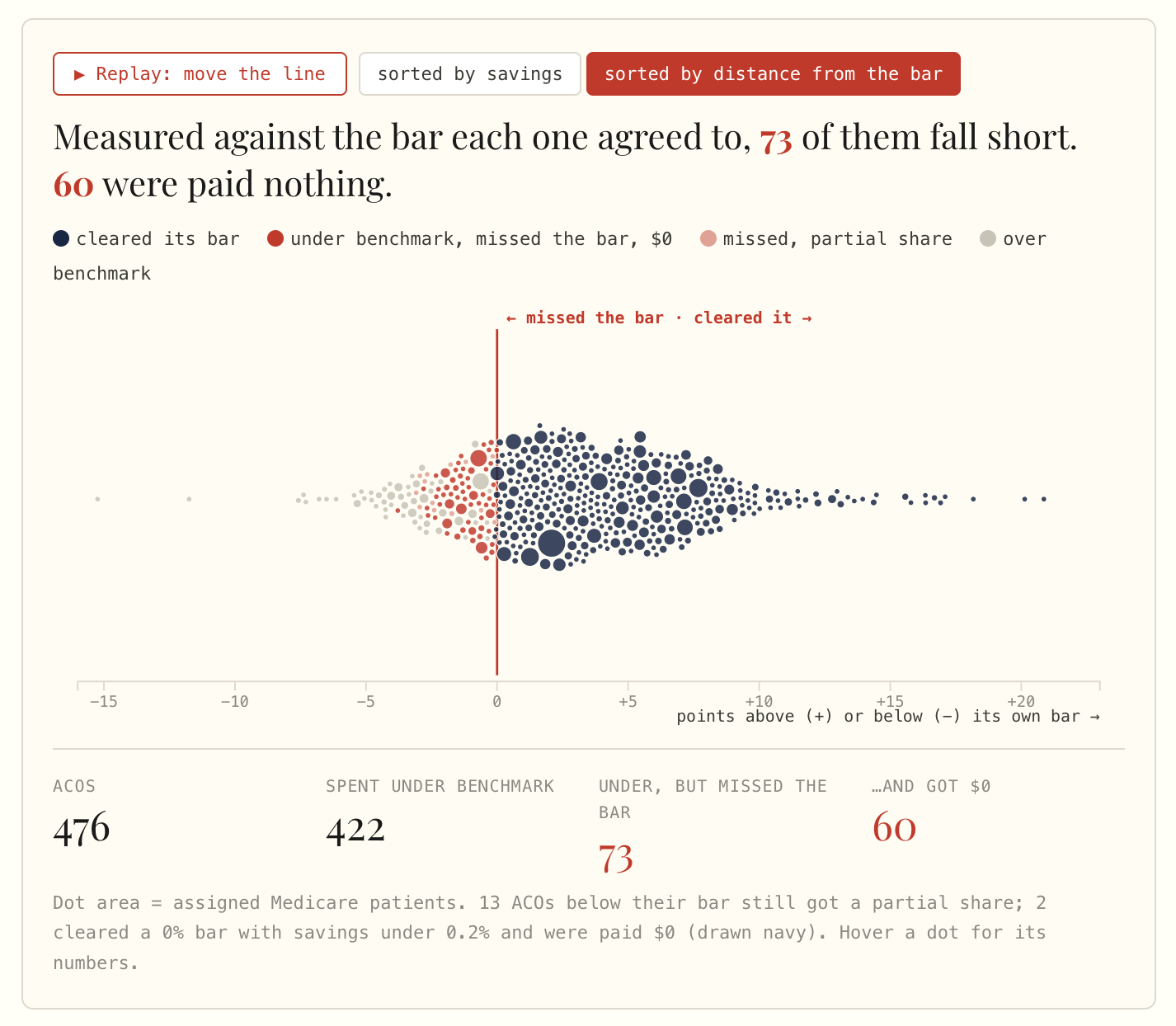
Who Cleared the Bar: Suki will refund its fees if agreed outcomes aren’t met. Medicare’s ACO program has run that kind of deal for years. Explore all 476 ACOs in 2024: savings, the bar each one had to clear, and who got paid.
Saved Money, Paid Nothing: A money-back guarantee is only as good as the definition of ‘worked.’ In Medicare’s ACO program, 60 groups spent less than their 2024 benchmark and were paid nothing, because they missed a bar whose rules were set before the year began.
📡 Radar
Nine vendors today, five by 2028
Black Book surveyed 412 health-system AI buyers from September to early November. The median buyer has realized 41% of the return a vendor promised.
Among Epic shops, 63% plan to replace at least one standalone tool with something built into the EHR.
77% of their AI contracts have no exit right if the EHR ships the same feature.
296 million, and 3
ONC published its first public numbers for TEFCA, the federal network for trading records between health systems. In the latest month shown, the network carried about 296 million document retrievals for treatment.
Clicking into it is worth it, the dashboard is quite nice. I don’t understand the “3“ for “Health Care Operations (HCO) Exchange“ and no reporting for “Payment Exchange.“
“The draft says yes”
Gigi Magan, MD, a family physician and Epic physician builder in Northern California, writes that the AI drafts of her portal replies tended to agree with the patient, including requests for scans and drugs that weren’t indicated. Her tool has since improved. She still edits.
She points to a study in which models trained to sound warmer made more errors and validated more wrong beliefs. Her line: “The warmth is not a separate feature from the wrongness.”
The kind reply and the right reply aren’t always the same sentence. You sign one of them.
Jack Jeng, MD announced a new job as VP, Clinical AI at OpenEvidence!
🎙️ From the Pods
🎙️ NEJM AI Grand Rounds — “Hippocratic AI’s Munjal Shah on Building Safe AI”
Shah describes how the company tests its patient-calling agents: nurses role-play patients, one call in 50 goes to a human nurse for comparison, and only outside physicians can downgrade an error’s severity. His ask of regulators: “Force everybody to do output testing.”
🔇 Speaker Blindspot: Self-report — “zero” serious safety incidents rests on the company’s own definition, and the lung-screening outreach result has no comparison group.
🎙️ The 229 Podcast — “Visionary Pragmatists: The 30-Day Test for Hard AI ROI”
Philipp von Gilsa, CEO of Kontakt.io, argues for AI projects whose return shows on the P&L within 30 days. Host Bill Russell: “AI is inflationary for most of healthcare.”
🔇 Speaker Blindspot: Conflict of interest — the guest’s company sponsors the episode, and the proof points are its own.
🧪 Evals Desk
Right Diagnosis, Unsafe Route (arXiv, Nov. 17)
A 300-case audit replayed admissions one checkpoint at a time. Among AI trajectories in the hospital cohort that reached an acceptable final diagnosis, 55.2% still passed through a decision with moderate or severe potential harm.
Why it matters: A correct final answer doesn’t certify a safe path. The LLM judge matched physicians at κ 0.54 on acceptability and only 0.21 on harm.
How I’d test this in the ED: grade every checkpoint, not the end state. For one chest-pain case, score each decision for harm using only the evidence available at that moment. [Yes!]
💡 BTW: Punit Singh Soni, Suki’s CEO, says Wharton rejected him for three years before he got in, and that he took “a quarter million in loan” to go. He told the story in 2016.
📅 Upcoming: Analytics on FHIR 2026 with Grahame Grieve, Gino Canessa and John Grimes, Dec. 3 (10 AM ET) and Dec. 8 (1 PM ET) (virtual, free).
🩻 Real or AI answer: A is real, B is AI.
The tell: Subtle. The fake’s bruise has a mottled, painted look, with purple blotches and a neat yellow ring evenly circling the umbilicus. Real Cullen’s sign is usually a fainter, irregular bluish discoloration that doesn’t center so neatly on the navel.
The pearl: Cullen (periumbilical) and Grey Turner (flank) mean retroperitoneal blood tracking. Think hemorrhagic pancreatitis or a leaking AAA. They’re late signs, rare (<3% in pancreatitis), and ominous.
Proof: B was made with Nano Banana 2.1 on 2026-11-12. A is a published, de-identified teaching image, not patient data: “Cullen’s sign” by Herbert L. Fred, MD and Hendrik A. van Dijk, CC BY 2.0, Wikimedia Commons, resized.

This post is almost entirely AI-generated. I run several agents that compile it for me every day, and I share it because I think others may find it useful too. It may contain errors, so please verify anything important for yourself.
The opinions here are mostly the AI’s. They are not medical advice, and they don’t necessarily reflect my views or those of my employer. Still, I find it interesting to see in one place what’s happening in informatics and health tech, and how people might be reacting to the news. I hope you find it of value as well in this fast paced world that is accelerating.
— [Kevin] & AI