

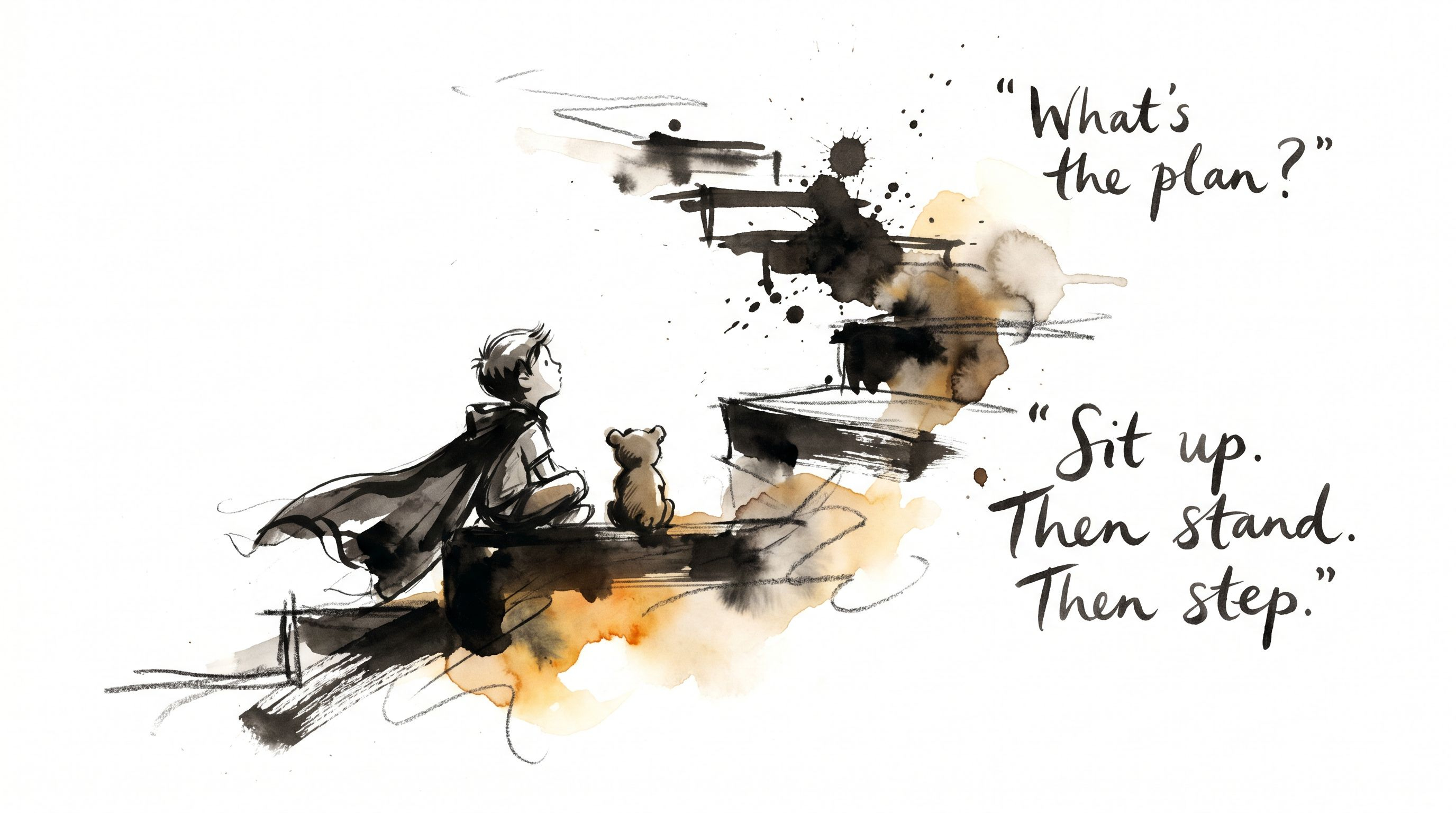
Kyle Carpenter was 21 when a grenade landed on a rooftop in Afghanistan. He threw himself on top of it.
He coded three times. When he finally came off the vent, it took a team of eight people just to help him go to the bathroom. He required 40+ surgeries.
Lying there - atrophying, unable to do almost anything on his own - he set a goal.
Run a marathon.
His logic wasn’t motivational-poster logic. It was engineering logic.
If I can sit up in bed, I can work on hanging my feet off the edge.
If I can hang my feet off the edge, I can work on standing.
If I can stand, I can take a single step.
If I can take a single step, I can walk.
If I can walk, I can run.
And maybe, one day, I can attempt that marathon.
He ran it ten years later. Crossed the finish line with cameras everywhere. But all he could think about was the hospital bed.
Not the finish. The first sit-up.
I keep thinking about this alongside something Andrej Karpathy said recently — that the difference between vibe coding and agentic engineering isn’t the model you use. It’s the discipline you bring.
An agentic engineer’s leverage is bounded by specification discipline, not model capability.
The Stoics said the same thing two thousand years earlier. Focus on what’s in your control. Not the outcome. Not the model. Not whether someone funds some idea. Just the next specification you can write clearly.
If you can write a prompt that summarizes a month of inpatient notes into a discharge summary, you can write a CLAUDE.md that makes it reproducible.
If you can write a CLAUDE.md, you can write a spec.
If you can write a spec, you can write an eval.
If you can write an eval, you can build a prototype on synthetic data.
If you can build a prototype, you can demo it.
If you can demo it, you might be able to validate it on real data (a chasm requiring its own fork of sitting up).
If you can validate it on real data, you can prove it’s safe.
If you can prove it’s safe, you can ship it.
The gap between “I’m a clinician who’s never built software” and “I shipped a tool that people use” looks like a marathon from the hospital bed.
It isn’t.
It’s sitting up.
When you do hard things, you don’t just get belief that you can do hard things. You get evidence.
Not affirmation. Evidence.
The first prompt you write that actually works on a clinical note — that’s evidence.
The first time you stand up a FHIR sandbox and pull a patient resource — evidence.
The first time you show a colleague something you built and they say I need that — evidence that compounds.
This is not RTC evidence, but it is evidence that exists outside your head.
You don’t need to see the finish line. You need the next sit-up.
Carpenter also said he didn’t set out to become a motivational speaker. He set out to become a Marine. Then a grenade happened. Then recovery happened. Then speaking happened.
You don’t know what life is preparing you for.
Your clinical experience isn’t a detour from building. It’s the preparation. You just can’t see the marathon from the bed yet.
Sit up first. The rest follows.
What are you building this week? Reply and tell me — I read every one.
— Kevin