

Microsoft’s CEO bet the strategy on the harness, not the model.
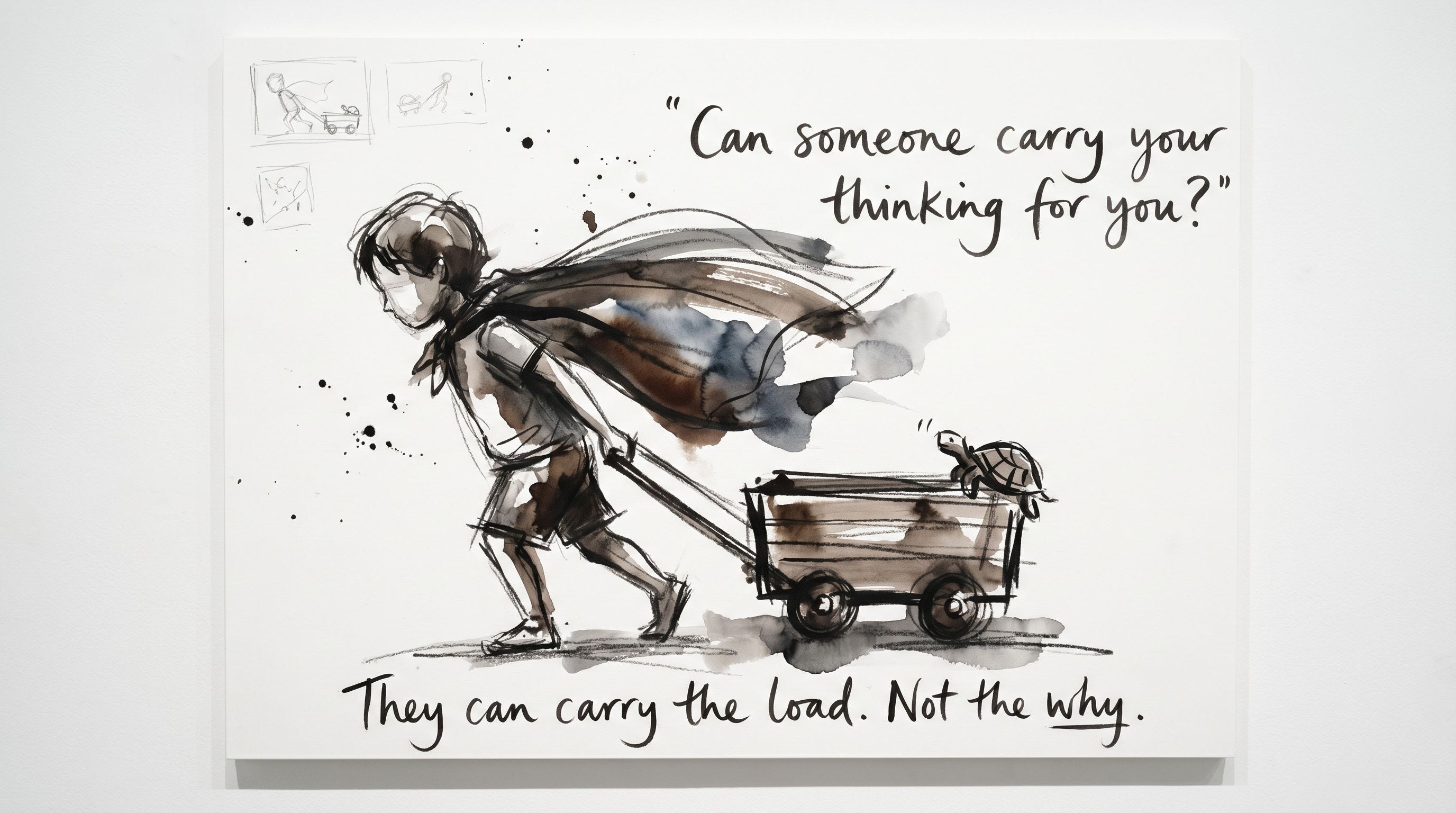
Satya Nadella published an article on X arguing for frontier ecosystems over frontier models: a learning loop between people and systems where “human capital and token capital compound.” His line worth stealing: you can offload a task or even a job, but you can never offload your learning. For a clinician-builder, that’s the whole game — the model is rented and swappable; the encoded judgment and the loop around it are yours.
😤 “This is a $3T company telling me to not worry about which model I use — convenient.” Sure, it’s self-serving. It’s also correct for you specifically. You’re not training frontier models; you’re encoding what a good discharge read looks like. Build that on a harness you can swap a local model into, and the next Friday shutdown is a config change, not a crisis.
“Know Your Agent” arrives — and the kill switch belongs to the institution, not you.
Brendan Keeler argues agentic identity (KYA) is inevitable in healthcare: tokenized, auditable agents with scoped permissions, rate limits, and a revocation switch — the KYC of bots. “Autonomy only works when the system can prove what the agent did.”
😤 “Great, more identity plumbing before I can ship anything.” It’s a config now and a rewrite later — so architect for it today. Register a distinct OAuth client per agent, request the narrowest scopes the task needs, keep your own per-agent audit log, and build a kill flag you control. The agent that survives the transition is the one whose identity, scope, and revocation were first-class from line one.
Your first clinical AI agent should be the discharge summary.
Doug Fullington makes the case that the discharge digest is an ideal first agent: bounded task, nameable failure mode — the “page-31” failure, where a pending blood culture is buried under pages of repetitive notes. Writing the prompt, he realized he was encoding his reading judgment — a reusable clinical object that supersedes order sets and dot-phrases. He runs it on M365 Copilot under a BAA. “An agent is worth exactly as much as your ability to catch it failing.”
A physician-builder reframes the family-coordination app around the phone already in your pocket.
Adam Carewe, MD argues the category solved the wrong problem: the constraint isn’t visibility (Skylight nails the wall screen) — it’s contribution friction, since apps die when only one parent feeds them. His move: the ambient surface already exists as the home-screen widget, “the kitchen screen distributed across every pocket,” with privacy-as-architecture (on-device parsing, no analytics SDKs) as the moat.
🎙️ From the Pods
🎙️ The 229 Podcast (This Week Health, Newsday) — “Healthcare’s AI Reckoning: Real Wins, Real Costs, Real Questions” (June 15, 2026 episode)
We’re in the “third era” — terminals, then EHRs, now AI — and the honeymoon (where everything got approved because it claimed HIPAA-compliance, interoperability, and outcomes) is over. The real finding: AI is delivering huge personal productivity (”four meetings down to one”), but that rarely maps to system ROI, so a five-question gate now decides what survives — what problem, whose data, how outputs are validated, what risk you’re accepting, who’s accountable when it breaks.
🔇 Speaker Blindspot: Composition fallacy — they treat individual time-savings as un-aggregatable into system value because no single clinician’s saved hours show up on the P&L. Absence of a clean attribution path isn’t proof the value isn’t there; it’s an unbuilt measurement layer (which is itself a product).
🎙️ Health Tech Nerds Radio — “The Grand Roundup: $12B Ensemble, Hawai’i’s payvider bet” (show feed)
The sharpest moment wasn’t the deal — it was the sepsis example. AI can predict which claims a payer is likely to audit, but it can’t predict a payer suddenly deciding that a sepsis diagnosis now requires a culture to bill. That’s not a data problem; it’s a negotiation-and-trust problem between two counterparties fighting over the same pot of money.
🔇 Speaker Blindspot: Anchoring — the hosts anchor on today’s adversarial payer-provider dynamic as permanent (”we want them adversarial”), while underweighting that payvider mergers like One Health Hawai’i are quietly collapsing the two sides into one entity, where that adversarial check disappears entirely.
🎙️ The Heart of Healthcare — “How AI Changed Healthcare Fundraising” (episode)
Rock Health killed “AI” as a funding category — not because it failed, but because it won: nearly every digital-health company is now AI in some form. The receipts investors want have hardened into five metrics, and one cuts cleanest: ARR per employee — a truly AI-native company runs $500K–$1M+ per head; well below that, you’re “a services business with an AI veneer.” Prior auth got named as the trap: pitched as a technical AI win, it’s actually a coordination-and-incentive problem you could’ve solved with decades-old tech if the incentives lined up.
🔇 Speaker Blindspot: Survivorship bias — the supernovas (OpenEvidence at 65% daily physician use, Abridge raising on a compressed clock) anchor the narrative, while the same data shows median seed-to-Series-A stretched to 616 days. Most companies live in the second number, not the first.
💡 BTW: Adam Carewe — the former Kaiser Permanente CMIO now building a privacy-first family-coordination app on the side — traces his whole informatics career back to being a kid obsessed with his grandfather’s gadgets, then volunteering for the paper-to-EHR transition in residency because nobody else wanted it. (rewskidotcom)
What are you building this week? Email and tell me (kevin@clinicians.build) — I read every one.
— Kevin