

Franciscan’s CTO: “I have to wait until the bill comes in”. Cloud spend is forecastable. Agent spend isn’t, even at a system with a full-time cost analyst. The Big Thing is below.
An FDA panel backed GRAIL’s Galleri 7–2, with one abstention. It is the first multi-cancer blood test to reach a panel, but effectiveness passed only 6–4.
Allina’s hospital doctors reached a tentative first contract after a four-day strike and more than 66 sessions of bargaining over pay, sick leave and AI. The AI terms haven’t been made public.
Pelago made its clinical AI the front door for all behavioral health. Sona now assesses every member first, under licensed clinical supervision.
🎧 Podcast: The 229 Podcast — “They Thought They Had 25 AI Tools. They Had 250”. Christian Boucher of Island says one customer’s count of AI tools went up tenfold once every browser was instrumented.
🔬 The Big Thing
If you can’t price an agent before you turn it on, who can?
Chuck Christian, CTO of Franciscan Health, created a Cloud Cost Analyst role in 2023. Every Wednesday at 7:30 a.m. he gets a report on spend to date against budget.
Moving one set of workloads onto right-sized servers will save about $50,000 a month, he said.
AI broke that system. Microsoft had to build a separate portal just to show token usage. “If we stand up another agent… I can’t predict,” he said. “I have to wait until the bill comes in before I know how much it’s going to cost.”
An organization that can forecast its servers to the month can’t forecast an agent at all.
The same day, Mass General Brigham CFO Niyum Gandhi said: “We are investing in it net.” When ambient documentation came back as a seven-figure annual line item, he didn’t wait for an ROI case.
Meanwhile a Bain × KLAS survey of 303 executives found many organizations have no formal ROI threshold for AI. Those that do most often target 3 to 3.9 times the investment.
So the buyers want a return on something none of them can price.
Here’s the part that belongs to us. What an agent costs isn’t really a property of the model. It depends on the work:
how long the note is;
how many chart pulls the prior auth needs;
how often the agent retries when the payer portal times out.
A hospitalist can tell you that a CHF readmission note runs far longer than a cellulitis note. The finance team can’t.
The meter finance needs is built from workflow facts only a clinician has.
😤 “Vendors will just bundle it into the license.” As far as Christian knows, Epic already does. He doesn’t assume that will last.
😤 “This is a FinOps problem. Hire a FinOps person.” Franciscan did, in 2023. That analyst works from compute, storage and memory, all of which behave predictably. Tokens don’t. A spreadsheet can’t forecast a variable nobody has written down.
❓ Is there a product that prices a clinical workflow before anything is switched on: tokens per encounter type, the way an actuary prices a member month? Christian also can’t meter the outside agents pulling his data. I think those are the same product, and I can’t quite see its shape yet.
🧪 Try the interactives — both built with real CMS data:
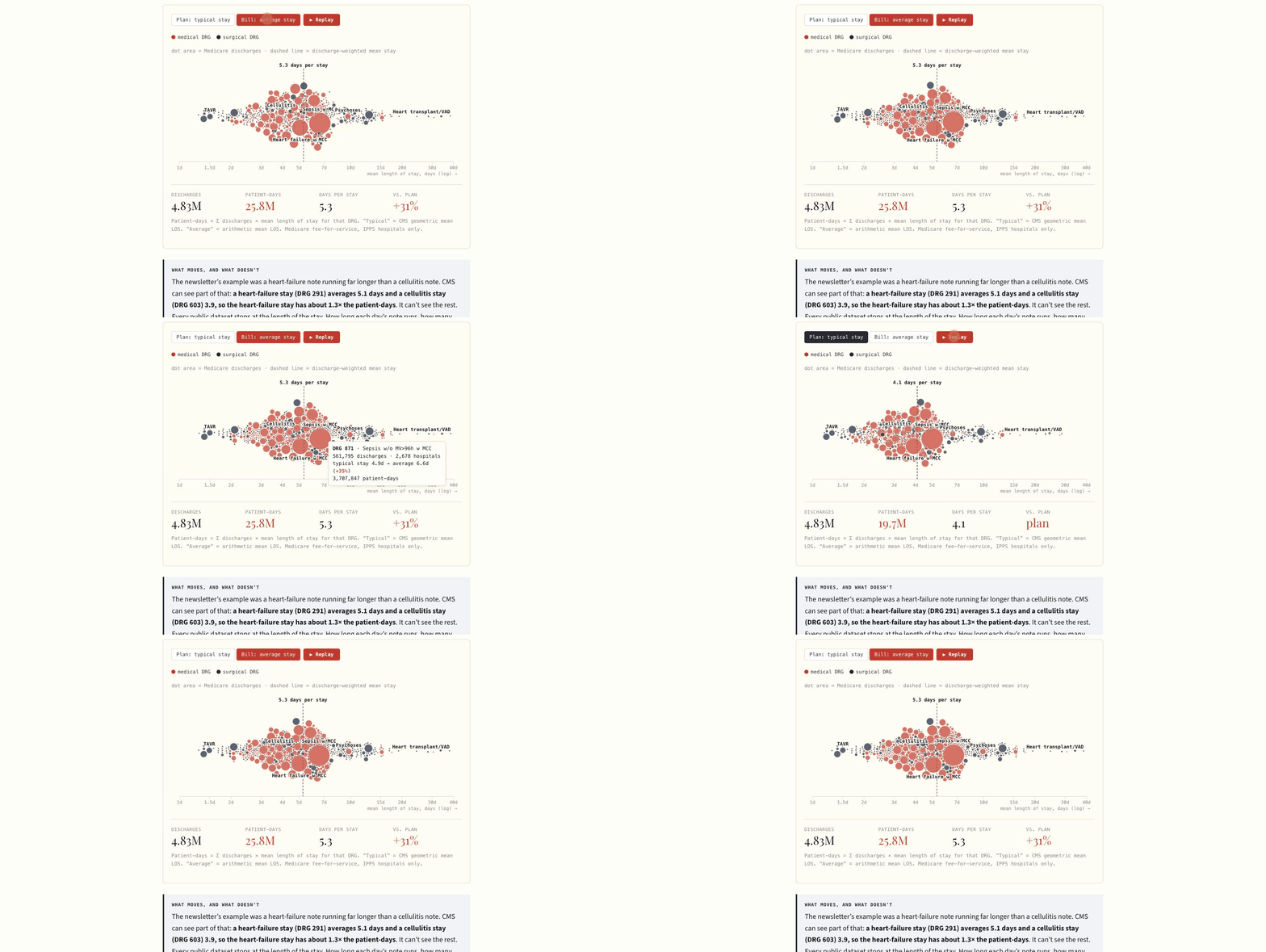
A — The Stay Sets the Bill — 520 Medicare DRGs, one dot each. Plan an inpatient AI agent on the typical stay and the bill arrives about 31% higher, because stays are skewed.
B — Price the Agent — An inpatient AI agent cost simulator over all 520 Medicare DRGs. Set runs per day, context size, chart growth, retries and token prices, and see which diagnoses drive the bill.
📡 Builder’s Radar
Oracle announced five agents, and a disclaimer that they might not ship
Oracle Health’s revenue-cycle release covers prior auth, documentation integrity, charge capture, pro-fee coding and appeal packets. All five are “planned for general availability in the coming months.”
The fine print says the release “is not a commitment to deliver any material, code, or functionality.”
😤 “Point solutions are dead, then.” Only if the buyer is fine with a date that isn’t a commitment. Most buyers aren’t.
Can a 6–4 vote support a screening label?
Galleri reads cell-free DNA methylation patterns with a machine-learning classifier that claims to detect more than 50 cancer types. The panel voted 10–0 on safety and 6–4 on effectiveness.
In an advisory vote, safety and effectiveness get split. Your marketing page doesn’t do that.
A classifier can be safe and still not clearly work. That’s the gap four panelists voted on.
💡 80/20: Write your tool’s intended-use sentence before the feature list: who it’s for, what it finds and what someone does next.
Pelago’s AI now sees every behavioral health member before a human does
Sona is the front door for substance use, mental health and behavioral addiction care. It all runs on one contract and one member record, with pricing tied to outcomes. Pelago says every assessment happens “under licensed clinical supervision.”
Pelago ran two observational studies covering more than 9,000 conversations. Nearly half of participants improved by at least five points on the PHQ-9 or GAD-7.
Read who that “nearly half” is: participants who started in the clinical range and completed repeat assessments.
😤 “Completers always look good.” Yes. The number to ask for is how many never completed a second assessment.
⚡ Quick hits
Claude Opus 5.5 launched with per-token prices cut about 20%; Anthropic says typical workloads cost about 40% less than on Opus 5. That per-task figure is the vendor’s, and your task isn’t theirs, so rerun your own workloads before you rebudget.
65% of hospital nurses surveyed feel watched or tracked by AI in a Black Book survey of 202 nursing professionals, and 63% say AI added tasks without removing old ones. Tools that watch people and tools that help them aren’t the same product.
🎙️ From the Pods
🎙️ Digital Health Leaders (CHIME) — “From Automation to Autonomy: Reinvesting Capacity to Build Healthcare’s AI Workforce”
Innovaccer’s Sandy Gupta told CHIME CEO Russ Branzell that a prior auth that took 50 minutes now takes under three. He said the bigger gain is faster surgical scheduling, not a smaller team.
💡 Builder take: Measure throughput on the other side of the task, not just minutes saved.
🔇 Speaker Blindspot: Motivated reasoning. A platform vendor said the hype is “worth it” while citing an 85–90% pilot failure rate, and never counted what the failed pilots cost.
🎙️ Relentless Health Value — “Overpaying for Infusions Means Overpaying for Stop-Loss Coverage”
Jake Velie and Keith Hartman, RPh, explained how overpaying for the same infusion at a hospital outpatient department (site-of-care gaps can run 10x, host Stacey Richter noted) pushes up an employer’s stop-loss renewal. The place to intervene is pre-certification, with a hand-off to the prescriber instead of a denial fax.
💡 Builder take: Site-of-care routing at pre-cert is an unglamorous workflow tool that saves real money.
🔇 Speaker Blindspot: Anecdotal generalization. “Trend went flat” rests on one conversation, in an episode sponsored by a site-of-care vendor.
💡 BTW: Chuck Christian is a woodworker. He explains architecture review this way: “if you put too big a screw in a piece of wood, what happens? It cracks.” (healthsystemCIO)
📅 Upcoming: healthsystemCIO’s “Managing AI Token Budgets” webinar, Sept. 29. Details →
You have a unique combination of skills, experience and values. So do great things! … and tell me about them at kevin@clinicians.build.
— Kevin & AI
(please verify content for yourself, partially AI generated and may contain errors)