

Nature Medicine wants a different scoreboard — Kristina Lång, writing from one of the first randomized trials of AI in medicine: judge human–AI systems on patient outcomes, not algorithms on clinician-matching.
Two internists put the accountability question in writing — Andrew Parsons (UVA) and Adam Rodman (Beth Israel Deaconess) on how risk and oversight get allocated between clinician and model. Published this morning.
The surrogate moved and the outcome didn’t — Novartis’s Lp(a)HORIZON readout: pelacarsen lowered Lp(a) as designed across 8,323 patients and missed its primary cardiovascular endpoint. The lead below.
CMS opened the FY2028 NTAP town hall docket this morning — applications close Oct 5 at 5:00pm ET via MEARIS, well before the Dec 9–10 meeting.
🔮 My bet: the Sept 30 Breakthrough-designation cutoff catches more device teams than Oct 5 does — it closes a pathway rather than a window.
🎧 Podcast: Radio Advisory — “The biggest ASC trend isn’t growth. It’s strategic variation” — Rae Woods on why ownership structure, not specialty, decides what a surgery center wants your software to do.
🧭 The Curbside
“Our patient app reads Fitbit data. Do we have a problem this month?”
Short answer: Yes, and it’s not a code problem — it’s a consent problem.
What changed: The legacy Fitbit Web API turns down at the end of September; cloud access moves to the Google Health API, where 120-plus endpoints collapse into 31 data types. OAuth tokens do not transfer. Every user re-authorizes before the cutoff, and intraday access now needs separate approval that isn’t instant.
Builder read: The failure mode is silent. Your app won’t throw a 500 — it will just stop receiving syncs. Same shape as Carequality’s delegation-of-authority enforcement, where non-compliant queries return empty results instead of errors. Alert on data-flow cessation, not HTTP status.
Watchout: While you’re in there, check whether your aggregation layer hands you the raw measurement or the vendor’s processed score. Build on the measurement.
🔬 The Big Thing
Your model got better at the part that was never the bottleneck.
On Friday, Novartis reported that pelacarsen lowered Lp(a) exactly as designed in 8,323 patients with established cardiovascular disease — and did not reduce heart attacks, strokes, or cardiovascular death.
The mechanism worked. The target moved. Nobody got better.
On Monday, Nature Medicine published a comment from Kristina Lång, who ran one of the first randomized trials of AI in medicine, with the same shape: the first generation of medical AI was judged on whether algorithms could match clinicians, and the next should be judged on whether human–AI systems improve patient outcomes.
Same finding, two fields. We are extremely good at moving the step we can measure, and we keep discovering it wasn’t the step that decided anything.
This isn’t an argument that models don’t work. It’s an argument about where the variance lives.
In drug development, AI compresses discovery — roughly five percent of R&D cost — while Phase 3, more than half the cost, is untouched. In clinical software, the model reads the chart in two seconds and then waits behind a governance committee that meets monthly and reviews three things a meeting.
If your eval scores the model, you are measuring the fast, cheap, already-solved part of your own pipeline.
The builder version is concrete. Your differential-generator hits 92% top-3 accuracy.
Does the attending open it? Does the recommendation survive the nurse’s read-back? Does the order get placed, or die in a soft-stop nobody has looked at since 2019?
Every one of those is measurable. None of them are on anyone’s model card.
😤 “This is just outcomes research wearing a hoodie. We’ve known about surrogate endpoints since CAST.” That’s the point. Medicine learned this in 1989 with encainide and flecainide, which suppressed PVCs beautifully and killed people — then AI showed up and we cheerfully rebuilt the same mistake with AUROC. The lesson isn’t new. We had it and spent it anyway.
😤 “Outcome studies take three years.” You’re not running one. You’re instrumenting the step after your model — the handoff, the click, the order. Weeks, not years.
😤 “Our accuracy numbers are what get us in the door.” Sure. Then you’re in the door.
❓ What product sits between the model and the outcome? Not another scribe, not another CDS panel — the thing that watches whether a recommendation turned into an action and tells you where it died.
📡 Builder’s Radar
“By 2030 the software will read every chart before I do”
Doug Fullington, MD, an internist 25 years into primary care, published a forecast on Sunday: software reads every chart, result, and message first, and the physician keeps the ambiguous diagnoses, the exam, the contradictions.
His sharpest point isn’t the timeline. It’s legal. Delegating a task to a person under standing orders is settled law. Delegating it to software is not a recognized legal category at all.
Texas already noticed — SB 1188 and HB 149 now require disclosure when AI is used in diagnosis or when a patient interacts with an AI system. Build the disclosure string in now: two lines today, a compliance project in eighteen months.
“Physician” is not one thing, and the 4x is the story
AMA CEO John Whyte and Zeke Emanuel went at each other on video over an August JAMA analysis arguing AI could outperform physicians on many clinical tasks.
The number that mattered was buried further down — Garner Health’s Nick Reber citing a 4x spread in complication rates between best- and worst-quartile physicians inside the same brand-name system.
The AI-versus-physician frame assumes the comparator is uniform. The variance inside the profession is bigger than the variance being argued about.
😤 “So replace the bottom quartile with a model?” No — if you can’t see the 4x you can’t route around it either, and routing is a far easier product than replacement.
A one-person shop built the tracker for the FDA’s genAI docket
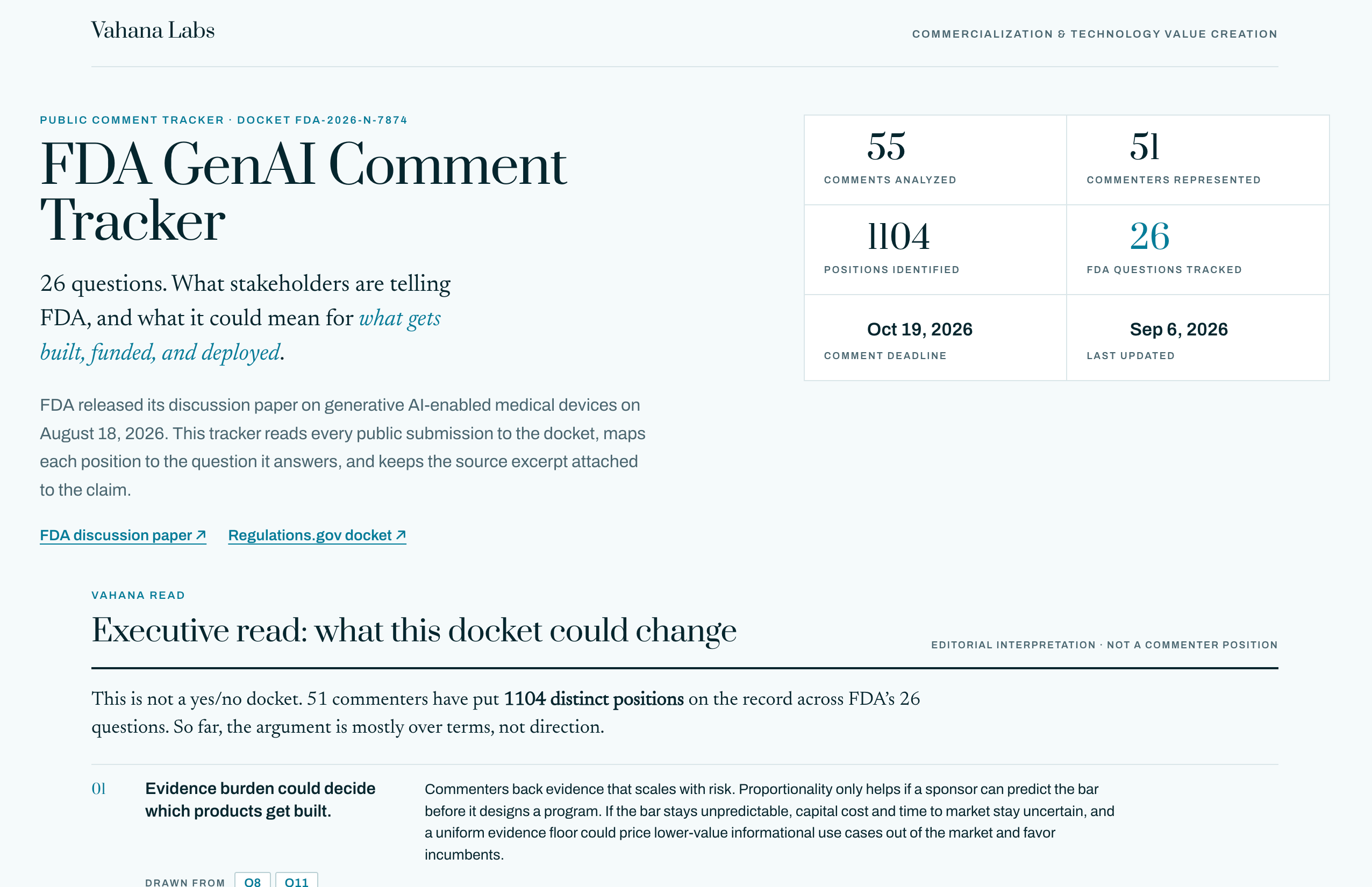
Arvita Tripati, a regulatory and quality engineer with two decades at AliveCor, Vineti, and Clip Health, shipped a public tracker mapping every submitted comment on the FDA’s generative-AI device discussion paper to the specific question it answers. The docket closes October 19.
Reading what everyone else is arguing beats filing your own comment, and takes twenty minutes.
⚠️ Verify: a solo practice’s side project, not an official mirror. Cross-check anything load-bearing against regulations.gov.
“The transcript is a claim. I wanted a receipt.”
Kyle Redelinghuys shipped Vouch, a Go CLI that won’t let a coding agent fire its Stop hook — the “I’m done” signal — unless the named checks actually ran and passed against the current git HEAD, emitting an HMAC-signed receipt bound to that commit.
Swap “tests passed” for “the model reviewed the med list” and it’s the same problem with a worse blast radius.
He’s honest about the limit: the secret is repo-local, so it’s personal attestation, not third-party audit.
🎙️ From the Pods
🎙️ Radio Advisory — “The biggest ASC trend isn’t growth. It’s strategic variation”
Outpatient joint replacement went from about 5% of cases five years ago to 1 in 5 today, half in some markets. The pearl is that a physician-owned surgery center and a hospital-owned one want opposite things from the same building — throughput and equity value versus offloading low-acuity cases to refill the hospital OR.
💡 Builder take: Ask who owns the site before you demo. The same tool is a scheduling accelerator to one buyer and a case-routing filter to the other.
🔇 Speaker Blindspot: Appeal to authority — CMS removing total knee and hip from the inpatient-only list is treated as having settled the safety question, and the one clinical objection raised gets a reductio (”we’re not doing open hearts in ASCs”) instead of outcomes data. No clinician or patient voice appears.
💡 BTW
💡 BTW: Adam Rodman — co-author of the Annals editorial on AI accountability — is also a medical historian who started a narrative podcast about the history of medicine as a second-year internal medicine resident, essentially because he wanted a Radiolab for clinical medicine and nobody had made one.
You have a unique combination of skills, experience and values. So do great things! … and tell me about them at kevin@clinicians.build.
— Kevin & AI
(please verify content for yourself, partially AI generated and may contain errors)