

CMS proposed cutting Medicare Advantage Star Ratings to 15 measures: outcomes and patient experience stay, most process measures go, starting with care delivered in 2028.
Northwestern Medicine named a chief AI, data and digital products executive: Eric Shelley, promoted from inside the 11-hospital system. 😤 “Another title.” The title is where the approval queue lives.
🎧 Podcast: UnHack with Drex DeFord — Institutionalized Incompetence: DeFord on why outages keep happening: “A system that hasn’t failed isn’t necessarily a resilient system.”
🩻 Real or AI?
Two photos of thrush. One is real. The other was generated by AI. Which is which?
A

B

Answer at the bottom.
🔬 The Big Thing
Medicare wants to cut its plan report card from 43 measures to 15. Which of your chores were on it?
CMS proposed Friday to shrink Medicare Advantage Star Ratings to 15 measures. The agency says the set keeps clinical outcomes and patient experience, plus a few process measures where performance is low.
Plans with drug coverage are rated on up to 43 today, by one count. The cuts would apply to care delivered in 2028 and show up in 2030 ratings. The fact sheet doesn’t list the 15.
The same rule proposes the first mandatory Medicare Advantage test model, starting in 2029 in randomly selected states. One piece runs in the background: a risk score inferred from claims and encounter data, next to the one built from the diagnoses plans submit.
Stars are why the plan sends your clinic a gap list. Change the measures and the list changes.
💼 What it means for your job: if you’re in primary care, or you’re the nurse or medical assistant who works the gap report, part of that work exists because a plan earns a bonus on it. Process changes get harder to justify. Outcome numbers, the kind where the blood pressure has to come down and not just get checked, get more weight.
😤 “I’m a hospitalist. Stars are the plan’s problem.” Plans pass the pressure down as contract terms and worklists. More than a dozen insurers have sued CMS over their 2027 ratings, which tells you what the bonus is worth.
😤 “It’s a proposal.” Yes. That’s when the list can still change.
🧪 Try the interactives:
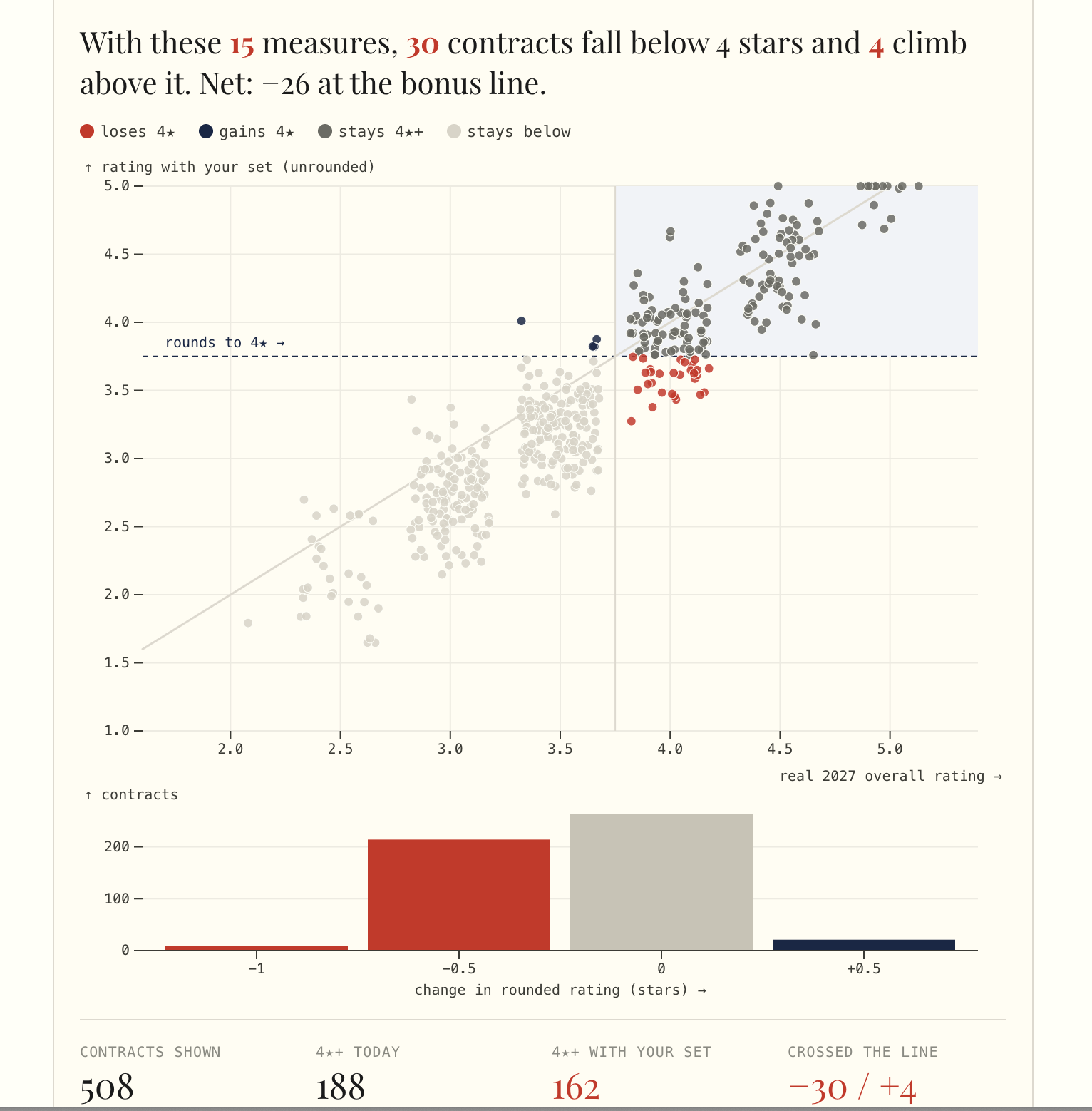
Keep Fifteen: CMS proposed cutting Medicare Advantage Star Ratings to 15 measures. Pick which of the 45 measures in the 2027 ratings survive and see how 508 rated contracts would move, and which cross the 4-star bonus line.
Forty-Five Report Cards: Every Medicare Advantage Star measure in the 2027 ratings, as the share of plans earning each star. The easiest stars are call centers, appeals and a few checkboxes; the hardest are ED follow-up, adherence, falls and blood pressure. CMS proposes keeping 15.
📡 Radar
Kaiser’s AI goal is a word that doesn’t fit on a dashboard
Nolan Chang, MD, of The Permanente Federation told Becker’s on Friday that the group’s AI strategy starts with trust. He prefers “augmented intelligence,” and says access should mean a patient’s concern got resolved, not that an appointment was available.
On ambient notes his rule is plain: physicians review and edit for accuracy before anything enters the record. The interview offers no numbers.
The note gets read by the person whose name is on it. That part doesn’t scale, and maybe it shouldn’t.
😤 “Trust is a slogan.” Until somebody measures it. Nobody here did.
Also: CMS’s Innovation Center named 15 projects, $47 million in all, to test lifestyle-medicine programs Original Medicare doesn’t cover.
🎙️ From the Pods
🎙️ Lifers with Christina Farr — “Systems of record vs. systems of action: the future of the EHR”
Paul Brient, athenahealth’s chief product and operations officer, says patients can now give Claude read-only access to their athena record, and that the move is “proving to be controversial” with customers. His view: “I think an empowered patient is a better patient.”
♟️ Your move: ask your practice manager whether your portal lets patients connect an AI tool, and decide what you’ll say when one walks in with its summary.
🔇 Speaker Blindspot: Anecdotal evidence — he fed his own knee MRI to a chatbot and reports “so far, it’s doing good.” The customers’ objections never get aired.
🎙️ The Nocturnists — “Trust in Medicine with Medscape”
Neha Pathak, MD, sees more patients who’ve told a chatbot their story and arrive with one diagnosis. What they want from her is the exam and the reassurance. Perry Wilson, MD: “trust takes time, trust takes communication.”
♟️ Your move: once today, ask what the chatbot said before you say what you think.
🔇 Speaker Blindspot: Golden-age fallacy — the fix offered is a return to long relationships, “what worked optimally before.” Her own family story is about people who had no doctor at all.
🧪 Evals Desk
Google built 4,561 clinical scenarios from 436 guideline monographs (arXiv, Nov. 20)
Researchers turned BMJ Best Practice monographs into branching vignettes and graded management plans on a four-point severity scale, from adherent to major deviation. An AI grader matched physicians exactly 89% of the time. Nine primary care physicians went from 50.5% to 70% guideline adherence after seeing the AI’s recommendation.
Why it matters: the rubric scores how bad a miss is, and the physicians’ gain came from fewer omissions, not fewer wrong actions.
💡 BTW: Paul Brient, the athenahealth executive in today’s Pods, wrote billing software for his father’s surgical practice at 15. The episode.
🩻 Real or AI answer: B is real, A is AI.
Proof: A was made with Nano Banana 2.1 on 2026-11-05. B is a published, de-identified teaching image, not patient data: “Human tongue infected with oral candidiasis” by James Heilman, MD, CC BY-SA 3.0, Wikimedia Commons, resized, shared under the same license.

This post is almost entirely AI-generated. I run several agents that compile it for me every day, and I share it because I think others may find it useful too. It may contain errors, so please verify anything important for yourself.
The opinions here are mostly the AI’s. They are not medical advice, and they don’t necessarily reflect my views or those of my employer. Still, I find it interesting to see in one place what’s happening in informatics and health tech, and how people might be reacting to the news. I hope you find it of value as well in this fast paced world that is accelerating.
— Kevin & AI