

⚡ Around the Wards
An AI system proved an 18-year-old math conjecture, and software checked every step. The harder question is who checked what it was asked to prove.
A new study ties 340B growth to about $75 billion a year in added spending, with $15 billion out of pocket.
Meta researchers recalibrated an AI grader on real outcomes, and the recalibrated grader lost on older work.
🎧 Podcast: The Gist — Hackensack Meridian’s Joel Klein on proving AI’s value: Klein says physicians using ambient on 80% or more of visits see one to three more patients a day and spend about 15 fewer minutes on pajama time.
🩻 Real or AI?
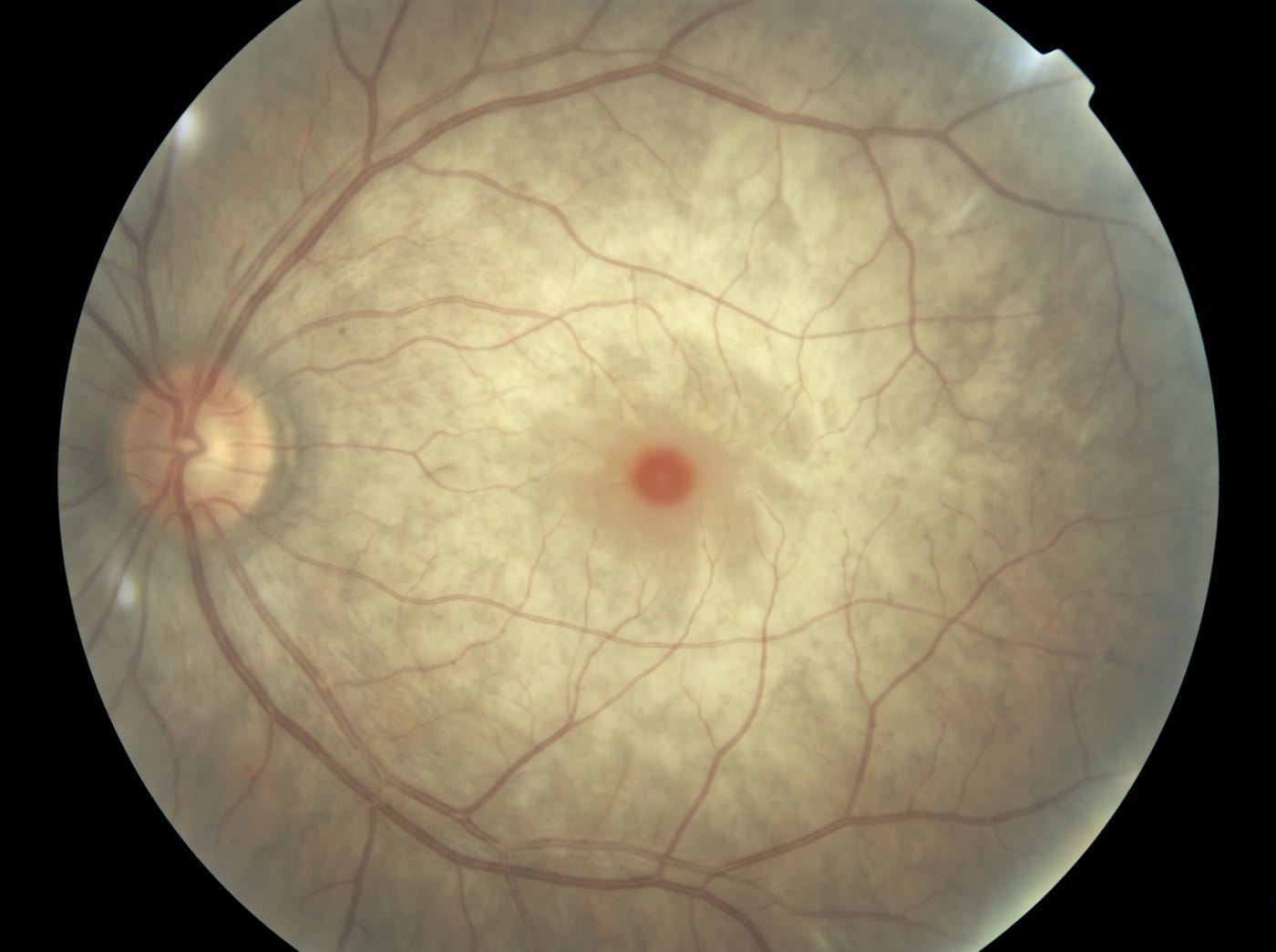
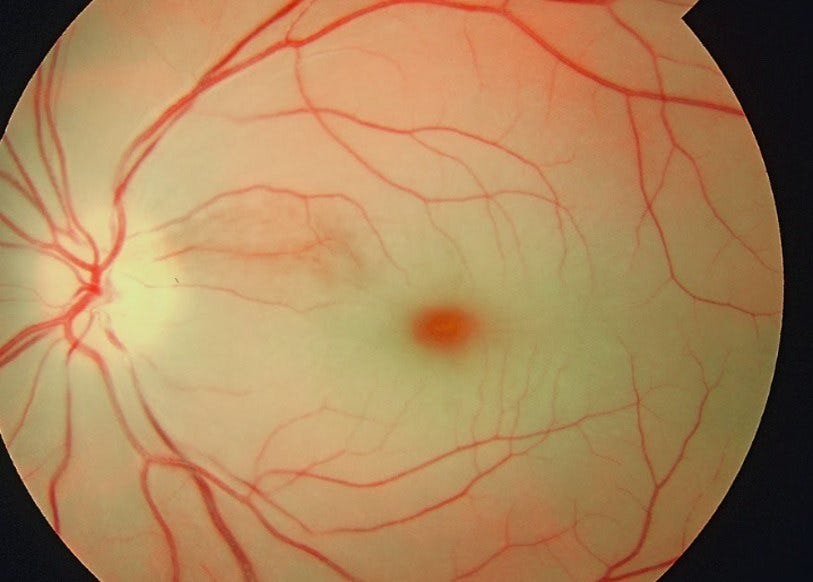
Two fundus photos with a cherry-red spot, both labeled “CRAO.” One is real. The other was generated by AI. Which is which? See the answer by scrolling to bottom.
A
B
🔬 The Big Thing
A machine checked every step of an AI’s proof. Who checks what it was asked to prove?
A math problem in quantum computing has sat open since 2008.
On Friday, a startup called Physical Superintelligence said its research system, running an unreleased Anthropic model, had a complete proof on day three of a run.
Nobody had to take the model’s word for it. The proof was checked in Lean, a proof assistant where software verifies every logical step. Lean doesn’t care who wrote the proof. Confidence earns nothing. Each line passes or it doesn’t.
A human, David Turturean, signed as the one responsible for whether it’s correct. Four Stanford researchers are reading the full proof and writing a shorter explanation for experts. That’s review from people the paper thanks, not a verdict from the field.
Here’s the part that matters for us. A checker like Lean only confirms the proof matches the statement someone wrote down. Write the statement wrong and you get a flawless proof of the wrong thing. PSI says the original conjecture itself was written in Lean too, not just the proof. That’s the step most people skip.
The checker is the easy part. The statement is the work.
😤 “Math has right answers. Medicine doesn’t.” True for a lot of diagnosis. Not for a contraindication or a blank handoff field. Start there.
The grader that expires
Meta’s AutoRefine rewrites an AI judge’s prompt to match free outcome labels: did the tests pass, did the code ship. Agreement with those outcomes rose from 0.36 to 0.60 on a held-out set.
On a small set of work from older workflows (16 diffs), the previous judge stayed ahead.
A calibrated grader has a date on it, like a guideline.
🛠️ For the builders: the clinical version of a free outcome label is “did the attending edit this?”
When the homework takes one prompt 🔭
Mihail Eric teaches CS146S, The Modern Software Developer, at Stanford. In an episode out Saturday, he says every student he surveyed already writes code with an AI agent, and they could one-shot much of last year’s homework.
So part of the homework changed. Students now submit a patch to a real open-source project, and the person who maintains it reviews it.
The agent can write the code in an afternoon. It can’t tell you whether the maintainer wants it, or what your change will break. That conversation is where a junior learns from a senior.
When the AI drafts the note, the learning moves to the defense.
♟️ Your move: next time a learner presents an AI-drafted ddx, ask them to defend one decision in it.
🎙️ From the Pods
🎙️ Raising Health — “The AI-Native Health Plan” with UnitedHealth Group’s Dan Kueter
Kueter says the internal goal is touchless prior auth, with a stated target of eliminating 30% of authorizations, and that personal AI agents are becoming a new front door to the plan.
🔇 Speaker Blindspot: Framing effect. “Touchless” describes the payer’s experience. The clinician’s experience depends on who answers when the invisible rule says no.
🎙️ The 229 Podcast — “Two Agents Stuck in a Loop” with Donald Pollard
SHI’s CTO says three customers in Nashville have had two agents loop and run up a $40,000 bill.
🔇 Speaker Blindspot: Anecdotal evidence from a seller. The episode is sponsored by the company describing the problem it sells the fix for, and the $40,000 stories come without names.
🧪 Evals Desk
Copies Are Not Confirmations: how duplication fools LLM judges (arXiv, Nov. 6)
18.9% of 200,000 news articles were near-copies. Shown three identical reprints of one false claim instead of one report, two judges raised accepted lies from 0.06 to 0.71 and from 0.21 to 0.90, ignoring a note that all three came from one source.
Why it matters: a grader scoring “supported by three sources” may be counting one source three times.
How I’d test this in the ED: give a triage case’s grader three versions of one guideline (original, reprint, paraphrase) and see if it credits them as independent.
🩻 Real or AI answer: B is real, A is AI.
The tell: Very hard. The fake’s retinal whitening runs evenly to the far periphery. Real CRAO whitening is densest in the posterior pole around the macula, which is why the fovea stands out cherry red.
A was made with Nano Banana 2.1 on 2026-11-05. B is a published, de-identified teaching image, not patient data: “Cherry red spot in patient with central retinal artery occlusion (CRAO)” by Dr. Gopal Bisht, CC BY-SA 4.0, Wikimedia Commons, resized, shared under the same license.

— Kevin & AI
(please verify content for yourself, partially AI generated and may contain errors)