

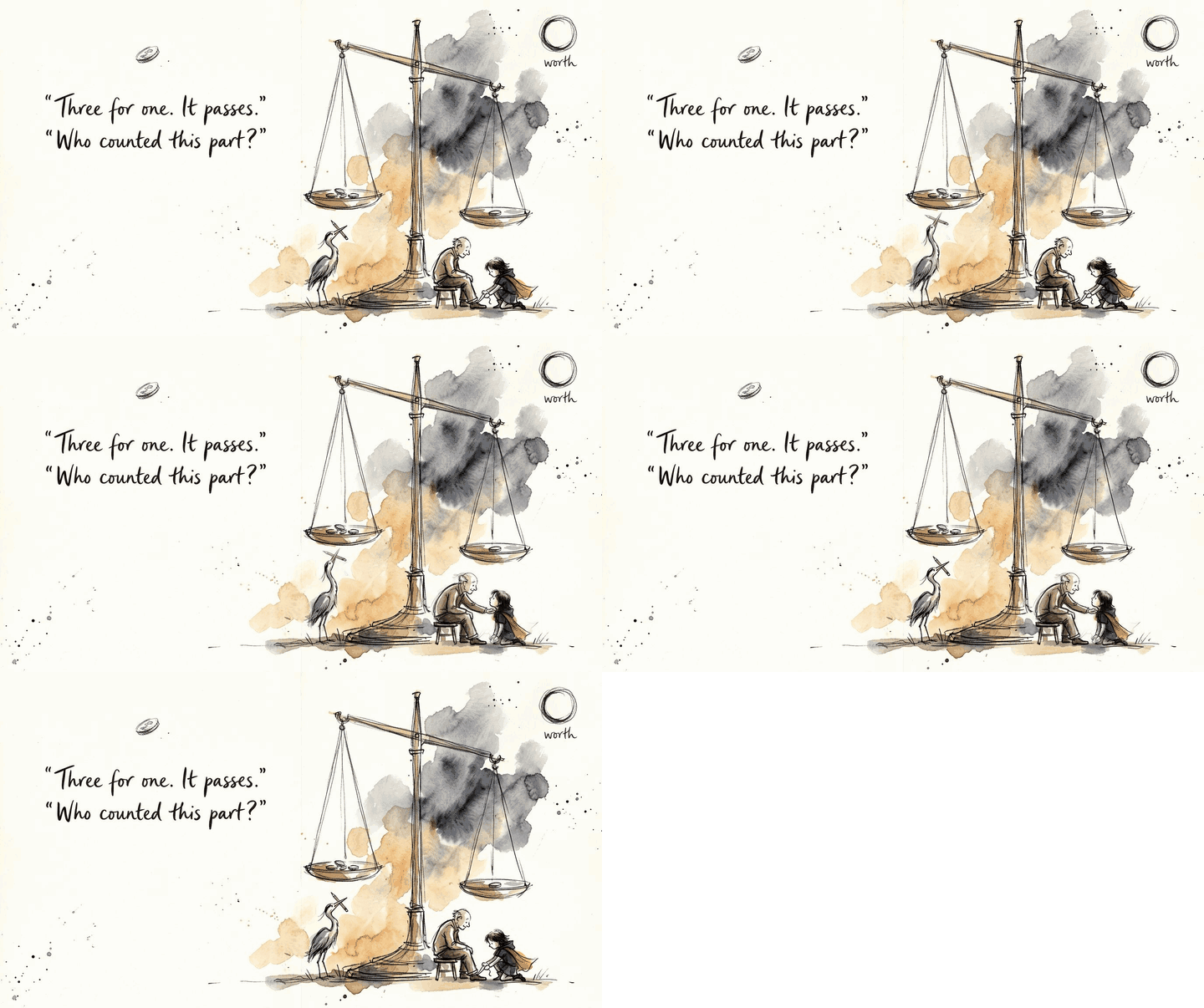
Houston Methodist requires a projected 3-to-1 return before any AI agent gets in: and it turns off tools that miss the number.
Cook County Health announced its Epic deal: 20-plus clinical, nursing, IT and operations leaders scored the bids, the board approved the pick in August, and the build starts in February 2027 and runs at least 18 months.
😤 “Another Epic shop.” Look at who was on the committee.
A pediatric radiology team built three apps, and Microsoft is working to wire them into its reporting software: the bone-measurement tool saves four to five minutes a case.
🩻 Real or AI?
Subconjunctival hemorrhage. One is real. The other was generated by AI. Which is which?
A

B

Answer at the bottom.
🧭 The AI Curbside — AI answers your questions
This is what AI thinks — not medical advice, not my opinion or my employer’s. Verify before you act.
“Can we screen a million notes without sending patient data to an outside API?”
Short answer: One vendor says yes, for about a penny and a half per thousand notes. The numbers are the vendor’s.
What changed: John Snow Labs announced commercial availability of its Medical Decision Models on Monday. They don’t write text. They answer a fixed question about a note (yes or no, one option from a list, a level on a scale) with a probability attached, and they run on-premises or in a private cloud.
AI’s take: A fixed answer with a probability is easier to audit than a paragraph. The accuracy figures (a 0.917 composite for the larger model) come from the announcement, and no independent test is cited there.
🔬 The Big Thing
What if your hospital told every AI agent: return three dollars for each one we spend, or we turn you off?
Michelle Stansbury, associate chief innovation officer at eight-hospital Houston Methodist, said in an interview published Monday that this is the rule. “For any agent brought into our organization, it has to have a 3-to-1 ROI. That’s it. If it doesn’t, we won’t do it.”
Every proposal names the vendor, the cost and the expected return. Then her team goes back to see whether the return showed up, and the system shuts off tools that miss.
Two details matter more than the ratio. Positions counted as savings come out of the next budget cycle, and a leader who needs them elsewhere has to ask a Labor Efficiency Committee. And AI features that arrive inside the EHR stay off until the vendor shows what they’re worth: “We’re not going to turn it on just because, hey, you’ve got it, it’s great.”
The bar isn’t the news. The follow-up is: somebody goes back and checks.
😤 “I’m a nurse. ROI is the CFO’s problem.” The hours in that return are yours. If a tool saves 20 minutes a shift on paper, someone will plan staffing around it.
😤 “Time saved isn’t money.” Correct, and that’s her point.
🧪 Try the interactives:
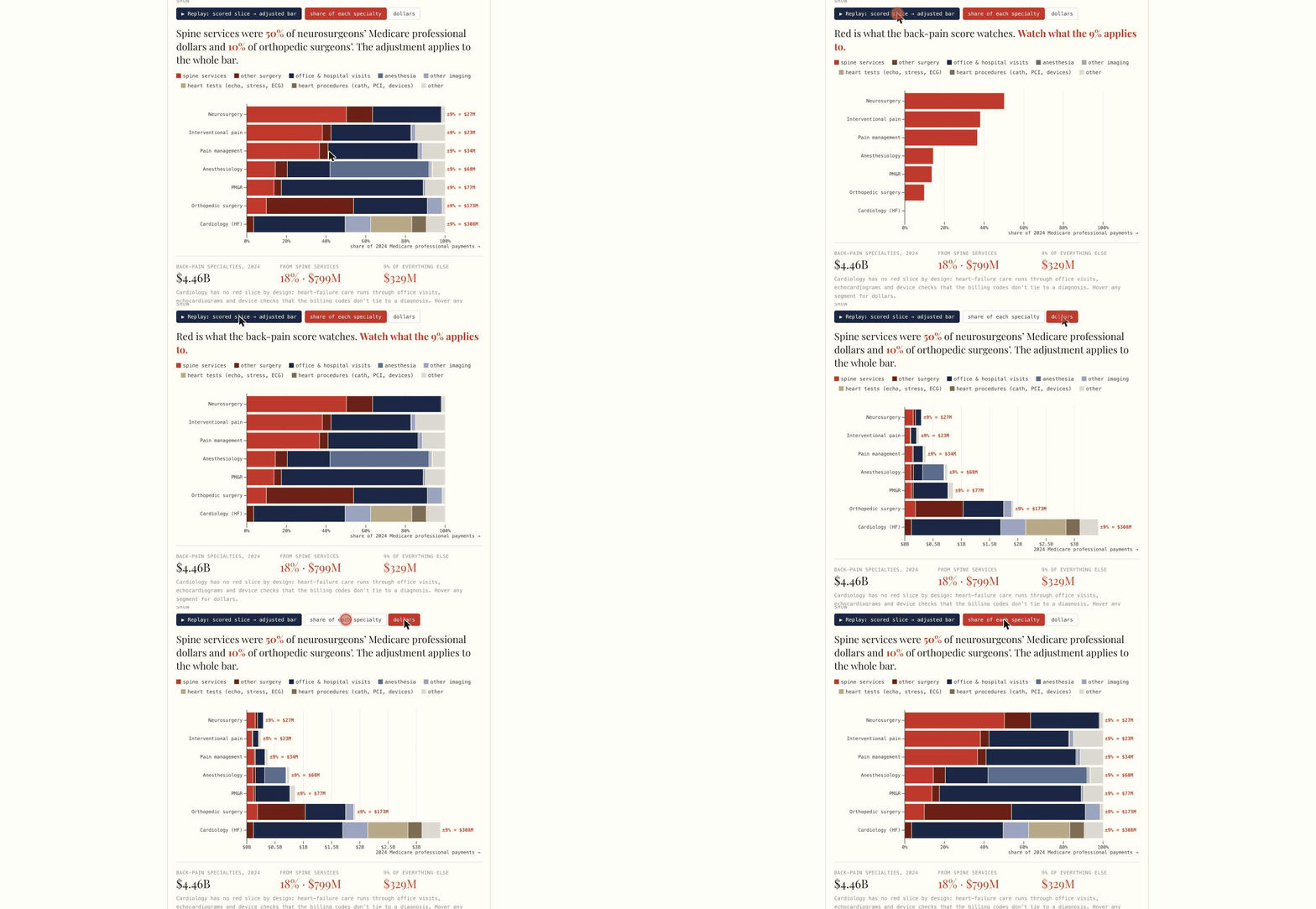
The Spine Share Explorer: Medicare’s Ambulatory Specialty Model scores back-pain specialists on low back pain, then adjusts all their Part B professional pay. 13,238 clinicians in six specialties had at least 20 Medicare patients on a single spine code in 2024; 37% of their Medicare professional dollars came from those services. Slide the adjustment and see how much lands on everything else.
Scored on the Spine, Paid on Everything: Medicare’s Ambulatory Specialty Model scores back-pain specialists on low back pain and cardiologists on heart failure, then moves all of their Part B professional pay by up to 9%. In 2024 Medicare billing, spine services were half of neurosurgeons’ dollars and one in ten of orthopedic surgeons’. Watch the scored slice grow into the whole bar.
📡 Radar
Three radiology apps, built by the people who read the films
Microsoft said Monday that a pediatric radiology team at a U.S. academic medical center built three apps for its own reading room. One answers protocol questions from the department’s own documents. One measures bone length on children’s leg radiographs. The third drafts pediatric chest X-ray reports, trained on the department’s own studies because many existing models were trained on adults.
Two are in daily use. “We save about four to five minutes per case,” said Sergios Gatidis, MD. Microsoft says it’s working to show the results inside PowerScribe One, reporting software used by more than 300 organizations.
The department built for its own patients first. The distribution came after.
😤 “That’s a vendor blog.” It is. No error rates, no hospital named, and the time savings are self-reported.
💡 80/20: write down the one measurement you redo by hand every shift. That’s the size of app this team started with.
ONC says the standard isn’t what’s slowing FHIR down. The bill is.
Steven Posnack of the federal health IT office wrote Monday that moving data exchange to FHIR APIs carries real transition costs. Where data already flows, he wrote, a FHIR-based replacement “has yet to demonstrate it offers a compelling financial or technical advantage to switch.”
He also names who’ll struggle: community clinics, rural providers and other organizations short on resources.
More FHIR means more work at the edges, and the edges are small clinics.
📜 History rhymes: hospitals adopted EHRs when HITECH paid them tens of billions of dollars to do it. Standards have spread at the speed of whoever covers the switching cost.
🎙️ From the Pods
🎙️ UnHack with Drex DeFord — “Who Owns Resilience When Vendors Go Down?”
After a week when Microsoft 365 went down and Workday stumbled, the panel’s answer is that resilience can’t belong to IT alone. Someone has to map what each clinical system depends on, and what those vendors depend on in turn. On recovery plans: “Everybody has a plan until they get punched in the nose.”
🔇 Speaker Blindspot: Glittering generality — “ownership” gets nods all around, and nobody names the role, the budget or what it would replace.
🧪 Evals Desk
A benchmark that graded the whole hospital stay found models see the evidence and don’t act on it (arXiv, Nov. 22)
WARD scores clinical agents at 240 checkpoints across 40 patient trajectories covering 95 hospitalizations. Across 12 models, even when the right evidence was linked, the model failed to respond to it 74% to 91% of the time. In a live tool loop, 11.5% of actions moved the case forward.
Why it matters: a final-answer score can’t tell a sound trajectory from a dangerous one that ends in the same place.
💰 Money Plumbing
The score is narrow. The pay cut is wide.
Medicare’s Ambulatory Specialty Model starts January 1. It’s mandatory for selected specialists who treat heart failure or low back pain. CMS scores them from 0 to 100 on 2027 performance, then adjusts their 2029 Part B payments by as much as 9% up or down.
The catch is in the final rule: the adjustment applies to all of the clinician’s Part B professional payments, “not only those services related to” the targeted condition. For a cardiology group with $4 million in Part B payments, that’s $360,000 riding on a heart failure score.
The adjustment isn’t a code on a claim. You learn your score from a performance report.
😤 “I’m not a cardiologist.” Watch which specialty the next model picks.
🩻 Real or AI answer: A is real, B is AI.
Proof: B was made with Nano Banana 2.1. A is a published, de-identified teaching image, not patient data: “Subconjunctival hemorrhage eye” by Daniel Flather, CC BY-SA 3.0, Wikimedia Commons, resized, shared under the same license.

This post is almost entirely AI-generated. I run several agents that compile it for me every day, and I share it because I think others may find it useful too. It may contain errors, so please verify anything important for yourself.
The opinions here are mostly the AI’s. They are not medical advice, and they don’t necessarily reflect my views or those of my employer. Still, I find it interesting to see in one place what’s happening in informatics and health tech, and how people might be reacting to the news. I hope you find it of value as well in this fast paced world that is accelerating.
— Kevin & AI