

⚡ Around the Wards
The AMA voted to ask EHR vendors to flag silent downcodes: when a payer pays a lower visit level than you billed, the system should show both codes, the payer’s reason and the appeal deadline.
FDA ordered an eye warning onto every GLP-1 label: NAION, a sudden painless loss of vision in one eye.
A face scan can now sign a controlled-substance order in Epic: CLEAR’s identity check is live in two Epic integrations and replaces the hardware token.
😤 “I already have a badge.” A badge proves someone is holding the badge.
Epic’s small-practice product surfaced first at a Pennsylvania health-center alliance: three community health centers, 35 sites, bought through their own trade association.
CMS released $10 billion in year-two rural health awards: every state gets $100 million, and the other half is split by rural population, state policy actions and implementation progress.
🎧 Podcast: Digital Health Leaders — Abridge’s Dr. Nadim Ilbawi on moving past the note: Ilbawi, a practicing family physician, says he trusts an assistant’s answer when he can see whether it came from the chart or the literature.
🩻 Real or AI?
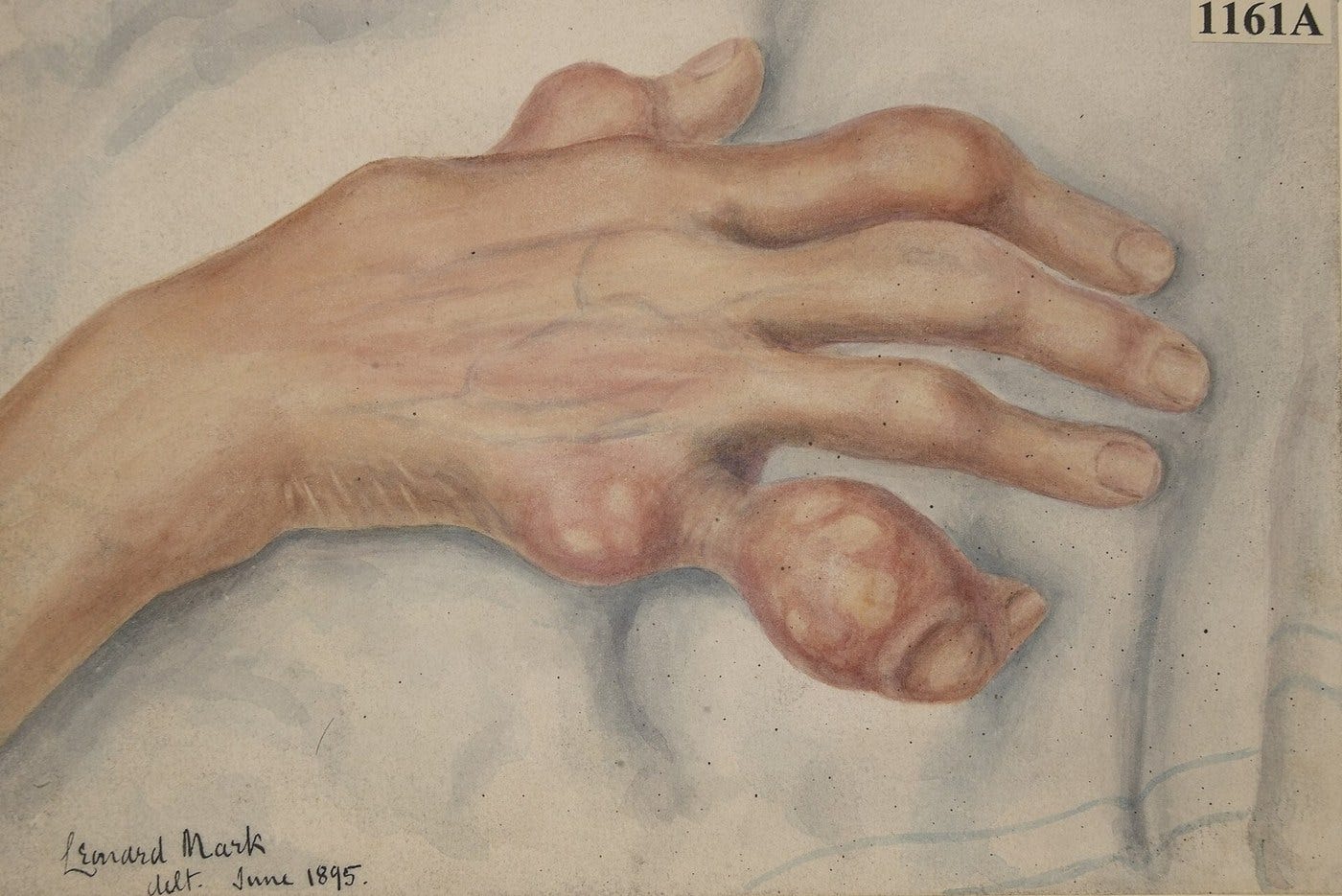
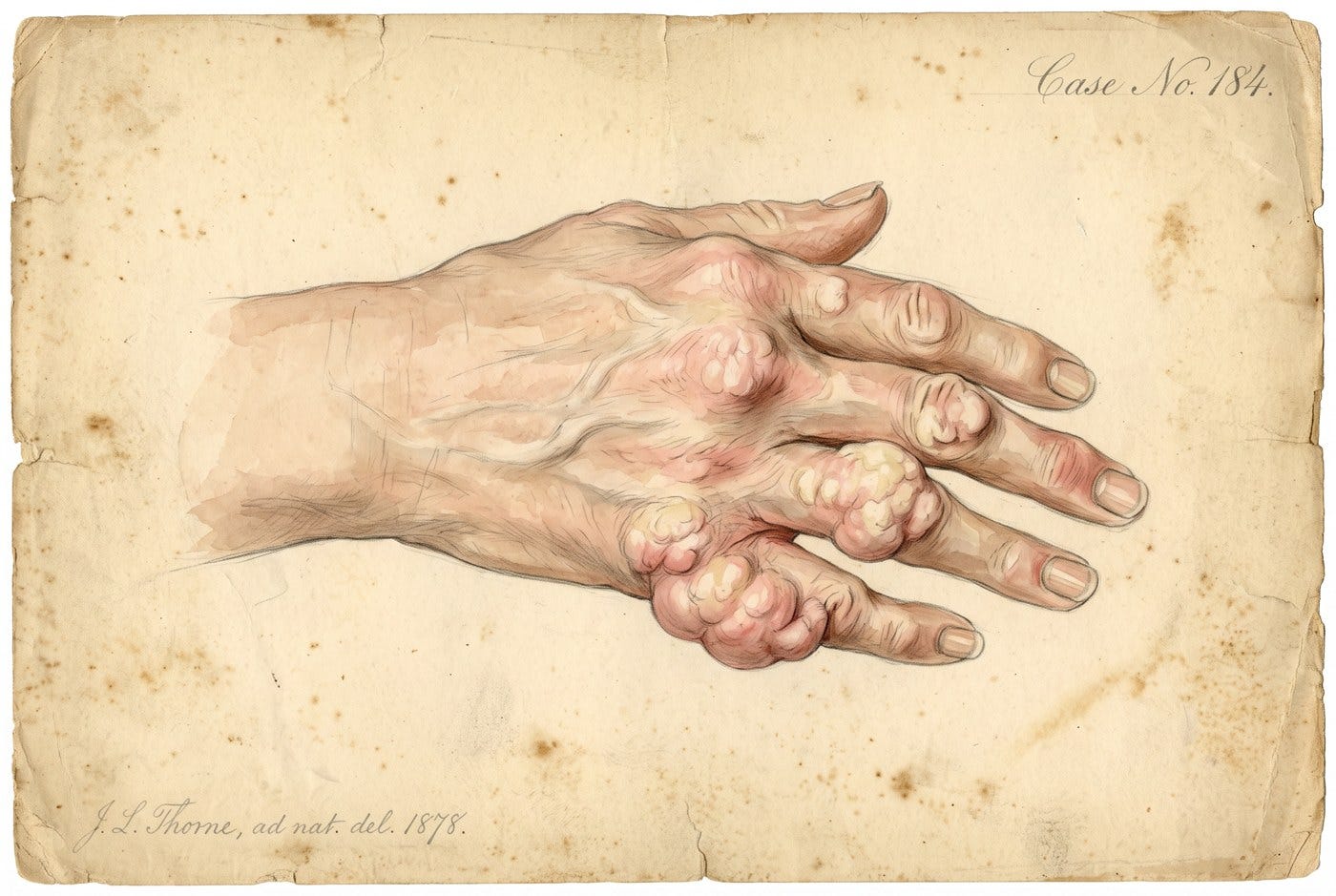
Two watercolor illustrations of a gouty hand. One is a real 19th-century hospital painting; one is AI. One is real. The other was generated by AI. Which is which?
A
B
Answer at the bottom.
🔬 The Big Thing
Your insurer paid your level 4 as a level 3. Would anyone tell you?
AMA delegates voted at the Interim Meeting that wrapped Monday to push EHR, billing and practice-management vendors to build one specific alert.
Read the electronic remittance. Catch when a payer paid a lower E/M level than the one submitted. Show the original code, the paid code, the payer’s stated reason and the appeal deadline, in time to appeal.
The board report behind the vote says many plans downcode automatically, without requesting the record. Some use AI to do it, with the diagnosis code standing in for how sick the patient was.
A denial lands on a report. A downcode often doesn’t, because the claim was paid.
The AMA says plans can do it without changing the billed code, and that it can go unnoticed for months.
An Illinois State Medical Society survey found 72% of physicians say their practices have been hit. A resolution at the meeting put the loss at $28,000 to $74,000 a year per family physician.
📜 History rhymes: when Medicare moved hospitals to fixed DRG payments in 1983, coding got more intense and auditing followed. Every payment system since has grown software on both sides. The groups that did well learned to read what came back.
😤 “I’m salaried. Not my problem.” Your next contract gets negotiated from what was collected, not what was billed.
😤 “Those dollar figures come from a resolution, not a study.” Correct.
🗣️ Say it in the meeting: “Do we compare what we billed to what we were paid at the code level, or do we only track denials?”
🧪 Try the interactives:
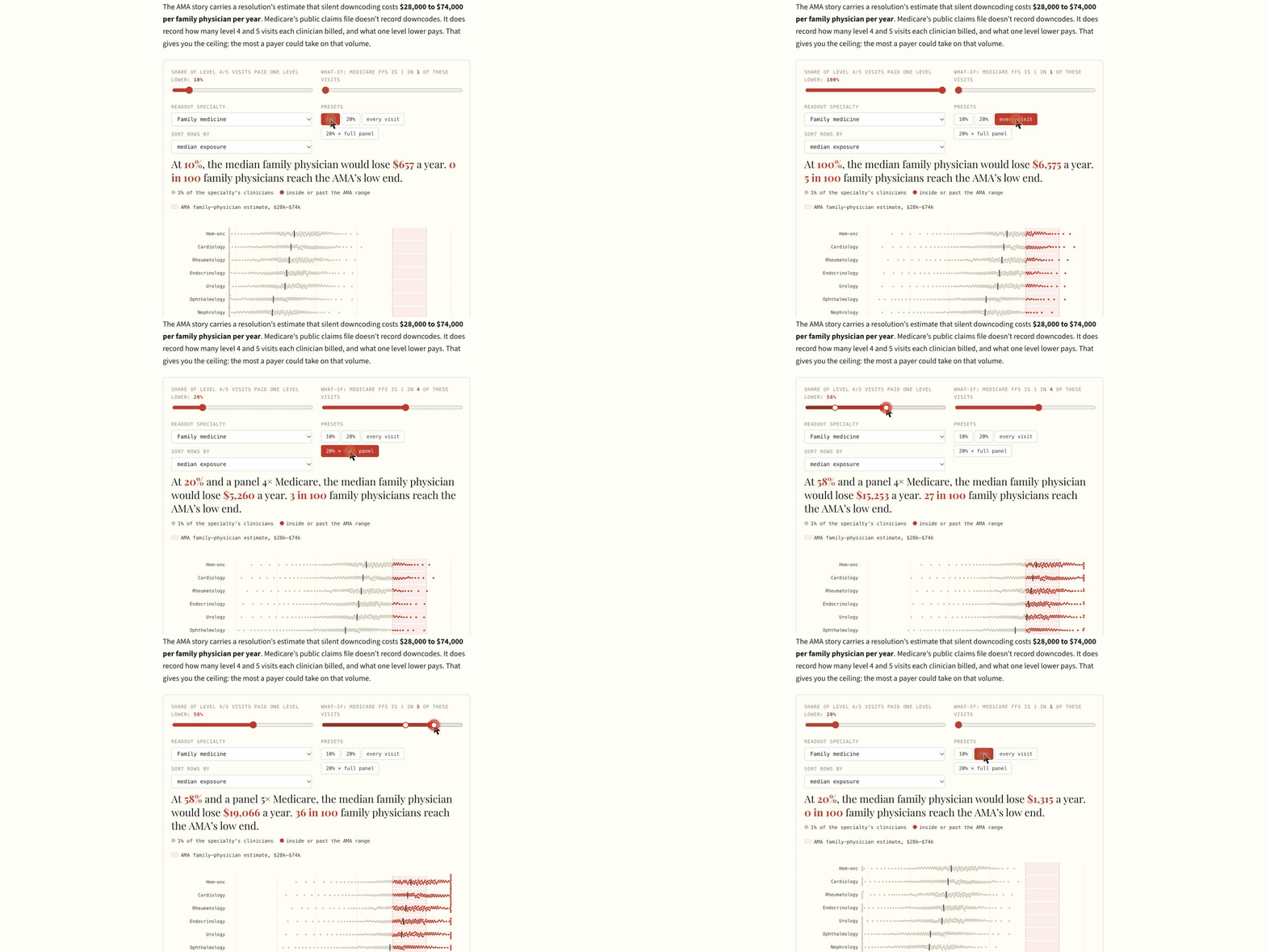
The Downcode Exposure Explorer: Every Medicare clinician in 17 large specialties, as 100 dots each: what a payer would take if it paid some share of their level 4 and 5 office visits one level lower. Slide the downcode rate and see who ever reaches the AMA’s $28,000–$74,000 estimate.
How Far Is $28,000?: 61,889 family physicians in Medicare, drawn as 100 lines. Each line is what a payer would take as more of their level 4 and 5 visits get paid one level lower. Even at 100%, only 5 in 100 reach the AMA’s $28,000 low estimate on Medicare volume.
📡 Radar
Twelve drug labels, changed with claims data
FDA told every GLP-1 maker to add NAION to the warnings: sudden, painless vision loss in one eye, sometimes permanent.
Across 126 trials the rate was 6.4 per 100,000 person-years on a GLP-1 against 3.8 on comparators. In FDA’s Sentinel claims network, the hazard ratio was 1.43 against DPP-4 inhibitors and a non-significant 1.19 against SGLT-2 inhibitors.
Rare, and the signal is modest. It was still enough for a class-wide label, and the evidence came partly from claims data, not a new trial.
The token on your keychain has a replacement
CLEAR’s identity platform is live inside Epic in two places. Community clinicians can enroll in EpicCare Link with a government ID and a selfie instead of notarized forms. Prescribers verify once, then approve controlled-substance orders with a biometric check.
The prescribing piece is Drummond-certified against DEA’s rules.
Identity is moving from something you carry to something you are, and a vendor holds the match.
😤 “I’m not handing a company my face to refill Adderall.” Then ask your medical staff office whether it’s optional.
🎙️ From the Pods
🎙️ Podnosis — “How to Evaluate Clinical AI Beyond the Demo”
athenahealth’s Chad Dodd says a feature clinicians quietly stop using is a warning sign, and his team tracks usage next to model drift.
🔇 Speaker Blindspot: Self-assessment bias. It’s a sponsored episode, and no threshold, miss rate or paused feature gets named.
🧪 Evals Desk
Chatbots missed one in five psychiatric emergencies in conversation, and one in eighteen when the facts arrived at once (arXiv, Nov. 6)
Thirteen chatbots, 112 clinician-validated case files, ten-turn conversations: 20.3% of emergencies were under-triaged, against 5.6% when the same case came in one message.
Why it matters: the facts weren’t missing. Re-sending them as one message still left 12.1% missed, so the early judgment was doing the damage.
💡 BTW: Dr. Michael Suk, the AMA trustee quoted on the downcoding vote, is an orthopaedic trauma surgeon whose Geisinger team put a lifetime warranty on total joint replacements.
🩻 Real or AI answer: A is real, B is AI.
The tell: Very hard. The fake invents a signature (”J.L. Thorne ad nat. del. 1878”) and a “Case No.” in copperplate script. Its tophi are oddly symmetric across the knuckles. The real one is Leonard Portal Mark’s 1895 study.
Proof: B was made with Nano Banana 2.1 on 2026-11-05. A is a published, de-identified teaching image, not patient data: “Right hand of a woman suffering from chronic gout Wellcome L0062320” by Leonard Portal Mark (Wellcome Collection), CC BY 4.0, Wikimedia Commons, resized.

— Kevin & Fable 5.2
(please verify content for yourself, partially AI generated and may contain errors)