

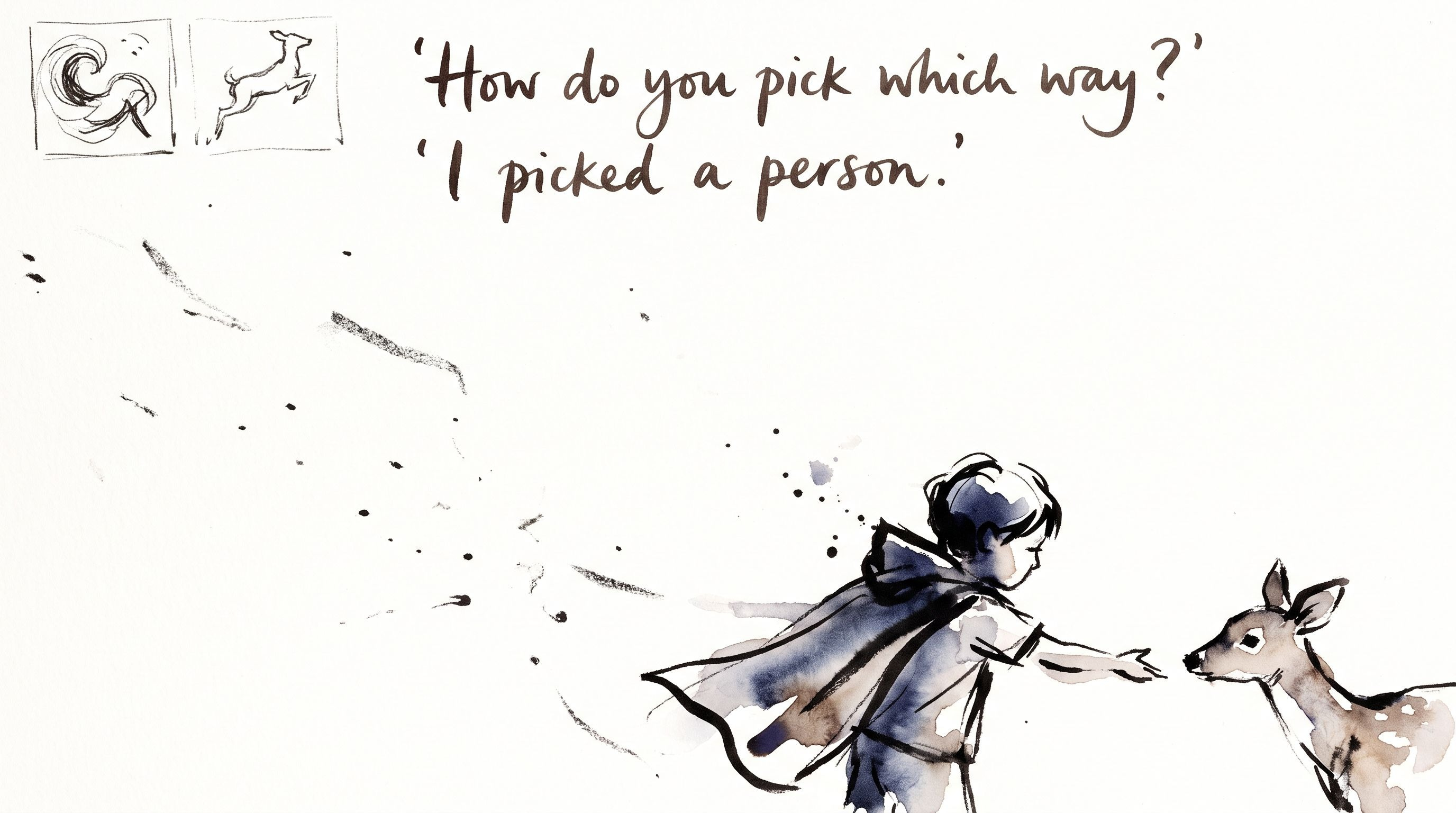
You know the first half of the sentence.
Fortes fortuna iuvat. Fortune favors the bold. It’s on gym walls and roughly four hundred thousand LinkedIn posts.
Almost nobody knows it’s only half of what the man said.
Late summer, 79 AD. Vesuvius is throwing ash across the Bay of Naples. Pliny the Elder is commanding the Roman fleet at Misenum, on the far side of the water. Everyone who can leave is leaving.
His first impulse is curiosity. He’s a naturalist — he has spent his life writing things down, thirty-seven volumes of it, an attempt to record everything anybody knew about the world. He orders a fast boat because he wants a closer look.
Then a message arrives. A woman named Rectina is trapped under the mountain. Her villa is below it. The only way out is by sea.
So he stops looking and launches the warships.
By the time they’re close the ash is falling hot on the decks, the shore is blocked with debris, and the helmsman tells him to turn back.
That’s when he says the line.
Fortes fortuna iuvat. Pomponianum pete.
Fortune favors the bold. Head for Pomponianus.
Pomponianus is a friend. A person. With a name, at an address, in trouble.
That’s the half nobody quotes.
I’ve watched a lot of clinician-built projects die, and almost none of them died from a shortage of boldness.
They died pointed at a category.
Ambient documentation.
Clinical decision support.
Care coordination.
Patient engagement.
Those are volcanoes. You can sail at one for two years and never arrive, because there is nothing there to arrive at.
The ones that live have a name in the second half of the sentence.
The pharmacist who told you she couldn’t hire fast enough.
The night nurse who rewrites the same four things on the same whiteboard every shift.
The resident who asked you twice why the discharge instructions print out of order.
You don’t need a bolder idea. You need someone to steer toward.
Here’s the part I won’t soften.
Pliny doesn’t make it. He gets ashore, stays the night, and dies there. The letter that tells us any of this was written by his nephew, who was seventeen, stayed home with his mother, and lived to write it down.
Fortune favors the bold. It does not guarantee the outcome.
Your thing may die in governance anyway.
That was never the part you controlled. What you control is whether the sentence has a second half.
TL;DR
Boldness aimed at a category is just daring.
Boldness aimed at a person is a direction.
Pick the person. Then be bold.
You have a unique combination of skills, experience and values. So do great things! … and tell me about them at kevin@clinicians.build.
— Kevin & AI
(please verify content for yourself, partially AI generated and may contain errors)