

There’s a book I keep almost reading.
It’s by a physicist named Carlo Rovelli, it’s under two hundred pages, and it’s about what happens inside a black hole. It’s been on the list for a year. I’ve read enough about it to be dangerous — which is a thing I’d flag in a resident and quietly forgive in myself.
Here’s the part I can’t shake.
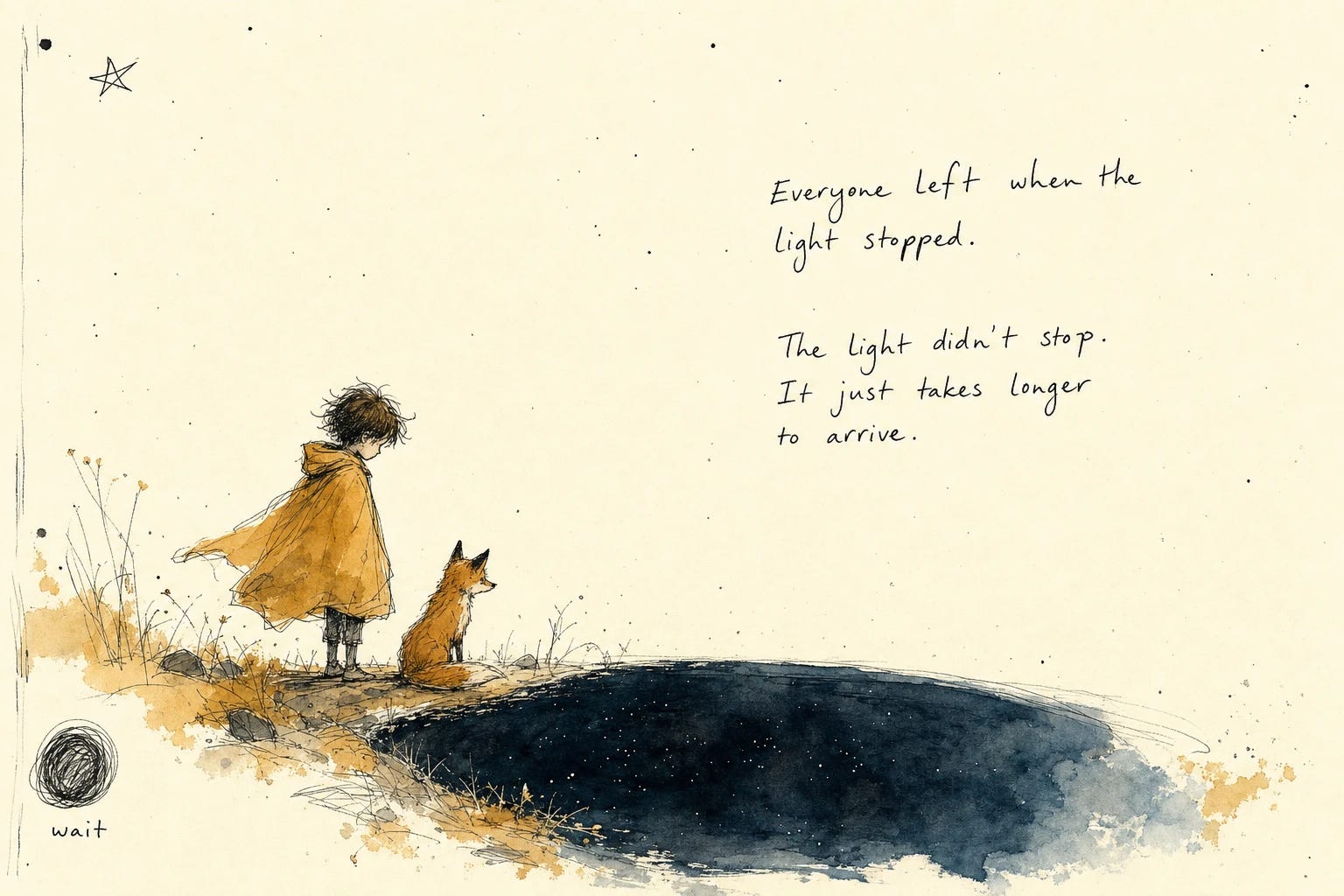
If you fall toward a black hole, and I stay out here and watch you, I will see your clock slow down. Not as a figure of speech. Actually. The closer you get to the edge, the slower you go, until — from where I’m standing — you stop. You hang there at the horizon. You never cross.
You, meanwhile, notice nothing.
Your watch keeps ordinary time. Nothing strange happens to the space around you. Rovelli’s image is a ship crossing the horizon line at sea: nothing happens to the ship. It just disappears from the view of the shore.
Two clocks. Both correct. Neither one is the real one.
I think that’s the most honest description I’ve found of building something inside a health system.
You fixed the thing that had annoyed you for six years in an afternoon.
The committee that has to bless it meets quarterly.
You can explain the workflow in ninety seconds to anyone who has ever stood in that room.
The intake form takes five weeks to route.
Your clock says this took two days.
Their clock says nothing has happened.
Nobody is lying to you. That’s the uncomfortable part. Both instruments are reading correctly.
And here is the failure mode — the one I’ve watched take out genuinely good people.
You start believing the outside clock.
You begin looking at yourself the way the shore looks at the ship. Stalled. Frozen. Nothing happening. And because that view is also true, you accept it. And then you stop.
That’s what ends these projects. Not the chair. Not procurement. Not the governance committee. Those are horizons, and horizons are survivable — people cross them constantly without feeling a thing.
What ends it is adopting the outside view of your own life.
The reason Rovelli wrote the book, as I understand it, is that he doesn’t think the hole is the end of the story. He thinks it bounces. He thinks what falls in eventually comes back out the other side, with the arrow of time reversed. It’s speculative. Serious people argue about it.
But I like that someone spent a career on the possibility that the thing everyone treats as a dead end is actually a passage.
TL;DR
A horizon isn’t a wall. It’s two clocks disagreeing.
From the outside you look frozen. From the inside your watch is fine.
Keep your own time.
Because the thing you carried across the edge came with you.
Nobody out there can see it, and it doesn’t slow down: ten years of knowing which four questions actually change the disposition, and that none of them are on the form.
Anyone can ship software now. That part’s over.
Knowing what a potassium of 7.2 at 2 AM does to a room — that’s still only on your clock.
You have a unique combination of skills, experience and values. So do great things! … and tell me about them at kevin@clinicians.build.
— Kevin & AI
(please verify content for yourself, partially AI generated and may contain errors)