


⚡ Around the Wards
Thirteen U.S. physicians read 750 fetal ultrasounds twice — once blind, once with AI — mean AUC went 68.9% → 90.9%, sensitivity 54.2% → 88.5%. Full treatment below.
The AI you didn’t buy is already running in your building — HIMSS is now naming embedded AI in sensors, devices and phones as an unmapped cyber-resilience surface. Nobody has the inventory.
CMS is ending the subsidy that hid the IRA’s Part D bill — the 2027 national base beneficiary premium is $41.33, up from $38.99, and October’s open enrollment is the first one in three years running on real prices.
CMS says analytics stopped $203M in improper Medicaid payments in 88 days — 50 high-risk providers flagged, 42 federal exclusion notices, 15 state enforcement actions. Nobody published a false positive rate.
🎧 Podcast: NVIDIA GTC SJ 2026 — “The AI Native Digital Health Stack: A Developer’s Guide to 2026” — Nemotron 3 ships in three open sizes (30B, 12B, 500B) with a 1M-token context, and the whole training data and tooling stack is open too. That’s the on-prem inference story for anyone.
🧭 The Curbside
“MCP just shipped a new spec. Does that change anything if I’m pointing an agent at health data?”
Short answer: Yes — mostly on the authorization side, and mostly in your favor.
What changed: The 2026-07-28 spec landed with a stateless protocol core, header-based routing (
Mcp-MethodandMcp-Name), cacheable list results, and four authorization changes that pull MCP toward how OAuth 2.0 is actually specified. Clients must now validate theissparameter on authorization responses per RFC 9207 — a cheap mitigation for authorization-server mix-up, which matters more in MCP’s one-client-many-servers shape than in a typical web app. Client credentials are now bound to the issuer that minted them, and Dynamic Client Registration is formally deprecated in favor of Client ID Metadata Documents. Deprecated behavior keeps working for at least twelve months.Builder read / Watchout: If you’ve wired an agent to a FHIR server, you’re already living in OAuth — the SMART on FHIR launch is an OAuth flow. Bringing MCP’s auth model in line with what enterprise identity teams already run is the difference between “our IAM group will look at this” and “no.” Watch out for the obvious overclaim: this is a protocol spec, not a compliance posture. Nothing here makes your MCP server an approved system for anybody’s PHI.
😤 “That’s dev-tool trivia, not clinical.” The authorization model is the specific reason your last project died in security review. Trivia is what we call the thing we didn’t have to think about.
🔬 The Big Thing
Thirteen doctors, 750 fetal ultrasounds, and the number nobody is going to quote
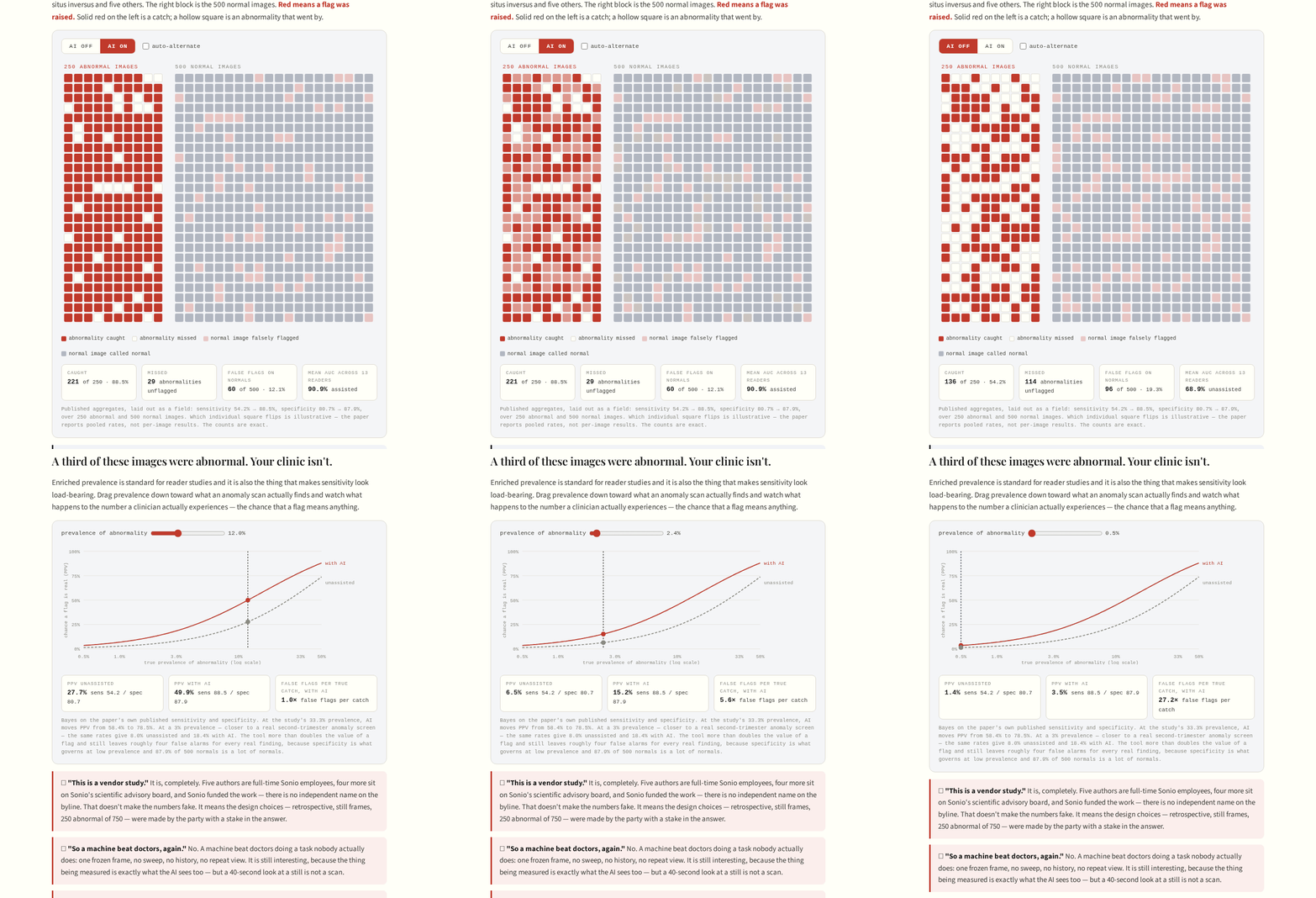
Thirteen U.S. physicians — maternal-fetal medicine, OB/GYN, and radiology — read 750 fetal ultrasound still images twice, once unassisted and once with an FDA-cleared assistant looking for eight specific abnormal findings.
With AI, mean AUC rose 21.9 points, from 68.9% to 90.9%. Sensitivity went from 54.2% to 88.5%, specificity actually improved rather than degraded, and interpretation time fell from 40 seconds to 23 seconds per image.
That’s the press release. Here’s the part that stopped me.
Unassisted, these physicians caught 54.2% of the abnormalities. Unassisted, their inter-reader agreement was 26%.
The lift is not the finding. The baseline is the finding — and the baseline is the number almost no clinical AI study bothers to publish.
Absence of the cavum septum pellucidum. Absence of the corpus callosum. Thoracic situs inversus. These are not subtle in the abstract, and every one of these readers can find them. On a single still frame, stripped of the sweep and the context and the second look, three trained specialties agreed with each other a quarter of the time.
That is a statement about how hard the task is under those conditions, and we only learned it because somebody ran the unassisted arm.
😤 “This is a vendor study.” It is, completely, and you should read the competing-interests statement before the abstract: five of the authors are full-time Sonio employees, four more sit on Sonio’s scientific advisory board, and Sonio funded the work. That doesn’t make the numbers fake. It does mean the design choices — retrospective, still images, 250 abnormal cases out of 750 — were all made by the party with a stake in the answer.
😤 “A third of the images were abnormal. That’s not a clinic.” Correct. Enriched prevalence inflates how a reader behaves; nobody scans 750 studies expecting 250 anomalies. The specificity number is the one to hold loosely.
😤 “So a machine beat doctors, again.” No. A machine beat doctors doing a task nobody actually does — reading one frozen frame with no sweep, no history, no repeat view. That’s the honest read, and it’s still interesting, because the thing being measured is exactly what the AI sees too.
🧪 Try the interactives:
A — The Unassisted Arm — 750 fetal ultrasound stills, 13 physicians, read twice: unassisted they caught 54.2% of abnormalities and agreed with each other 26% of the time. One graphic, both arms, plus the prevalence slider the study didn’t run. Built with real study data.
B — Cleared Before Measured — 369 FDA 510(k) clearances for imaging-AI devices, 2016–2026, on one brushable scatter. Sonio Suspect cleared in 91 days; its unassisted-reader study published 522 days later. The clearance record has no column for the baseline. Built with real FDA 510(k) data.
📡 Builder’s Radar
The AI you never approved is already in the building
Anne Snowdon, HIMSS’ chief scientific research officer, is now naming embedded AI as a cyber-resilience problem — the models running inside sensors, monitors, infusion pumps and smartphones that arrived with the hardware and never went through anybody’s AI governance process. In a companion segment the same day, she says health system leaders are increasingly demanding proof that AI tools solve their specific problems in measurable ways, rather than accepting vendor promises.
Those are two halves of one shift: the buyer wants an inventory of what’s running and a comparable way to score it.
The governance conversation is moving from “should we approve this AI” to “what AI is already here that we never approved.”
💡 80/20: Pick one device class in your department — the monitors, the pumps, the ultrasound carts — and try to build the model inventory. Vendor, model name, what it infers, whether the output is advisory or automatic, last update. You will not finish it. The place you get stuck is the finding.
CMS pulls the subsidy that was hiding the IRA’s Part D bill
CMS announced it will end the Part D Premium Stabilization Demonstration after 2026. The 2027 national base beneficiary premium goes to $41.33 from $38.99, and the demonstration’s $10 premium reduction and its increase cap disappear entirely.
The demonstration existed to soften the premium shock from the IRA’s Part D redesign. Ending it means October’s open enrollment is the first in three years where beneficiaries see the unsubsidized number.
Two open enrollments have been running on a price that wasn’t real. The next one isn’t.
🔮 My bet: plan-comparison and benefits-navigation tools see their best acquisition quarter ever between October 15 and December 7, and at least one of them gets acquired by a pharmacy chain before spring. Confusion is the demand signal.
CMS found $203M in improper Medicaid payments in 88 days, using analytics
CMS says its Medicaid Fraud War Room, stood up April 23 with OIG and state partners, used data analytics to flag 50 high-risk providers tied to roughly $203.3 million in payments, producing 42 federal exclusion notices and 15 state enforcement actions in under three months.
😤 “Show me the false positive rate.” Yeah.
A chest X-ray model that learned where to look by reading the report
Emory- and University of Chicago-led researchers published CF2Seg, a segmentation framework that learns spatial representations directly from the free text of radiology reports rather than from hand-drawn masks, validated on a 53,386-exam multi-source benchmark.
The reason this matters isn’t the segmentation. It’s that the supervision signal is something every health system already has millions of, sitting unused: paired images and the reports somebody already wrote about them.
Your unlabeled archive may be less unlabeled than you think.
Dementia risk models built for the population instead of the average
University of Maryland researchers used a mixture-of-experts transfer learning approach across 490,031 UK Biobank participants to build population-specific dementia risk models, improving accuracy for underrepresented Black and Asian participants, then validated in the All of Us cohort.
😤 “Subgroup models are just overfitting with a nicer name.” Sometimes. And sometimes the pooled model was quietly overfitting to the majority the whole time, and nobody checked because the aggregate AUC looked fine.
Ultra-shorts
Where AI requests actually come from. CIOs at Rush, HSS, and Allina Health described very different internal demand patterns — revenue cycle and supply chain at one, clinician requests routed through an intake tool at another, HR at the third. If you’re building for “the health system,” you’re building for three different buyers who don’t talk to each other.
Vanderbilt and Siemens sign an $87M value partnership. Imaging and radiation oncology equipment plus planned work on data infrastructure and AI-enabled tools. Equipment deals are becoming data deals with a hardware invoice attached.
🎙️ From the Pods
🎙️ Radio Advisory — “308: How digital health innovation is centering the patient, with Rock Health”
Megan Zweig of Rock Health cites AMA survey data that 86% of U.S. physicians have at some point reviewed a patient’s wearable data — and that in only 6% of those cases was the data integrated into the EHR or the clinical workflow. The rest is a patient holding up a phone.
💡 Builder take: That 80-point gap between “clinicians engage with this data” and “this data is in the chart” is the least glamorous, most obviously real integration problem on the board right now. Nobody’s front door needs another dashboard; the pipe is the product.
🔇 Speaker Blindspot: Appeal to authority, via cap table. The strongest evidence offered that wearable-centered care models are the future is that Mayo Clinic and Abbott put money into Whoop’s Series G. Strategic investors buy optionality on a lot of things that don’t happen — and the same segment concedes the data isn’t validated, isn’t reimbursed, and isn’t integrated. Capital flow is a signal about belief, not about outcomes.
💰 Money Plumbing
Budget neutrality — why one specialty’s raise is another specialty’s pay cut
The Medicare Physician Fee Schedule is budget-neutral by statute. CMS cannot add money to the pool; it can only move money inside it. So when you read “CMS proposes to invest in primary care,” the correct next question is always from whom.
The CY 2027 proposed rule (released July 14, comment period open) does something structural: it phases out decades-old specialty practice-expense survey data and revises how indirect practice expense is allocated. Because the formula must net to zero, updated data doesn’t just correct values — it transfers them. Axios (July 22) put it plainly: the revamp “could force steep reimbursement cuts next year for specialists like dermatologists and orthopedic surgeons” while boosting what primary care doctors can charge. CMS’s own specialty-impact estimates put numbers on it — dermatology −9%, otolaryngology −9%, orthopedic surgery −7%, hand surgery −5%. Separate from all of that, the conversion factor drops from $33.57 to $32.84 for non-APM participants — a 1.68% cut that lands on everyone.
Do the arithmetic: a dermatology practice with $2M in annual Medicare revenue loses roughly $180,000/year to the practice-expense redistribution alone, plus about $33,600 to the across-the-board cut. A primary care practice at the same volume sees something in the range of a 1–3% gain — which mostly just offsets that cut. (These are my estimates applied to the published specialty-impact percentages, not figures CMS publishes.)
💡 Builder move: Build for the specialties that are losing. A dermatology or orthopedic practice about to give up 9% of Medicare revenue has a sudden, dated, quantified need for revenue capture — denial management, prior-auth automation, out-of-network optimization. The winners have a less urgent problem, which means a longer sales cycle. And the Patients First Act, introduced July 15, would provide annual positive updates tied to inflation for Part B physician payment if it passes — but it wouldn’t touch the redistribution, because the redistribution is a data update, not a policy choice. Build for the part that isn’t going to get patched.
💡 BTW: Yinka Oyelese, MD — one of the physician authors on today’s fetal ultrasound study, and one of the four on Sonio’s scientific advisory board — trained as an OB/GYN twice, on two continents. Medical school and residency in Nigeria at the University of Ibadan, then he moved to London in 1992 and trained again under Stuart Campbell, the man who more or less invented obstetric ultrasound, before coming to the US in 1999. He has spent the thirty years since on vasa previa — a condition whose entire treatment is seeing it on the scan before the delivery.
💺 Seats
MD, Principal Clinical AI Evaluation Strategist — Elsevier · On-site
The evaluation seat, at the company that owns a large slice of the evidence layer clinical AI cites. If you’ve been building evals as a side habit, this is the job description version of it. (Comp seems low)
🔗 LinkedIn
Director, Engineering — AI-First Healthcare Transformation — Humana · Charlotte, NC / Remote
Payer-side AI engineering leadership. Rare vantage point: you’d be building on the side of the table that sees denial and utilization data at national scale.
🔗 LinkedIn
Know someone hiring for a clinical AI or informatics leadership role? Reply and I’ll include it.
📅 Upcoming: Preparing Health Plans for the 2027 CMS Prior Authorization Rule (AHIP/eviCore) runs today at 2:00 PM ET.
What are you building this week? Email and tell me (kevin@clinicians.build) — I read every one.
— Kevin