


Epic’s AI flood is forcing health systems to triage it themselves — Seattle Children’s stopped piloting and started sorting. The evaluation queue is the new integration queue.
Inova’s CIO says a data moat is a losing strategy — Matthew Kull’s ChatGPT Health traffic into Epic has skyrocketed in two months; plan for 10X API fees.
🔮 My bet: within 12 months a major EHR publishes a per-call price list for outside model traffic, and “who pays for the tokens” becomes a standard contract line.
Microsoft retired the SMART on FHIR proxy yesterday — nine days ahead of Azure API for FHIR itself. If something of yours broke Monday, this is why.
🎧 Podcast: Health Tech Nerds Radio — “The Grand Roundup” — an AI assistant app is now messaging telehealth vendors on users’ behalf and negotiating discounts.
🧭 The Curbside
“The imaging vendor says FDA-cleared for 17 findings. Does it diagnose?”
Short answer: No. a2z-Abdo-Triage is computer-aided triage — it flags suspected positives so radiology can reorder the worklist. Ten findings cleared September 21 on top of seven.
😤 Haters: “Seventeen findings is seventeen chances to be wrong.” It’s also seventeen chances to move the hemoperitoneum ahead of the surveillance chest.
🔬 The Big Thing
Who on your org chart is qualified to say no to 300 AI features?
Clara Lin, MD, VP and chief medical information officer at Seattle Children’s, said it plainly at Becker’s IT + Revenue Cycle conference: Epic is releasing “like 100, 200, 300 … just so many different AI things all at once.”
Her team stopped piloting on its own timeline. They sort the list by where a return is likeliest to show up.
The same week, Matthew Kull at Inova said walling off your data is a losing strategy now: patients ask a chatbot who’s available nearby, and the system that can’t answer inside that conversation loses the appointment. His ChatGPT Health API volume has skyrocketed in two months.
Both are describing the same shortage from opposite ends: demand for clinical judgment is arriving faster than anyone can supply it, and the supply is a person, not a product [unless Jev can do it.]
On this week’s Newsday, Bill Russell said CIOs at the front of ambient adoption are telling him EHR request volumes went “up 9000%” — because ambient vendors widened their scope from drafting a note to pulling the longitudinal record and checking rev cycle along the way.
Treat it as a rumor, because it is one: no system, no baseline, no window. But the mechanism is arithmetic — a tool that goes from one write to N reads produces a number like that whether or not anything is wrong.
😤 “This is just governance. We have a committee.” You have a committee that meets monthly and a vendor that ships weekly. That’s not governance, that’s a lagging indicator with catering.
😤 “Epic shipping features is a good problem.” It is. It’s also how point solutions die — not outcompeted, just never evaluated. If the review board has room for six items a quarter and the platform takes four, you didn’t lose on merit.
🧪 Try the interactives — both built from the FDA’s own 510(k) clearance database:
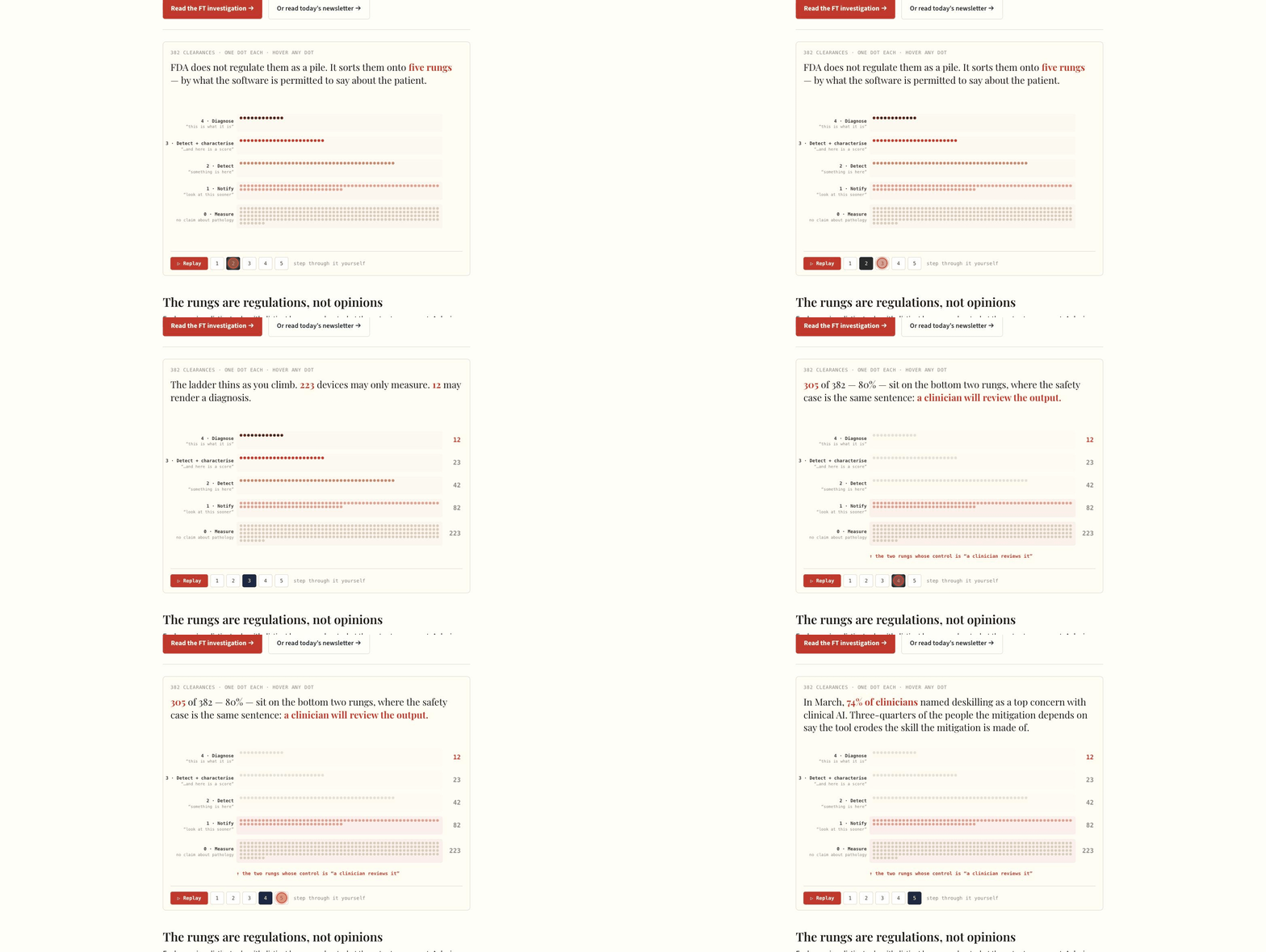
A — Watch the Ladder Collapse — 382 AI-pathway FDA clearances sort themselves onto five rungs of what the software is allowed to say. Four in five land on the two rungs whose safety case is “a clinician will check it.”
B — The Permission Ladder — 382 AI-pathway 510(k) clearances, one dot each, sorted onto the five rungs of what the software is legally allowed to say. The ladder collapses as you climb: 223 clearances at “measure,” 12 at “diagnose.”
📡 Builder’s Radar
FHIR grew a place to put the model card
At HL7 Connectathon 43 on September 19–20, the AI Transparency on FHIR track tested the implementation guide, which balloted in January and is now in reconciliation. It carries model cards inside FHIR resources — CHAI’s and Hugging Face’s both, with no format mandated — and Provenance tagging at the element level, not just the resource.
Element-level is the part to notice: “this sentence came from a model, that one from a human” becomes expressible in the chart itself.
If your tool writes into a record, the standard for saying so in machine-readable form is in ballot reconciliation right now, not two years out.
💡 80/20: Emit one Provenance resource for one thing your tool generates. If you can’t describe your own output in the standard’s vocabulary, that’s the gap.
Clinicians drew the line, and it’s in a strange place
Sarah Neville reported in the Financial Times on September 20, under the headline “Medical AI has a proof problem”, that clinicians accept AI in imaging and diagnostics while pushing back hard on everything past it — documentation, treatment recommendations, patient communication — because the performance data is thin.
The numbers underneath come from a March survey of 355 US doctors and nurses: 74% named deskilling, 74% hallucinations, 72% advertiser-driven bias, and only 27% reported any awareness of AI governance where they work.
The deskilling number is the operational one. Every monitoring plan I’ve read names “clinician review” as the mitigation. Three-quarters of clinicians just said the tool degrades the skill that review depends on. That’s not an ethics finding, it’s a broken control.
😤 “Doctors always say this and adopt it anyway.” They do. The interesting part isn’t the resistance, it’s where it stopped — at the boundary between finding something and deciding something.
The gray zone nobody wants to define
Ben Schwartz, MD, an orthopedic surgeon, writing September 20 on the models he uses: “nearly all of them tend to err on the side of caution and slight catastrophizing.”
That’s a specific, testable failure mode — and the opposite of the one everybody evaluates for. We build harnesses to catch a model missing badness. Almost nobody builds one to catch it manufacturing badness, which in an ED is the difference between a discharge and a $4,000 workup.
⚡ Quick hits
Oura’s $2.2B IPO isn’t a raise — 50 million shares at $40–$44, about $14.1B at the top of the range, but the company is selling only 13.5 million of them and Forerunner is unloading its entire stake. Seventy-three percent of the offering is a cash-out, not capital.
Addiction treatment keeps consolidating — seven closed transactions in H1 2026 against eighteen in H1 2025 — the prior consolidation wave having left fewer sizable targets to buy.
🎙️ From the Pods
🎙️ Health Tech Nerds Radio — “The Grand Roundup” (Sept 21)
A user told an AI assistant to get a restaurant reservation; it hit the Resy API roughly 200 times an hour until it got one, and the user got temporarily banned. Telehealth vendors now see the same assistants messaging them on patients’ behalf.
💡 Builder take: Your rate limits were designed for humans who get bored. Check your per-identity request ceiling and ask what happens when the requester is an agent on a five-minute cron.
🔇 Speaker Blindspot: Appeal to an interested authority. The bearish OpenEvidence read leans on a Doximity earnings-call claim that a major system is banning the product — from a direct competitor, relayed as “I think they said,” unnamed and unchallenged.
🎙️ The Heart of Healthcare — “Can AI Finish What The Quality Revolution Started?” with Dr. Azita Hamedani, Chief Clinical Officer at Bunkerhill Health (Sept 21)
Hamedani walks an agentic incidental-findings workflow end to end: chest CT shows coronary calcification, the agent reasons across contraindications and existing specialists, then auto-generates the cardiology referral, the patient letter and the PCP note.
💡 Builder take: The product isn’t detection. It’s the closure record — proof a flagged finding reached a human with authority to act.
🔇 Speaker Blindspot: False dichotomy, said out loud in four words — “it’s all upside.” Unfollowed findings versus AI follow-up deletes the third option, that some incidentals shouldn’t be chased. Also unasked across 37 minutes: who’s liable when the auto-generated referral is wrong.
💡 BTW
💡 BTW: Dr. Azita Hamedani, Bunkerhill’s new chief clinical officer, spent fifteen years turning emergency medicine at the University of Wisconsin from a division inside Internal Medicine into its own academic department, doubling clinical volume and raising a $10 million endowment along the way. She was its founding chair.
💺 Builder Seats
Just ones I found on LinkedIn that look interesting. No sponsorship. Use at your own risk.
Strategic Medical Director, Inpatient — Cohere Health · Remote (US) · $285K–$305K
Prior auth from inside the company automating it — a rare seat where clinical judgment is the product spec.
🔗 Apply on LinkedIn
You have a unique combination of skills, experience and values. So do great things! … and tell me about them at kevin@clinicians.build.
— Kevin & AI
(please verify content for yourself, partially AI generated and may contain errors)