


Epic paused product development to harden security. Judy Faulkner says the company is focused on safeguarding its system against attacks. Expanded below.
Mass General Brigham isn’t letting AI agents act autonomously across platforms. Claude Cowork is in a pilot there, but only ring-fenced inside MGB’s own environment.
😤 Haters: “That’s just a big system being slow.” It’s a big system that lost track of its own devices during an outage and decided not to repeat that.
Heidi raised $340M, and only $100M of it is equity. The rest is a $240M go-to-market investment from General Catalyst, pointed at “supervised action.”
Abridge won a seat on a $775.72M VA contract. It’s a multiple-award ceiling, not a check.
CMS posted preliminary 2027 lab rates, about 16% lower on average. The money math is in Money Plumbing below.
🎧 Podcast: Radio Advisory — “Inside Sutter Health’s playbook for scaling AI”. Sutter CMIO Veena Jones says the scale signal was pilot clinicians asking “when are my colleagues going to get this?”, and patient and family advisors graded the AI in-basket drafts.
🧭 The Curbside
“Patients are booking with us through Gemini and Amazon’s health AI now. What changed?”
Short answer: Your calendar became an API that someone else’s agent can transact against.
What changed: Zocdoc opened its Care Access Network to any provider on Tuesday. One connection makes a provider bookable across Amazon Health AI, Gemini, Yelp, Healthgrades and payer directories. There’s no booking fee for existing patients or for searches by provider name.
Builder read: Your visit-type rules and intake questions now have to work for an agent, not just a person at the front desk. If a new-patient slot needs a referral, someone has to encode that.
🔮 My bet: by mid-2027, “agent-bookable” shows up as a line item in practice RFPs, next to “EHR-integrated.”
🔬 The Big Thing
What does it mean when the EHR stops shipping features to go look for its own holes?
Epic has paused product development while it makes sure its systems can’t be exploited. Judy Faulkner framed it as preventing attacks.
The full story is paywalled. Scope and duration aren’t public yet, and I’m not going to guess at them.
The context is. Since spring, health system CIOs have been bracing for AI models that shrink the gap between finding a flaw and exploiting it. Corewell Health’s CISO, Scott Dresen, put it plainly: the new models don’t create new risks, they shorten the time between discovering a flaw and exploiting it.
The scarce resource at the biggest EHR company this fall isn’t engineers. It’s confidence that what’s already shipped can’t be turned against a hospital.
😤 “This is PR after the AI-feature backlash.” Maybe. But pausing a roadmap is about the most expensive press release a software company can write.
😤 “This slows everyone down.” Yes. For now, that’s the point.
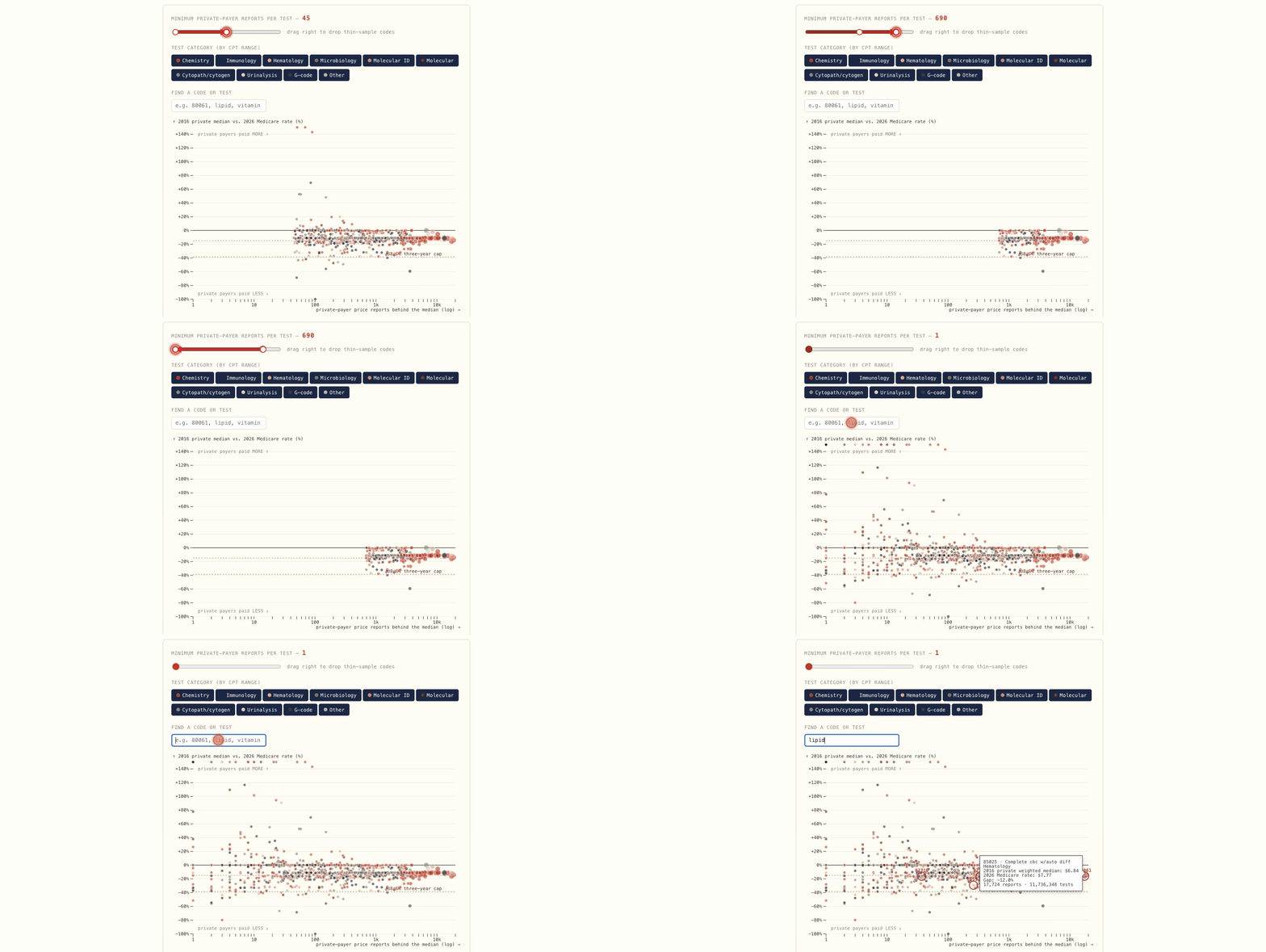
🧪 Try the interactives — both built with real CMS lab-pricing data:
A — How a Lab Price Is Made — 17,372 private-payer prices for one lipid panel, and the single Medicare number they collapse into. The volume-weighted median, drawn.
B — The Unfinished Cut — 942 lab tests, one dot each: the private-payer weighted median from the first PAMA round (2016 data) against what Medicare pays in 2026. Most of the gap CMS is about to close was already there.
📡 Builder’s Radar
Only $100 million of Heidi’s $340 million is equity
Heidi’s $100M Series C values it at $900M. The other $240M is a growth investment from General Catalyst’s Customer Value Fund to pay for go-to-market. The stated goal is moving “from documentation into supervised action.”
Heidi says it will also invest in clinical evidence, quality management and regulatory submissions. That’s what agentic features in healthcare require, and it’s rarer to see it in a funding announcement than it should be.
“Supervised” is the word doing the most work in that release.
🔮 My bet: within 12 months an ambient vendor files an FDA submission for an agentic feature. Scribes that act start to look like devices.
Abridge won a hunting license, not a contract
The VA contract is a five-year, multiple-award IDIQ with a $775.72M ceiling shared by all eligible vendors. Each medical center or regional VA network places its own task orders. Abridge came in through a distribution partner and already runs at 75+ VA medical centers.
The moat wasn’t the model. It was running on VistA/CPRS and the Oracle-based Federal EHR at the same time, in the middle of a migration.
😤 “$775 million is a big win.” It’s a ceiling shared with competitors. The revenue is a hundred local decisions.
⚡ Quick hits
Benji Graham (FHIR architect, HL7 certified educator) says his FHIR Department forum is near 900 members and made the agenda at an HL7 working group meeting. A grassroots community for the people who actually write the resources (via LinkedIn).
💰 Money Plumbing
The weighted median: how a reporting sample becomes a national lab price
Under PAMA, labs report what private payers paid them for each test, and Medicare pays the volume-weighted median. The preliminary 2027 file covers 1,528 of 1,947 codes from 6,411 reporting labs and averages about 16% lower.
The spread is the lesson. Genomic sequencing drops 23% and molecular pathology 22%, but proprietary lab analyses (PLA codes) fall only 2.4%. Cuts are capped at 15% a year for 2027–2029, which compounds to roughly 38.6% over three years.
If your CDS nudges an order or your RPM program depends on a panel, those unit economics just moved. Comments go by email within 30 days of posting, and final rates publish in November.
🎙️ From the Pods
🎙️ The Gist — “Examining physician payments tied to GLP-1 drugs”
Washington Post data reporter Lydia Sidhom walks through more than $270 million that Lilly and Novo paid prescribers from 2018 to 2025, reaching roughly 270,000 of them. The limit she names is the useful part: Open Payments shows who got paid, not what they prescribed.
💡 Builder take: Open Payments is free and public. Joining it to prescribing data is a real weekend project, and nobody hands it to you pre-joined.
🔇 Speaker Blindspot: The bias blind spot. The highest-paid prescribers describe the money as peer education, and self-assessment is exactly where influence research says people are least reliable.
💡 BTW: Heidi CEO Thomas Kelly trained in vascular surgery, and before Heidi he ran a company tutoring medical students in clinical skills. He was a teacher before he was a founder.
You have a unique combination of skills, experience and values. So do great things! … and tell me about them at kevin@clinicians.build.
— Kevin & AI
(please verify content for yourself, partially AI generated and may contain errors)