

⚡ Around the Wards
Duke Health built its own chart reader rather than wait for a vendor — Scout reads years of notes, labs and imaging and returns a source-linked summary in one to three minutes; a preprint RCT found ~40% faster task completion and 40–50% lower cognitive workload. Enterprise-wide since early July.
Roughly 80 AnMed sites went dark after a malware attack — the four-hospital South Carolina system closed its medical group offices and its imaging services while EDs and urgent care stayed open. Offices reopened Tuesday with the network still down. Downtime is a clinical event, not an IT event.
A practice-management vendor breach exposed more than 425,000 patients — Unlimited Technology Systems, one vendor, many unrelated provider organizations, one blast radius.
🎧 Podcast: The Heart of Healthcare — “Why We Demand Perfect Machines Yet Tolerate Human Carnage” — Jonathan Slotkin, neurosurgeon and Geisinger CMO for strategy: being safe and feeling safe are two different engineering problems, and healthcare learned that the expensive way.
🧭 The Curbside
“A vendor told me their clinical AI is ‘validated.’ What should I actually make them show me?”
Short answer: Ask which cases, held by whom, scored inside what harness. If any of those three answers is “public benchmark,” they haven’t answered you.
What changed / Evidence: Outside healthcare, Legora published its BAR writeup this month — a benchmark drawn from a corpus of ~5,100 real legal cases across 28 practice areas, each reviewed by a legal professional. BAR itself is a private subset of a few hundred of them, deliberately not open-sourced to prevent contamination (one synthetic case is public so you can see the shape), and scored end-to-end inside the production harness rather than a sandbox.
Builder read / Watchout: That’s the shape clinical eval should be and mostly isn’t. A MedQA score tells you the model can pass a test written for humans; it tells you nothing about your harness, your retrieval, your prompts, or your patients. The watchout cuts both ways — a private corpus is uncontaminated and unauditable, so “trust us, it’s held out” is a claim you can’t check either.
“We want to put an MCP server in front of our FHIR data. Is that safe?”
Short answer: The protocol isn’t the risk. The auth layer is, and most MCP tutorials skip it entirely.
What changed / Evidence: PropelAuth published a full walkthrough of OAuth 2.1 with MCP, including the token-handling and scoping details that a “connect your EHR to Claude in five minutes” demo leaves out.
Builder read / Watchout: Distinguish clearly between demoing against a synthetic FHIR sandbox (fine, do it tonight) and pointing anything at production PHI (needs a BAA, scoped tokens, an audit trail, and your security team’s signature). The MCP ecosystem is maturing fast on capability and slowly on identity. Nothing about running a model locally or self-hosting a server changes the BAA question — that’s a contract, not an architecture.
🔬 The Big Thing
Duke spent ten years on the plumbing. The language model took months.
Duke Health put Scout into general use across the enterprise in early July — an in-house tool that reads a patient’s entire record, years of notes, labs, imaging and pathology, and returns a synthesized summary in one to three minutes, inside Epic, with every claim linked back to its source document.
They ran a controlled trial first, then a three-month pilot: 200-plus users across 20-plus specialties, 6,600-plus interactions. Pre-visit planning, discharge summaries, tumor board prep. Training is required before you get access.
The number that will get quoted: the preprint RCT found clinicians completed tasks 37.6% faster, with significantly lower perceived workload — the biggest drops in mental demand, effort and time pressure. Chief digital officer Jeffrey Ferranti, MD told Becker’s the summaries came out “as good or better than our senior clinicians.”
But the number that should get quoted is ten years.
Duke didn’t build a summarizer. Duke spent the better part of a decade building secure programmatic access to its own EHR data — SMART on FHIR panels inside Epic, the governance around who can touch what, the treatment-relationship gating. Then the models arrived and, in Ferranti’s words, “layering a large language model on top of it and making it secure and safe for our providers to use was not as heavy a lift as you might imagine.”
That sentence is the whole thesis of this newsletter with the polarity flipped. We keep saying the engineering barrier collapsed. It did — for the model layer. The part that didn’t collapse is access to the data, and the institutional patience to build it before there was anything to put on top.
😤 “This is Epic’s summarizer with a Duke sticker on it.” No. Epic’s runs off Epic’s model of your chart. Scout runs off Duke’s own data-access layer, with Duke’s own prompts, tuned per specialty, and Duke tracks how those prompts perform in practice. That last clause is the difference between a feature and a product — somebody at Duke owns whether the tumor-board prompt is still good in November.
😤 “A preprint isn’t evidence.” Correct. It’s an RCT that hasn’t been peer reviewed, from the institution that built the thing, reporting on its own tool. Read it as a strong signal and a weak proof. Also notice what it measured — speed and cognitive load, not a patient outcome, not a missed-finding rate.
❓ If the moat is the data-access layer and not the model, who sells the data-access layer? Duke built theirs over a decade because nothing existed. I keep thinking there’s a company in the gap between “we have Epic” and “we can programmatically reach our own records safely” — something between an integration consultancy and a product. I can’t quite see its shape yet.
🧪 Try the interactives:
A — One Vendor, Many Letters — sixteen years of large healthcare breaches reported to HHS, replayed month by month, and the three moments when a single vendor incident surfaced as dozens of separate filings under other organizations’ names. Built with real HHS OCR breach data.
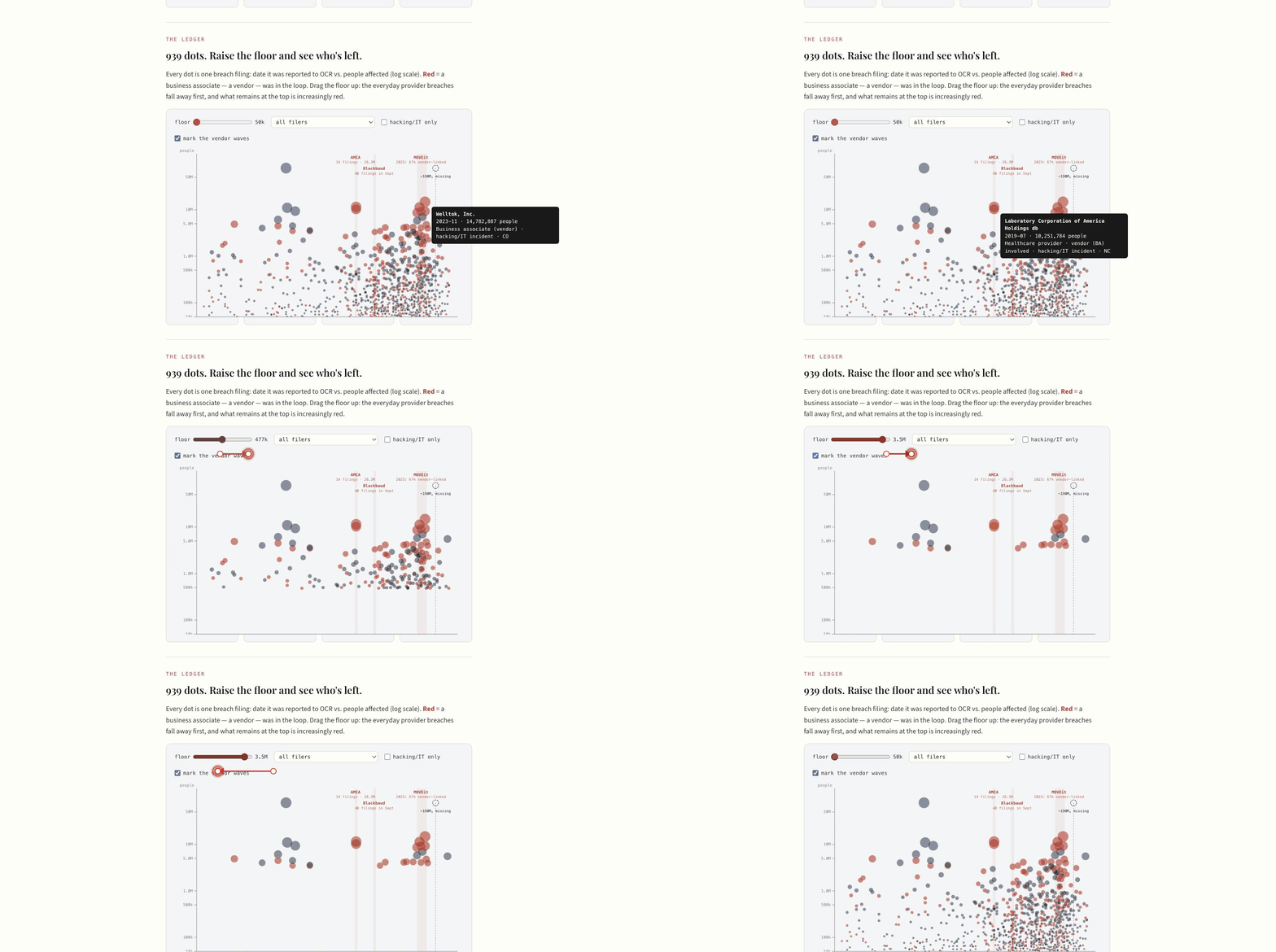
B — The Blast Radius Ledger — every large breach reported to the HHS Office for Civil Rights since 2009, 939 filings of 50,000+ people and 586 million records, on one brushable scatter with vendor-linked breaches in red: their share of affected people grew from 18% to 63%. Built with real HHS OCR breach data.
📡 Builder’s Radar
Roughly 80 sites went dark, and the ED stayed open
AnMed closed its medical group offices — which reach from upstate South Carolina into Hartwell, Georgia — along with all five of its South Carolina imaging sites on Monday after confirming a cybersecurity disruption involving malware. Urgent care, kids care, integrated therapy and labs stayed open; EDs kept seeing patients. Counts vary by outlet — 79 of 106 facilities, “more than 80,” “dozens.” AnMed itself has published no number.
That split is the whole story. The parts of the system that can run on paper ran. The parts that can’t, closed.
And the sequel makes the point twice: physician offices reopened Tuesday while phones, internet and computers were still down, clinical teams working on downtime procedures, patients asked to bring their medications in the original containers. A dozen sites — imaging, radiation oncology, sleep and cardiac diagnostics, women’s diagnostics — stayed shut. The reopening is sorted exactly along the same line as the closure.
Every tool you build is one of those two things, and you get to choose which.
😤 “Downtime procedures are an IT problem.” They’re a clinical problem wearing an IT badge. If your tool has no degraded mode, you have written a workflow that deletes itself under stress — which is exactly when the workflow matters.
A physician wants the EHR to record the moment he overruled the safe answer
Doug Fullington, a practicing internist, argues that charts capture the world after a decision and never the decision itself — specifically the moment a clinician judges the guideline-supported “safe” option insufficient and does something else. He proposes a four-part schema: the expected default, what was actually chosen, what changed the threshold, and what happened next.
His two cases are the kind you recognize immediately: an “unlikely” DVT that was real, and a portal refill request that wasn’t routine.
Every clinical AI is trained on the output of decisions and blind to the judgment that produced them. This is a data model for the missing column.
(Disclosure in his post: he holds a stake in a clinical-intelligence company.)
💡 80/20: Add the refusal field to whatever you’re building this week. When your tool proposes something and the user does otherwise, capture why in one free-text box and one structured reason code. That log is the most valuable dataset in your product and almost nobody is collecting it.
Digital mental health for kids: the hybrid works, the app-only mostly doesn’t
A meta-analysis of 57 studies covering 43,973 children and youth, out yesterday in npj Digital Medicine, found universal low-intensity digital mental health interventions produced small but statistically significant effects on 9 of 16 pooled effect sizes — and that hybrid formats, in-person plus digital, showed more consistent and better-sustained benefit than purely virtual delivery. The authors are careful in a way the headline won’t be: most pooled findings were low-certainty evidence, and the hybrid advantage at follow-up is moderate-certainty.
😤 “So digital mental health doesn’t work.” It works less than the deck said and more than the cynics said. The finding isn’t “don’t build” — it’s “don’t build the standalone app.” The delivery model is the intervention. If your product only works when a human is also in the loop, that’s not a weakness in the product, that’s the product.
Ultra-short: Flourish Health raised a $26M Series A led by B Capital with F-Prime and Cherryrock, to scale intensive in-home and community youth behavioral healthcare. High-touch clinical labor as the product, software as the margin.
🎙️ From the Pods
🎙️ The Heart of Healthcare — “Why We Demand Perfect Machines Yet Tolerate Human Carnage”
Jonathan Slotkin, MD — neurosurgeon, Geisinger’s CMO for strategy and growth — reads his Noema essay on why autonomous vehicles keep winning on safety data and losing on trust, and maps it directly onto thirty years of hospital patient-experience work. The trust-killers patients name are almost never clinical errors; they’re the used bandage on the floor, the bloodstain on a scrub top. During San Francisco’s December signal blackout, when traffic lights went dark across a third of the city, Waymos behaved exactly as coded — treating dead signals as four-way stops, queuing for remote confirmation faster than the ops team could clear it — and the phone video of them sitting frozen with their hazards on became, in his phrase, the bandage on the floor of a self-driving car. He’d argued in the New York Times a month before that resistance to these vehicles was an ethical failure costing lives. Then in January he sat in one that stopped for a construction dumpster and wouldn’t move through a green light, and he couldn’t tell whether the remote agent or the car had solved it.
💬 Standout Quote
“Being safe and feeling safe are not the same”
🔇 Speaker Blindspot: Special pleading. He calls AV crash counts “a numerator with no denominator” and demands a federal reporting mandate — then builds his own safety case on the one company’s self-published miles, on geofenced, mapped, mostly low-speed roads, against an all-roads human baseline. Mandatory verification for everyone else; voluntary self-report is fine for the incumbent whose data he needs.
🎙️ The Gist Healthcare Podcast — “Rethinking patient safety through the lens of access”
Victor Hassid, MD, MBA — plastic surgeon and AVP of access strategic operations at MD Anderson — describes reclassifying “a patient called and did not leave with an appointment” as a never event, the same category as wrong-site surgery. It’s the operational version of his recent JAMA Viewpoint, Patient Safety Begins With Access. Enterprise median days-to-appointment-offer went from five days to two, and to a single day for patients who’ve had no prior care and arrive with the fewest records. The mechanism wasn’t software. It was putting the clinicians who own the scheduling logic in the same room as the people running the phones.
🔇 Speaker Blindspot: Texas sharpshooter, with a side of composition fallacy. The headline metric is median days to appointment offering — a process measure — not time to treatment or any outcome. And a single NCI-designated cancer center with global self-referral and no capacity crisis is not the system that would have to adopt this.
🎙️ Podnosis — “HaloMD’s Patrick Velliky explains why No Surprises Act IDR enforcement matters” (sponsored episode — worth knowing before you weigh the argument)
The arbitration process under the No Surprises Act is legally binding but has no private right of action, and roughly 45 federal court decisions have gone against physicians who sued to collect. So some payers simply don’t pay awards they lost. Physicians are paid in arrears; insurers collect premium in advance and earn float on every unpaid day. The worst case for a non-compliant payer is eventually paying exactly what it already owed.
🔇 Speaker Blindspot: Availability heuristic plus a conspicuous omission. The central claim rests on unnamed payers and undisclosed samples — “examples that we are aware of directly,” no denominator. And he never mentions provider-side IDR gaming, batching or volume flooding, which is unsurprising given that his company’s revenue scales with dispute volume and paid for the episode.
🧰 Builder’s Tip
Weekend project: turn a public clinical guideline into an agent skill.
You have a specialty guideline PDF you re-read four times a year. Convert it once into a structured skill your agent can load on demand, instead of pasting the whole thing into context every time.
book-to-skill is an MIT-licensed skill that takes a technical PDF and produces a SKILL.md carrying the core mental models and a chapter index, plus a chapters/ file per chapter and a glossary, a patterns file and a cheatsheet — all in the open Agent Skills format that Claude Code, GitHub Copilot CLI and Amp all read. Per-chapter loading means a 200-page document costs tokens proportional to the question, not the page count.
git clone https://github.com/virgiliojr94/book-to-skill.git ~/.claude/skills/book-to-skill
Then point it at something public and clinically real — a society guideline, a CMS manual chapter, an FDA guidance document. Nothing you use here touches a patient.
Friday night: convert one guideline. Saturday: write ten synthetic cases, including three where the guideline’s answer is wrong for the patient in front of you. Sunday: run all ten and read the failures. By Sunday night you’ll know something concrete about where retrieval breaks on your own specialty’s literature — and you’ll have a reusable artifact, not a chat log.
What are you building this week? Email and tell me (kevin@clinicians.build) — I read every one.
— Kevin & AI