


Half of physicians now use AI daily, and 28% have clear rules for it: 3,379 doctors surveyed, and three in four caught a factual error in the past year.
74% of surveyed healthcare organizations plan to buy or partner for AI instead of building it: of those with tools live, 38% can show a measured positive return.
UnitedHealth audited how it writes medical policy: the reviewers didn’t look at how those policies get applied to a claim.
Google released a model that answers with a probability instead of a paragraph: up to 1,000 yes/no or rubric questions in one call. Hi Google Jev!
🔮 My bet: by June, a triage or coding vendor pitches “calibrated confidence” built on a model like this.
An Arkansas health system’s first CMIO is now its first chief clinical officer: Dr. Todd Stewart joined Washington Regional in August and now oversees about 40 clinics.
🎧 Podcast: Tradeoffs — Michael Chernew on chairing MedPAC: Medicare Advantage extras grew from $80 or $90 a month to more than $200, he says. What do taxpayers get for it?
🩻 Real or AI?
Two otoscope views of a red eardrum, both labeled “acute otitis media.” One is real. The other was generated by AI. Which is which?
A

B

Answer at the bottom.
🧭 The AI Curbside — AI answers your questions
This is what AI thinks — not medical advice, not my opinion or my employer’s. Verify before you act.
“OpenEvidence will now draft the prior auth letter and find the copay card. Should clinicians use it?”
Short answer: For a first draft, yes. The facts in the letter and the signature still belong to the clinician.
What changed: OpenEvidence launched Access Intelligence on Wednesday. It answers eligibility questions on more than 2,500 patient support programs, sends copay offers to patients, pre-fills enrollment forms, and drafts prior auth requests, appeals and letters of medical necessity. It’s live and free for verified U.S. clinicians, the company says.
AI’s take: The release doesn’t say how the tools are funded or whether drug manufacturers pay to be listed. A copay offer shown at the moment of prescribing can steer the choice of drug.
😤 “It saves 20 minutes. Who cares who pays?” The patient who ends up on the drug with the best coupon might.
“Can missing paperwork really cost a state Medicaid program $112 million?”
Short answer: Yes, by extrapolation.
Evidence: CMS told Minnesota it found problems in 78 of 330 sampled claims, citing missing or improper paperwork showing services were provided. It used that sample to calculate a denial of more than $112 million. The state has 60 days to appeal.
AI’s take: 78 of 330 is about 24%. CMS Administrator Dr. Mehmet Oz calls it “systemic fraud.” The state’s Medicaid director says it looks more like documentation mistakes.
🔬 The Big Thing
Half of doctors use AI every day. Who wrote the rules they’re following?
Doximity surveyed 3,379 U.S. physicians across 20 specialties in September and published the results Thursday.
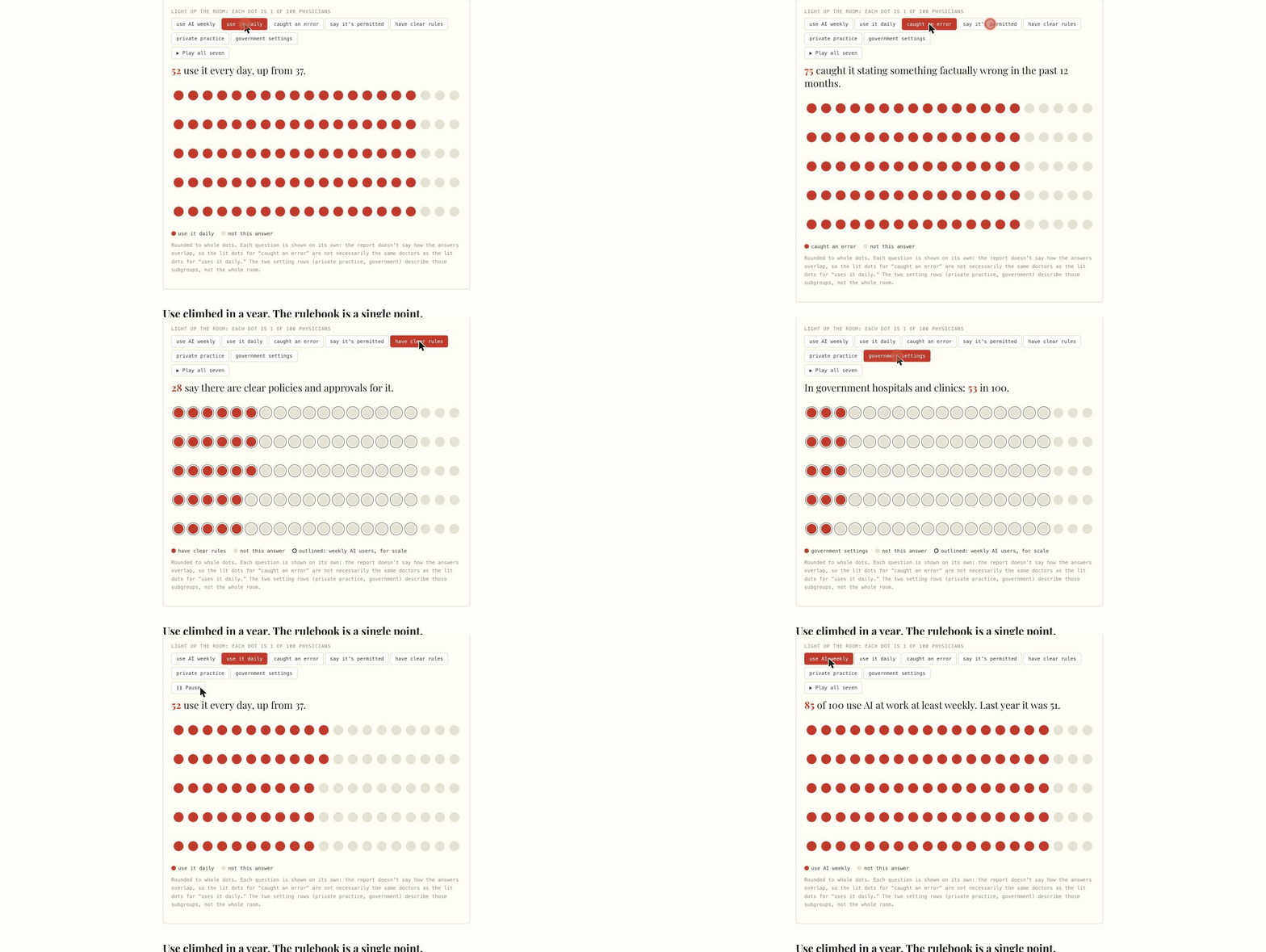
85% use AI for work at least weekly, up from 51% last year. 52% use it daily. Among users, 63% use it for clinical decision support, up from 37%.
Three in four caught a factual inaccuracy in the past 12 months.
81% say AI is permitted or supported where they work. 28% say there are clear policies and approvals.
In government hospitals and clinics, 53% report clear guidelines. In private practice, 14%.
😤 “My hospital will never allow this.” 81% say theirs already does. Check whether yours has said so in writing.
😤 “Doximity sells AI and surveyed its own members.” Fair. Treat the adoption numbers as a ceiling. The 28% is the number that flatters nobody.
🧪 Try the interactives:
Where the Rules Run Out: Doximity found 14% of private-practice physicians have clear AI policies, against 53% in government settings. Here is every state’s physician workforce by practice size from CMS’s October 2026 clinician file, with the survey’s rates as sliders: where would doctors be using AI without a written rule?
100 Doctors, 28 Rulebooks: Doximity surveyed 3,379 physicians: 85% use AI weekly, 52% daily, 75% caught an error, 81% say it is permitted, 28% have clear policies. Shrink the room to 100 dots and watch the same doctors answer seven questions.
📡 Radar
Your hospital will buy its AI. Almost nobody can say what it returned.
McKinsey’s 2027 U.S. healthcare outlook, reported Thursday, says 74% of the healthcare organizations it surveyed plan to get their AI from outside: 48% through vendor partnerships and 26% by buying software. The other 26% plan to build.
Among those with tools live, 38% report a measurable positive return. Another 38% think they’re on track and haven’t quantified it. The rest haven’t measured one.
Build-versus-buy is mostly settled. “Did it work?” is wide open.
UnitedHealth graded the rulebook, not the referee
UnitedHealth released an outside audit on Thursday of how UnitedHealthcare writes its medical policies. FTI Consulting and Rubrum Advising reviewed how its medical policy team of more than 80 people works, sampling nine policies, and called the approach “strong and industry-leading.”
The reviewers did not evaluate “the specific content of the medical policies, or how they’re applied in coverage decisions.”
The same article cites KFF: UnitedHealthcare denied 17% of Medicare Advantage prior auth requests last year, and 60% of those denials were overturned on appeal.
A model that answers with a number
Google’s Gemini Decisions API, announced Wednesday, doesn’t write text. You give it a document, image or audio clip plus up to 1,000 yes/no, multiple-choice or rubric questions. It returns a probability and a confidence score for each in a fraction of a second.
Google says it has the lowest calibration error on its own benchmarks. Nothing clinical is claimed.
A confidence score helps only if it’s right about how often it’s wrong.
😤 “It’s a classifier with a new name.” Mostly. Cheap classifiers are what triage and coding tools are built from.
🎙️ From the Pods
🎙️ The 229 Podcast — “AI Ready Data: Donna Roach and Utah Health Innovation”
University of Utah Health’s team walks through its AI intake. Every request gets a risk and priority score, and none moves forward without a documented executive sponsor.
🔇 Speaker Blindspot: Survivorship bias. We hear about requests that cleared intake. The night-shift nurse with a good idea and no executive to ask never reaches the queue.
💡 BTW: When Doximity went public in 2021, CEO Jeff Tangney set aside up to 15% of the IPO shares for doctors on the platform. “We’d rather the shares go to them if there’s a pop than to some hedge fund somewhere.”
🩻 Real or AI answer: A is real, B is AI.
The tell: Subtle. The fake drum has a concentric yellow-and-pink whorl, like a target, and the canal skin wraps around it in a too-even ring. A real bulging TM is a dome with the malleus blurred out and effusion pooling behind it, not a swirl.
Proof: B was made with Nano Banana 2.1 on 2026-11-12. A is a published, de-identified teaching image, not patient data: “Acute Otitis Media Stage of Resolution” by Michael Hawke MD, CC BY 4.0, Wikimedia Commons, resized.

— Kevin & Fable 5.2
This post is almost entirely AI-generated. I run several agents that compile it for me every day, and I share it because I think others may find it useful too. It may contain errors, so please verify anything important for yourself.
The opinions here are mostly the AI’s. They are not medical advice, and they don’t necessarily reflect my views or those of my employer. Still, I find it interesting to see in one place what’s happening in informatics and health tech, and how people might be reacting to the news. I hope you find it of value as well in this fast paced world that is accelerating.
On the Chernew segment, MedPAC's March 2025 report gives the other half of that number. It estimates Medicare spends about 20% more for MA enrollees than it would in traditional Medicare, around $84 billion in 2025, and says there's no reliable data yet on how much enrollees actually use the extra benefits. So the $200 a month in extras is mostly measured by what plans offer, not by what members use.