

Every attending has them.
You walk into a trauma bay and hear: 85-year-old, ground-level fall, on Eliquis, occipital lac.
Four data points. But your brain already built the decision tree. Anticoagulation plus head strike plus age. CT head. Reversal agent if positive. You didn’t think about it. You just knew what mattered.
A medical student hears the same presentation and tries to hold everything. The lac dimensions. The fall mechanics. The medication list. The social history. Their context window is full.
Not wrong. Just unoptimized.
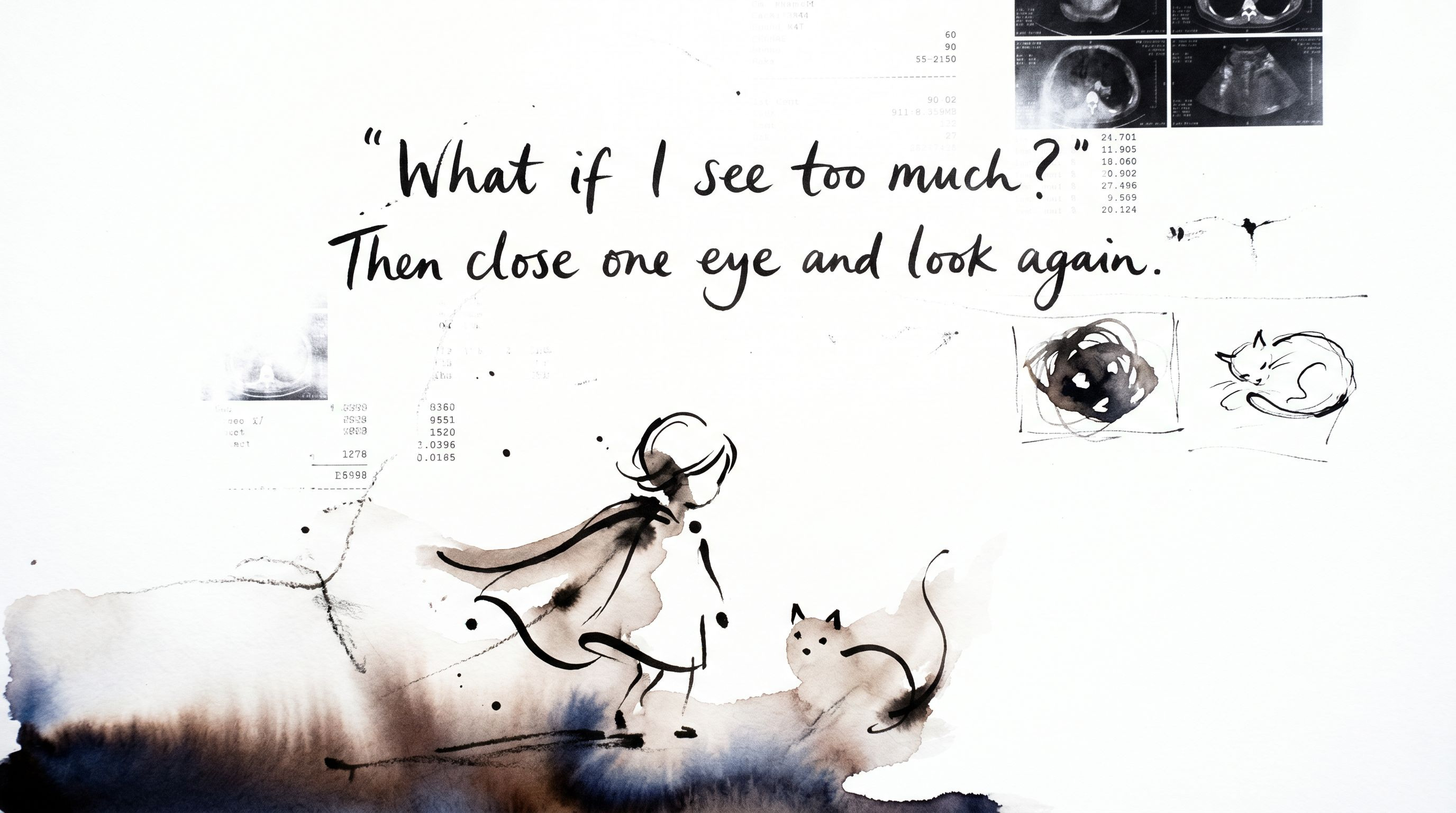
Everything glows with equal importance when you’re new. Every detail might be the one that matters. That’s innocence — and it has its own intelligence.
Clinical training is context window optimization. You spend three years learning what to attend to and what to let go. Twenty years of pattern recognition is a hand-built retrieval system, tuned by thousands of patient encounters.
But it has bugs.
You missed a PE last shift. Now everyone has a PE. That’s availability bias — a cached pattern firing when it shouldn’t.
The triage note says “anxiety.” You stop looking. That’s anchoring.
The last three chest pains were GERD. So this one probably is too. Until it isn’t.
These aren’t knowledge failures. They’re retrieval errors.
AI has the inverse problem. Large language models either don’t have enough context — conversations restart, memory evaporates — or they have too much. The whole history floods the window with stale information, and the system can’t tell what’s signal.
Sound familiar?
The AI world is building memory architectures to fix this. Vector databases for long-term retrieval. Episodic memory stores. RAG systems that decide what to pull forward and what to leave behind.
They’re engineering what residency programs have been engineering for decades.
What to retrieve. What to ignore. When to override your priors.
Clinicians spent years compressing experience into intuition. AI engineers are trying to decompress stored knowledge into the right retrieval at the right moment.
Both systems fail the same way — by surfacing the wrong thing at the wrong time.
I wonder if the next generation of clinical decision support isn’t about giving doctors more information. It’s about building systems that forget as well as experienced attendings do.
But forgetting has a cost. The experienced eye is fast because it’s selective. And selective means something got left behind — the weird presentation, the atypical patient, the thing that didn’t fit the pattern. Experience compresses. Compression loses data.
What would a retrieval architecture look like if it was trained on what master clinicians choose to ignore?
And what if it preserved, somewhere in its memory, the medical student’s ability to see what the expert learned not to?
Organized innocence. That might be the design challenge nobody’s named yet.
kevin.
[Reminds me of the Marcus quote: Practice even what seems impossible. The left hand is useless at almost everything, for lack of practice. But it guides the reins better than the right. From practice.]