


A continuous AI sepsis monitor got a Medicare payment pathway — hospitals can bill starting October 1. (The Big Thing, below.)
Ochsner handed its AI program to an ER doc who still works shifts — Alexander Fortenko, MD will lead data science, the AI Center of Excellence and the CMIO group across 47 hospitals.
Robots that round, take contactless vitals and write the note raised $14M — running in US skilled nursing facilities since August 2025.
🔮 My bet: the contested part won’t be the robot. It’ll be the write path into the chart, and somebody’s governance committee is about to find it has no policy for a non-human author.
Build the AI audit trail now, before anyone asks for it — model versions, prompt versions, retention, legal holds. Cheap on day one, archaeology on day four hundred.
🎧 Podcast: The 229 Podcast — “The Winners Don’t Have the Most AI” — Alan Gabriola (CTG) on why the organizations pulling ahead aren’t the ones with the biggest model portfolio.
🔬 The Big Thing
Nobody was waiting for a better sepsis model. They were waiting for someone to pay for it.
Bayesian Health announced Wednesday that its FDA-cleared continuous sepsis monitor was approved for a Medicare New Technology Add-on Payment under the FY 2027 inpatient rule. Hospitals can bill for it starting October 1 — up to $61.84 per eligible case, across an estimated 739 MS-DRGs, for up to three years.
Bayesian says it’s the first continuous sepsis monitor to hold an FDA clearance and a Medicare reimbursement pathway at once. The clearance came in April.
That gap — April to September — is the part almost nobody building clinical AI plans for.
We’ve spent three years arguing about model performance. The actual gate is a line item in a 2,000-page payment rule.
Look at what else came through the same door. CMS approved 19 new technologies in the FY 2027 IPPS final rule — three through the traditional pathway, sixteen through the alternative one. One of the sixteen, announced this week, is a peripheral stent whose platform was designated a Breakthrough Device in January 2020. Six years from designation to a payment code.
And in that same rule, CMS finalized the closing of that alternative pathway. Starting with FY 2028 applications, everyone has to prove substantial clinical improvement again — with one exception: if your device holds a Breakthrough designation as of September 30, 2026, you can still use the old door through FY 2029.
That is four weeks away. Bayesian and the stent both came in on the pathway now being repealed.
😤 “82% sensitivity is a coin flip with a marketing budget.” Sensitivity isn’t the number that hurts you — positive predictive value is, and across 53 sepsis-prediction studies the pooled positive predictive value is 34.2%. An add-on payment attaches to cases where the technology was used, not where the alert was right. Different denominators, and only one shows up on the invoice.
😤 “$61.84 is a rounding error against a DRG.” It is. It’s also the only line in the Medicare payment system with your product’s name on it, and the first one anybody has drawn for continuous monitoring software.
❓ There is no outpatient equivalent. If your tool watches a patient in a clinic instead of a bed, the doors are a Category III code and a fee schedule cycle — both slower, neither built for software that changes monthly. What gets built in that gap?
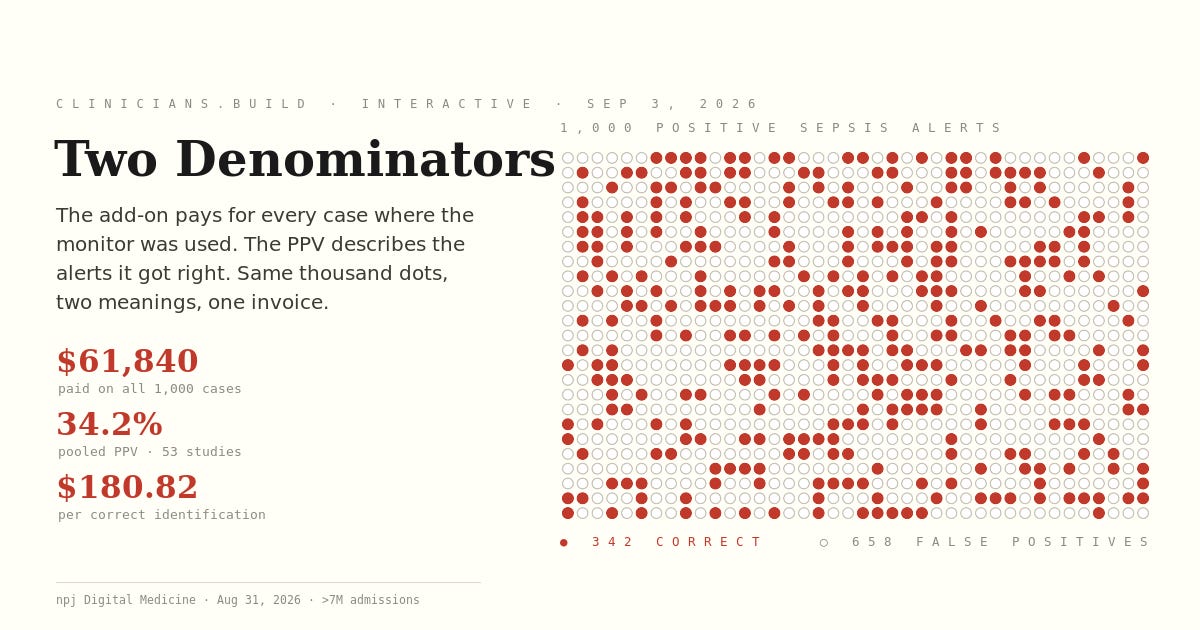
🧪 Try the interactive: Two Denominators — the add-on pays for use, not for being right — A thousand dots, colored two ways: one coloring is what the Medicare claim counts, the other is what the sepsis alert actually got right, and only one of them shows up on the invoice. Built with real CMS data.
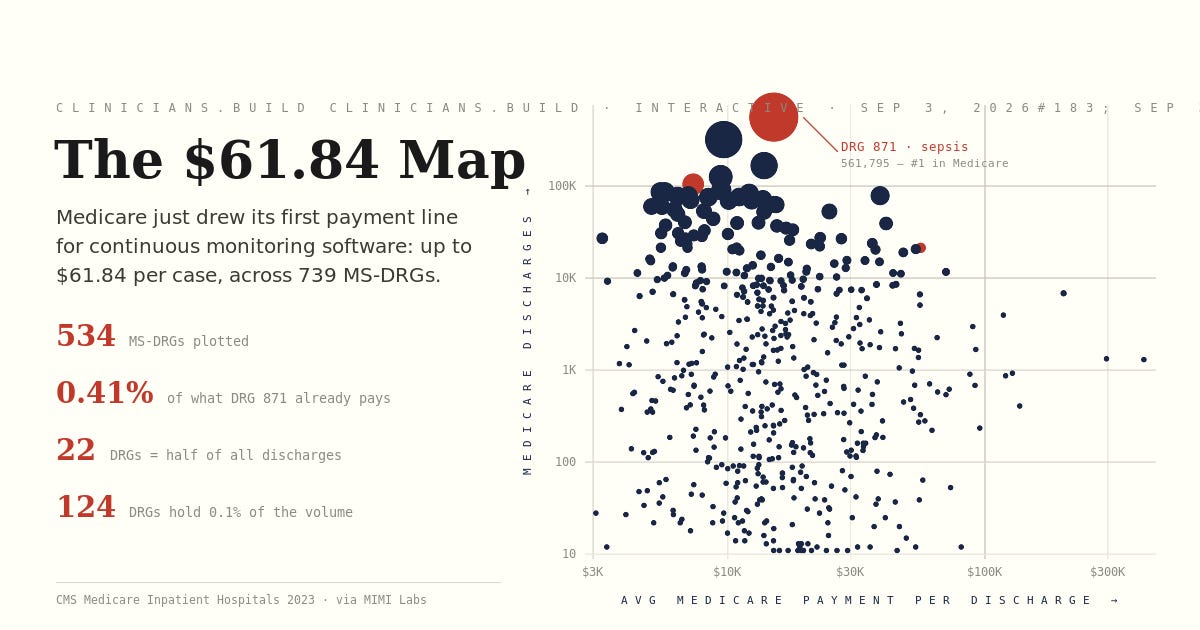
🧪 And the companion: The $61.84 Map — where a Medicare add-on payment actually lands — All 534 MS-DRGs in Medicare fee-for-service inpatient, plotted; drag the add-on amount and a volume floor and watch the “739 eligible DRGs” collapse into about twenty that matter. Built with real CMS data.
📡 Builder’s Radar
An emergency physician just got the keys to a 47-hospital AI program
Ochsner Health named Alexander Fortenko, MD its VP of Innovation, leading the direction of its data science team, its AI Center of Excellence and its CMIO group across 47 hospitals. He came from NewYork-Presbyterian and Weill Cornell — and the release is explicit that he keeps seeing patients in the emergency department, because “maintaining an active clinical practice is central to his approach to innovation.”
The person deciding what gets deployed is the person who uses it.
That’s the shortest feedback loop between an alert threshold and its human consequence, and most health systems have engineered it out of the org chart.
The robot rounds, takes your vitals, and writes the note
Norbert Health raised a $14M Series A for a physical-AI control system that runs on partner robot hardware — rounding, contactless vitals, patient requests, and, in the company’s words, documenting “every encounter into the EHR.”
The interesting claim isn’t the robot. It’s the last three words.
🔮 My bet: the fight in 2027 isn’t whether a machine can take a blood pressure. It’s whether a non-human author can sign a vitals entry, and whether your EHR’s attestation model has a row for that.
⚡ Quick hits
41 adherence studies reviewed, and the problem was never the model — a systematic review in npj Digital Medicine found 71% raised serious concern on development quality and 80% carried high risk of bias in evaluation. Discrimination didn’t reliably improve with more complex algorithms.
😤 “Another paper telling us to do better statistics.” Yes. Read the risk-of-bias criteria anyway — it’s a free checklist for what your own eval is skipping.
Elucid raised $55M in a Series D to push BioIntegrated FFR-CT — the blood-flow half of its stack — through FDA review. Its plaque-quantification product, Plaque-IQ, is already cleared: characterization off a CT you already ordered.
Marit Health has 100,000+ clinicians sharing what they’re paid — co-founder and CEO Vikas Sabnani, ex-Glassdoor, ex-Transcarent, on the Pear Healthcare Playbook: 15 months, ~50 health-system and group partners, 36,000+ salary submissions growing about a hundred a day. Comp opacity survived this long because everyone downstream of it benefits from the fog.
🎙️ From the Pods
🎙️ The 229 Podcast — “The Winners Don’t Have the Most AI”
Alan Gabriola (VP of Healthcare, CTG) argues the constraint isn’t model capability — it’s the operating model and the governance around it. Host Bill Russell frames the setup with an example that lands harder than the answer: a health system that had to have the difficult conversations about standardizing physician schedules, versus everyone else who kept kicking that can down the road. You can’t sprinkle intelligence onto a process nobody standardized.
“The winners of the AI era isn’t the organizations that has the most AI.” — Alan Gabriola
💡 Builder take: Before you demo, ask what the current process looks like when two people do it. If the answer is “differently,” your pilot measures variance, not your tool.
🔇 Speaker Blindspot: Survivorship bias. Weighing his own options, he says he was humbled to find no fewer than a dozen people at CTG for whom it was their first and only job — but that counts only the ones who stayed, which is exactly the population that can’t falsify the claim.
🎙️ Podnosis — “The stories behind the 2026 Fierce 50”
Ayla Ellison walks through seven of the fifty honorees. The one that lands for builders is Lisa Fitzpatrick, MD, on health misinformation: most of it isn’t malice. It’s people who didn’t understand something, were embarrassed to admit it, and assembled an explanation themselves from the people and sources they already trust.
On David Baker’s protein design work, Ellison’s framing is the line worth keeping:
“Computation can guide an experiment. It can’t replace the experiment.” — Ayla Ellison, Editor-in-Chief, Fierce Healthcare
💡 Builder take: If your patient-facing tool makes admitting confusion feel like a failure, more accurate content won’t fix it. Design the “I don’t get it” button first.
🔇 Speaker Blindspot: Texas sharpshooter. A unifying theme gets declared across seven deliberately unrelated honorees — a property of the curation, not a finding about the field. The people who bet everything and folded were never eligible for the list.
🤝 Selling It
Design the pilot to end in a signature, not a compliment
The failure mode isn’t the product. It’s finishing a good 90-day pilot and then waiting six weeks for a decision meeting nobody scheduled. Treat the pilot agreement as a contract document from day one.
Five things go in it before day one: three KPIs measured from data the health system already collects (if you’re the only one who can measure success, your champion can’t defend it); a pre-agreed price contingent on hitting them; a go/no-go meeting on the calendar with named attendees; a commitment that the physician champion presents the results, not you; and written kill criteria.
That last one feels like handing over an exit. It reads as confidence. A vendor with no kill criteria is saying they’ll take the money either way.
And from the KLAS Arch Collaborative’s 2026 read: clinician satisfaction climbs as tools are added up to about four, then plateaus. Past that, each one is another login.
💡 Try this: Rewrite the top line of your pitch as a replacement claim. If you can’t name what comes out, you’re the fifth login.
💡 BTW
💡 BTW: Suchi Saria directs the Johns Hopkins Machine Learning and Healthcare Lab — and she lost a nephew to sepsis. She founded Bayesian, as CNBC put it, to bridge the gap between medical research and real-world outcomes. Today that company holds the first FDA clearance and the first Medicare add-on payment for continuous sepsis monitoring.
💺 Builder Seats
[These are just ones I found on LinkedIn that look interesting, no sponsorship or anything. Use at your own risk but look legit]
Clinical Product Manager, Care Solutions — Verily · Dallas, TX
$186K–$280K. A clinical PM seat where the product surface is care delivery, not dashboards about care delivery.
🔗 Apply on LinkedIn
CTO, Healthcare & Life Sciences — Microsoft · US
Clinical AI from inside the company selling the substrate everyone else builds on.
🔗 Apply on LinkedIn
You have a unique combination of skills, experience and values. So do great things! … and tell me about them at kevin@clinicians.build. Also share with a friend!
— Kevin & AI
(please verify content for yourself, partially AI generated and may contain errors)