

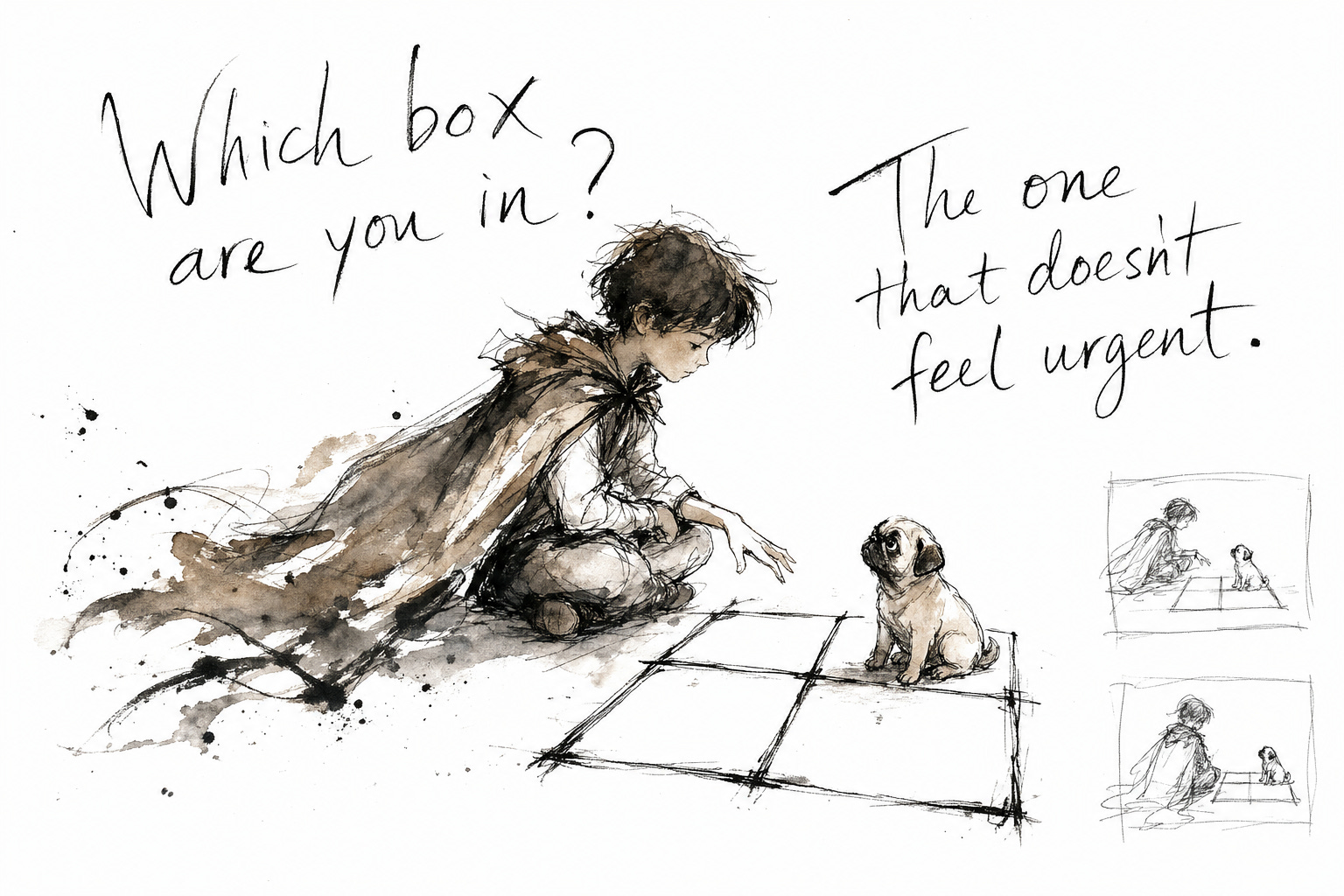
The Four Boxes
“I have two kinds of problems, the urgent and the important. The urgent are not important, and the important are never urgent.”
Dwight Eisenhower - 1954
He’d just finished running D-Day and was in the middle of running the country.
The insight wasn’t theoretical.
It was operational.
The man who coordinated the largest amphibious invasion in history was telling a room full of people that the hardest part of leadership isn’t the big decisions — it’s not letting the small loud ones eat the big quiet ones alive.
Stephen Covey later turned the quote into the 2x2 grid most people know: urgent/important on two axes, four quadrants, four actions.
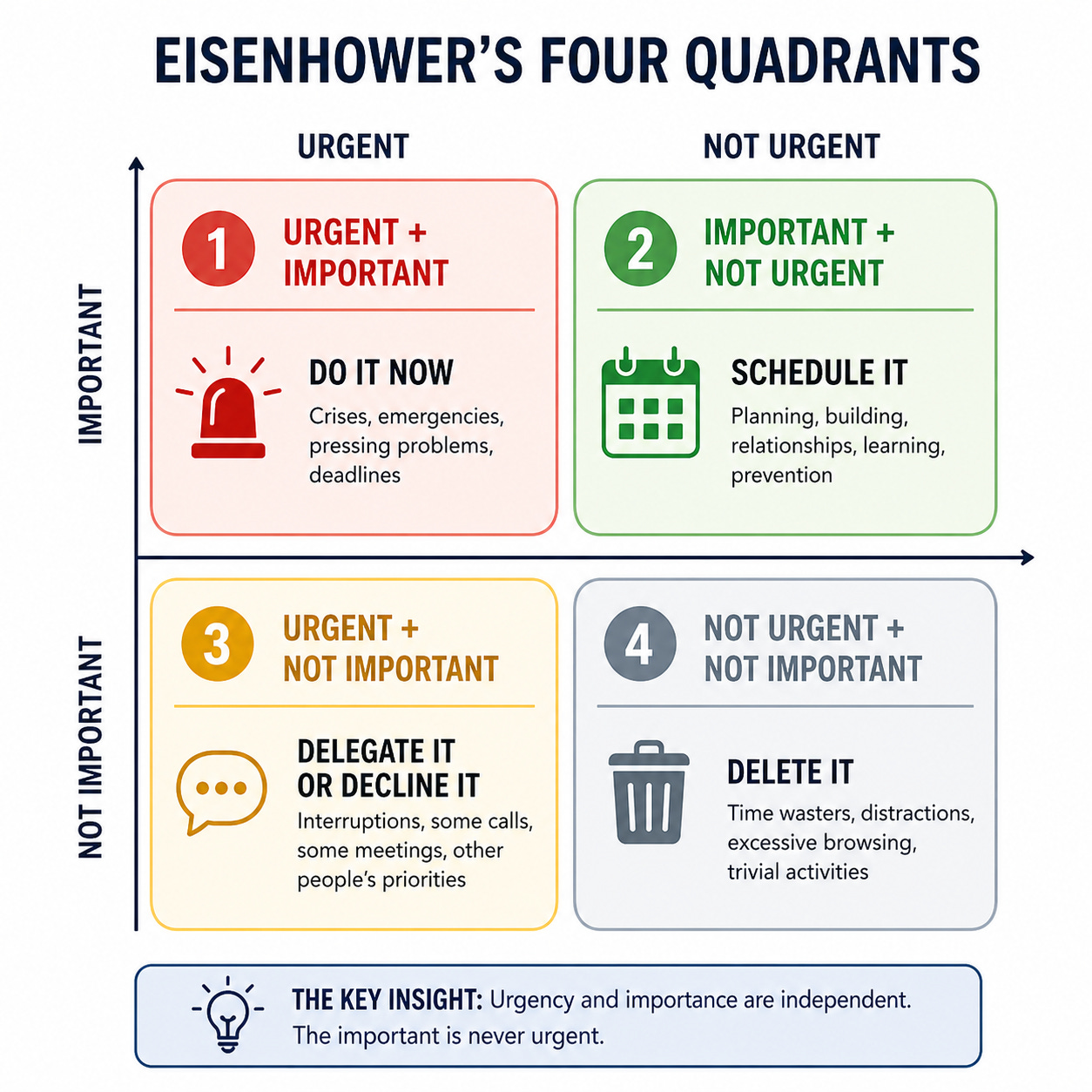
Quadrant 1: Urgent + Important. Do it now. The crashing patient. The server that’s down. The kid with a fever at school. You don’t choose these — they choose you.
Quadrant 2: Important + Not Urgent. Schedule it. The FHIR app you’ve been speccing in your head for six months. The Georgetown course prep. The Scrub Capital scout thesis. The conversation with your spouse about what the next year looks like. This is where all the compounding work lives — and it’s the quadrant that gets eaten first, because nothing in it is on fire today.
Quadrant 3: Urgent + Not Important. Delegate it or decline. The Slack thread that feels like it needs a response right now but doesn’t. The meeting that could have been an email. The prior auth that someone else on the team can handle. These feel like Quadrant 1 because they’re loud, but they’re not yours.
Quadrant 4: Not Urgent + Not Important. Delete it. The doom scroll. The third redesign of a logo for a product that doesn’t have users yet. The LinkedIn rabbit hole that started as networking and ended as comparison. You know this quadrant by how you feel afterward: empty.
Here’s why this matters for clinician-builders specifically.
Clinical practice is almost entirely Quadrant 1. Every shift is a series of urgent, important decisions made under time pressure. You’re trained for Q1. You’re exceptional at it. Your entire residency was a Q1 factory. The muscle is overdeveloped.
Building is almost entirely Quadrant 2. Claude Coding on a weekend. Designing a workflow. Thinking about what the product should actually do before you build it. Reading the FHIR spec. Having the conversation with a potential user. None of this is on fire. All of it compounds.
The failure mode for clinician-builders isn’t laziness — it’s that Q1 muscle memory makes Q2 feel wrong. When you sit down to build on a Saturday morning and nothing is urgent, the absence of urgency feels like the absence of importance. So you check Slack. You answer an email. You find a Q1 task to do instead, because Q1 feels productive in a way that Q2 doesn’t — until you look up and realize the FHIR app is still in your head six months later.
Eisenhower’s insight — the one the unnamed university president actually said — is that urgency and importance are independent variables. They feel correlated. They’re not. The thing that will matter most in your life a year from now is almost certainly not urgent today. And the thing screaming for your attention right now will almost certainly not matter in a year.
Three things to try this week.
Name your Q2 list. Write down the three most important things you’re not doing because nothing is forcing you to. Not the tasks — the outcomes. “Launch the beta” is a task. “Have 10 clinicians using the tool” is an outcome. The outcome is what belongs in Q2.
Block Q2 time like Q1 time. Your shifts are scheduled. Your Q2 time isn’t. That’s the problem. Put two hours on your calendar this week with the same non-negotiability as a clinical shift. If someone asks you to cover, you’re already booked. You are. You’re building.
Audit your last Saturday/Sunday. How many hours did you spend in each quadrant? Be honest. If you spent your building time in Q3 (answering Slack, clearing inbox, “quick” tasks that felt productive but weren’t yours), that’s the diagnosis. The treatment is boundaries, not more hours.
Eisenhower ran a world war and a presidency with this grid. You’re running a clinical practice, a family, and a side project. The grid is simpler than your life, and that’s the point.
Complexity is the excuse for not prioritizing.
The grid removes the excuse.
The important is never urgent.
Build anyway.
What’s in your Quadrant 2 right now? Reply and tell me — I read every one.
— Kevin