


At least 41 health systems are warning patients about a fake MyChart “Medicare Kit” — nothing was breached. The attack surface was the brand.
Ardent Health crossed 1 million ambient AI encounters — and its CMIO says the ROI is the least useful number in the report — 650+ clinicians, 87% of their visits, entirely voluntary, ~3x validated return, 20% more HCCs per visit. Expanded below.
Komodo Health and NCQA are building quality measures with AI analytics — a colorectal-cancer follow-up measure was tested in about a month, against a two-to-three-month norm.
Cigna’s AI chief says mining old call transcripts moved more than 80% of a targeted campaign onto a biosimilar — the model wasn’t the product. The transcripts were.
🔮 My bet: as token cost drops with open source models, “we looked at everything” increases.
🎧 Podcast: HIMSSCast — investment in ambulatory surgery centers soars — CMS retires the inpatient-only list entirely by 2029. Surgical volume is relocating to facilities with no hospital-grade IT.
🔬 The Big Thing
Your ambient AI just documented 20% more HCCs. Is that accuracy, or appetite?
Ardent Health has run more than a million patient encounters through ambient documentation since last September, and published the operating numbers instead of a case study.
More than 650 clinicians, using it in roughly 87% of their visits. Three-plus hours a week returned. A validated 3x ROI. One Texas family medicine physician cut documentation time by 53%.
Also: a 20% increase in hierarchical condition categories documented per visit.
CMIO Brad Hoyt gets out ahead of the obvious read. “Ambient AI didn’t create revenue,” he says. “It helped close the gap between the care that was delivered and the care that was documented.” Compliance reviews confirmed the codes were supported.
That’s the right answer. It’s also exactly what the wrong answer would sound like.
Here’s the part I keep turning over. Every number in that list — hours saved, ROI, HCC lift — is one a vendor helps you produce. Hoyt’s argument is that the one worth watching isn’t on the list at all.
Ardent never mandated the tool. The clinicians who picked it up use it in 87% of their visits anyway.
“Adoption that’s required tells you very little,” Hoyt said. “Adoption that’s chosen tells you the tool is solving a real problem.”
Mandated usage is the metric that survives a steering committee. Voluntary usage is the metric that survives a bad Tuesday.
😤 “87% is a selection artifact. That’s a self-selected population, and volunteers were always going to like it.” That’s the point, not the flaw. You aren’t proving the tool works on the median clinician — you’re finding out whether anyone reaches for it unprompted, and how deep it goes for the people who do. If nobody does, the enterprise rollout is an expensive way to learn that later.
😤 “The HCC lift is upcoding with better manners.” Ardent’s compliance reviews cleared it, and documentation genuinely was leaving money on the table. What nobody has published is the counterfactual: how many newly captured conditions changed a care plan versus changed a bill.
❓What’s the equivalent of “voluntary use” for a tool clinicians can’t opt out of — a triage model, a sepsis alert, an agent working the inbox overnight? There’s a measurable version of consent-by-behavior in there and I can’t get it to resolve. Override rate is the obvious candidate and I don’t think it’s right.
🧪 Try the interactive: Sicker, or Better Documented? — 2,985 US counties plotted by average HCC risk score against the hospitalizations nobody can document into existence, and the 40% of the variation the risk score never explains. Built with real CMS data.
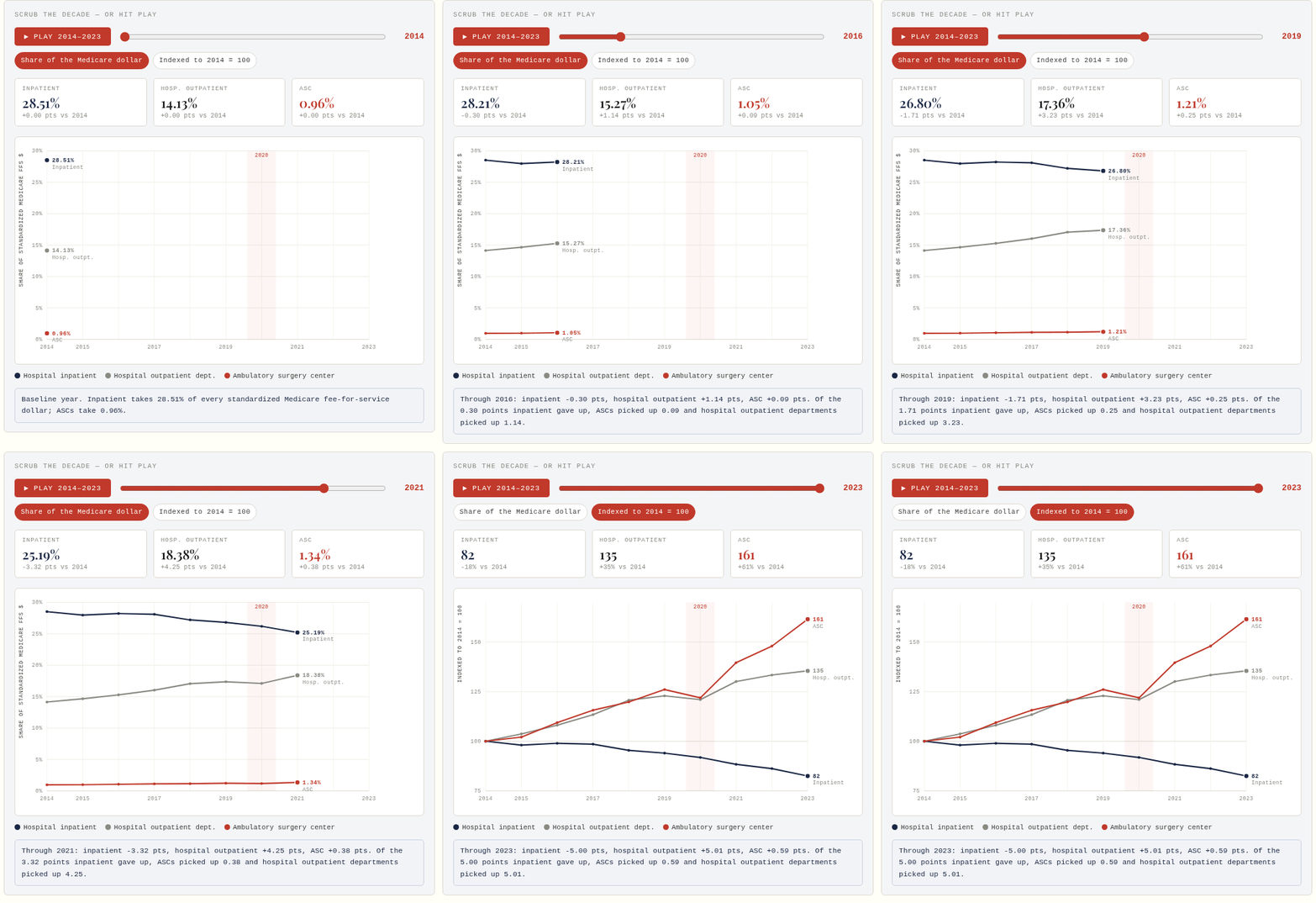
🧪 And the second one: The Relocation — ten years of Medicare data on where surgical volume actually went: inpatient’s share of standardized dollars fell 5 points, ASCs picked up 0.6 of them, and hospital outpatient departments took the rest. Built with real CMS data.
📡 Builder’s Radar
The AI wasn’t the product. The call logs were.
Cigna’s chief data, digital and AI officer told Fortune that her team looked at thousands of prior conversations between customers and service reps about biologics versus biosimilars, then used what they found to craft the digital messaging. The targeted campaign, Katya Andresen says, led more than 80% to opt for the biosimilar. Humira can run a patient around $7,000 a month.
The intelligence came from listening to what patients actually ask, not from a bigger model.
💡 80/20: You have the same asset and you call it a nuisance. Every clinic has a phone log, a portal message queue, and a triage line full of the questions patients ask when nobody’s watching. Pull 200, cluster them by hand for an hour, and see whether your product answers the top three.
41 health systems, one fake Medicare Kit, zero breaches.
A phishing campaign impersonating MyChart with an offer for a “Medicare Kit” has Cleveland Clinic, Mount Sinai, Mass General Brigham and 38 others on the list — and Becker’s is still adding to it. Epic’s position is that it exploits brand recognition, not a platform flaw — which is correct, and which is the uncomfortable part. The better you train patients to trust a portal, the more valuable it becomes to impersonate.
🔮 Where this lands: AI is a creativity that is making attack surface very broad.
Quality measures are about to move faster than your dashboard.
Komodo Health and NCQA announced a multiyear collaboration applying Komodo’s dataset of more than 330 million de-identified patient journeys to HEDIS measure development. Quantitative testing of a new HEDIS measure has historically taken two to three months; NCQA tested a colorectal-cancer follow-up measure in about one, across Medicare Advantage, Medicaid and commercial populations.
💡 80/20: If you’ve hard-coded measure logic anywhere, it just became a maintenance liability with a shorter half-life than you budgeted. Treat measure definitions as configuration, not code.
⚡ Quick hits
DEA’s telemedicine special-registration framework is at OMB — OIRA received the final rule from DEA on August 25, the last stage before Federal Register publication. If your product touches a controlled-substance workflow, the design assumptions are about to be fixed for years. Current telehealth flexibilities expire December 31.
CMS says its enforcement actions have now stopped $1.6 billion in potentially improper Medicare lab payments — a running total since January 2025, including 157 lab providers revoked. Detection at that scale is a pattern-matching problem, and the same capability points at coding intensity next. Read the Big Thing again with that in mind.
🎙️ From the Pods
🎙️ HIMSSCast — investment in ambulatory surgery centers soars
Capital One’s Erik Tellefson tells host Susan Morse that the inpatient-only list “is set to go entirely by 2029,” and that hospitals can charge 50%+ more than ASCs for the same procedure.
💡 Builder take: Scheduling, pre-op clearance, anesthesia workflow and post-discharge follow-up in small independent surgical facilities — none of them with hospital-grade IT — is an unglamorous, underbuilt market with a deadline attached.
🔇 Speaker Blindspot: Selection bias. The 40–50% cost gap is offered as proof of ASC efficiency, but ASCs screen out the comorbid and complex patients hospitals must accept. Asked twice what drives the differential, he deferred to an absent colleague.
🎙️ UnHack with Drex DeFord — a fake job offer put a children’s hospital on a target list
Security researcher Vangelis Stykas tracked the pattern for nearly two years: 1,640 companies, 57 countries, some independent contractors holding simultaneous access to as many as 30 organizations. “Nobody kicked down the digital front door with some brilliant zero day,” DeFord notes. “They walked in as people who were supposed to be there.”
💡 Builder take: Your real attack surface is offboarding hygiene.
🔇 Speaker Blindspot: Availability heuristic. The children’s hospital anchors the story emotionally, but by the hospital’s own account it involved a former contractor’s personal device with no evidence of access to hospital systems — the most alarming example is the weakest one.
💡 BTW
💡 BTW: Katya Andresen, the Cigna executive above, worked as a foreign correspondent for Reuters and the Associated Press before she ever touched health insurance — and wrote a book on nonprofit marketing called Robin Hood Marketing. Reading transcripts to find out what people are actually asking is, in retrospect, a reporter’s instinct.
💺 Builder Seats
[These are just ones I found on LinkedIn that look interesting, no sponsorship or anything. Use at your own risk but look legit]
Medical Director, Clinical Informatics — Availity · Remote
Clearinghouse side. Rare seat where you’re building on the transaction rail instead of asking someone else for access to it.
🔗 Apply on LinkedIn
Managing Director, New Ventures (Cedars-Sinai) — Redesign Health · Remote
Venture studio inside an academic system. Spinning clinical problems into companies, with a budget.
🔗 Apply on LinkedIn
Know someone hiring for a clinical AI or informatics leadership role? Hit reply and let me know.
📅 Upcoming: Measuring What Matters: ROI Frameworks for AI and Long-Horizon Healthcare Initiatives (CHIME, free, Sept 2, 2–3pm ET). [I ❤️ CHIME.]
You have a unique combination of skills, experience and values. So do great things! … and tell me about them at kevin@clinicians.build.
— Kevin & AI
(please verify content for yourself, partially AI generated and may contain errors)