

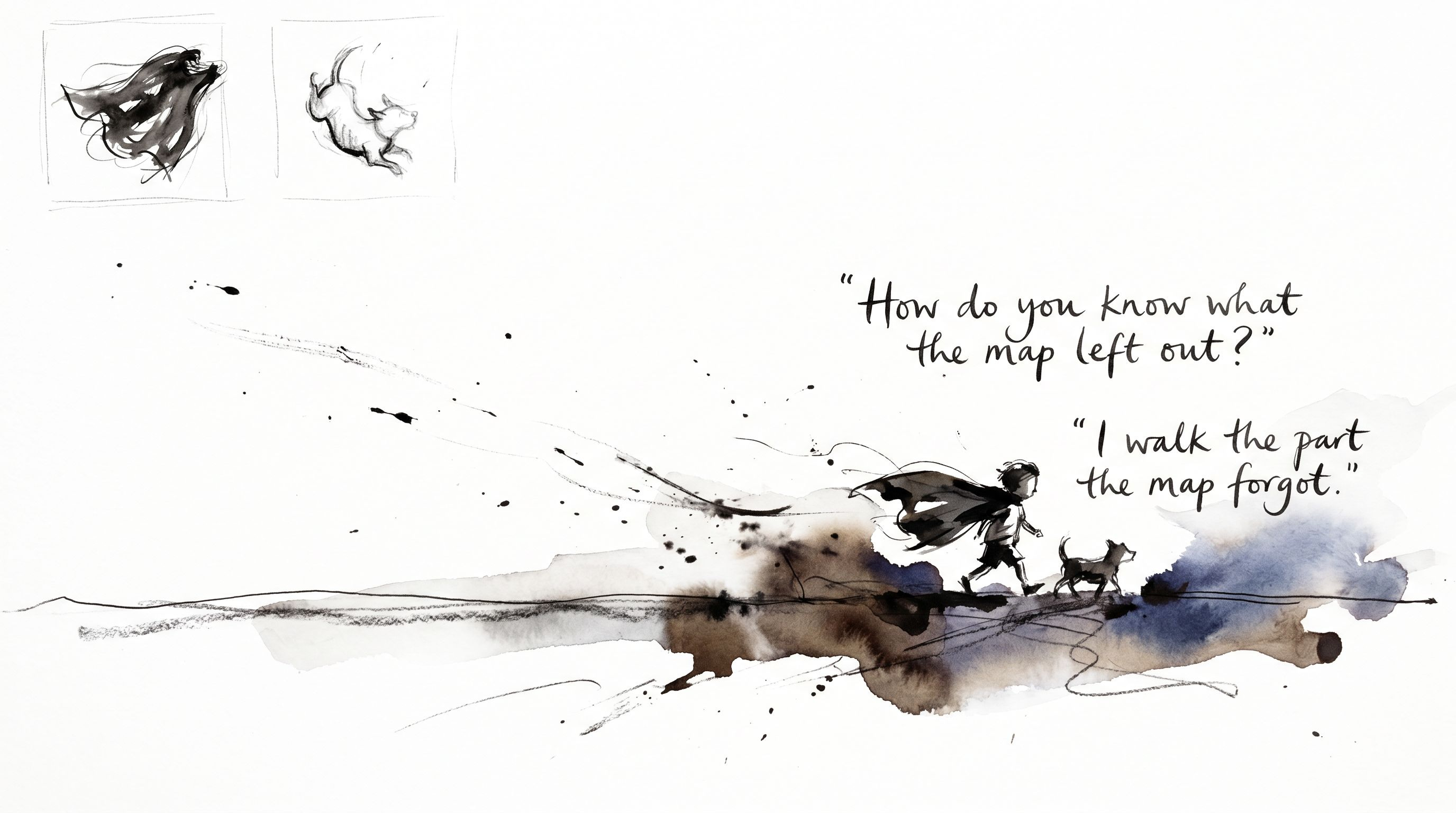
What AI Knows — and the Part It Can’t
A piece I couldn’t stop thinking about this week maps Michael Polanyi’s old distinction onto AI: explicit knowledge (the stuff you can write down) versus tacit knowledge (the stuff you can only do).
Explicit knowledge is now legible to the machine and effectively free. Tacit knowledge — riding a bike, reading a room, the gestalt that something is off before the labs confirm it — is not.
The scarce input was never the explicit knowledge the model just commoditized. It’s the embodied judgment nobody could write down — and the discipline to keep practicing it.
This is why “AI saves time” is the weakest case for clinical AI. A careful read of the actual studies — ambient scribes save about 16 minutes per 8-hour day, used by maybe a third of clinicians — shows the durable win is cognitive, not chronological. Burnout drops; minutes mostly don’t. And the time you do claw back tends to get refilled with more patients.
So the field is leading with its worst argument and measuring the wrong thing. The real value is the load lifted off the clinician’s head — and the danger is that leaning on the model for the first draft of thinking quietly atrophies the very judgment that was the point.
The prescription one writer calls “enlightened inefficiency”: deliberately do the hard human reps at human speed. Think before you prompt. Keep hiring and training the juniors even when the model can do their tasks — because that apprenticeship is the only pipeline to senior judgment, and there’s no shortcut to the bike.
😤 “This is cope. The models keep getting better at exactly the ‘tacit’ stuff you say they can’t do.” Some of it, sure — and where tacit knowledge can be made explicit, it should be. But “the model is improving” and “the model has the embodied judgment of someone who’s run a code” are different claims. The gap that matters isn’t capability on a benchmark; it’s accountability in a room. Watch what your tool does when it doesn’t know — that’s where the bike shows up.
😤 “Tacit knowledge is just a fancy word for stuff we haven’t digitized yet.” Maybe. But the same essay names the failure mode: companies that couldn’t name their tacit knowledge replaced it, then quietly died when no one could do the thing anymore. Klarna fired its support team for a bot in 2024 and walked it back by 2025. “We’ll digitize it later” and “we deleted it by accident” look identical from the outside.
😤 “So your big advice is ‘be human’?” My advice is measure the load you lifted, not the seconds you saved, and don’t fire your apprentices. Less inspirational, more useful.
💬 Standout Quote
“A large language model can know Pythagoras’s Theorem. It cannot know how to ride a bicycle.” — David Mattin
💡 80/20: Stop reporting “minutes saved” as your headline metric. On your next pilot, measure decisions deferred to the human and self-reported cognitive load instead — and one thing to try this week: write down three things you noticed on a patient that weren’t in any field of the chart. That list is your tacit knowledge. It’s also your spec.
The Job You’ve Been Doing Finally Has a Name
Two physician-builders make a clean argument: the field has been borrowing “clinical informaticist” for two different jobs, and one of them never had a word.
There’s the board-certified clinical informaticist who stewards the system of record — the EHR, the orders, the governance. And there’s the physician who builds products. They proposed a name for the second one: the product informaticist.
Naming the role is how it stops being a hobby and starts being a career ladder — which is exactly the identity a lot of clinician-builders have been missing.
😤 “We don’t need another title.” We don’t need title inflation. We do need a word for the person who can sit between the clinic and the codebase, because right now that person gets hired as either a doctor who dabbles or a PM who once shadowed in an ED — and neither is the job. A name is how the job gets a budget.
💡 80/20: If your work is “I build the thing, then I make it survive contact with real clinical workflow,” you’re not a clinical informaticist who codes — you’re a product informaticist. Put it on the LinkedIn headline and watch which recruiters change their pitch.
MedTech Spent $1.6B on Surgeons and $0 on the Front Door
Christian Pean MD's essay lands a sharp point: ortho/device makers paid surgeons over $1.6B from 2014–2019, but they’re nowhere in the consumer Health-AI layer that’s becoming patients’ actual front door.
Amazon is putting agentic AI in front of One Medical. Google rebranded Fitbit as Google Health with a Gemini coach. A wearable player raised $575M and is bolting on telehealth. About one in three US adults already asks a chatbot for health info.
Whoever owns the AI front door owns the patient relationship — and the incumbents who bought the physician relationship are watching from the parking lot.
😤 “Patients won’t trust a chatbot over their surgeon.” They don’t have to trust it more — they just have to open it first. The front door isn’t where the trust lives; it’s where the triage happens. Own the first question and you shape every referral after it.
A Startup Selling the “Why” Behind an AI Answer
A new entrant (HypotheX) is building warrant chains for AI-derived conclusions: given an answer a model produced, it reconstructs what data grounds it, where the model reached past its evidence, and produces an audit-ready record — pitched as making AI evidence “FDA-traceable instead of a black box.”
It’s early and aimed at biotech R&D first, but the shape is dead-on the thesis I keep coming back to: as more conclusions come from models, the provenance becomes the product.
😤 “This is compliance theater.” Could be — a warrant chain is only as good as whether anyone acts on the part that says ‘the model is reaching here.’ But “show your work or it doesn’t count” is exactly how evidence-based medicine was built. The audit trail isn’t theater if it changes what you’re allowed to ship.
Ultra-short:
Anthropic called for a global pause on frontier AI. A frontier lab arguing for a slowdown is either conviction or positioning — either way, builders should read where the regulatory wind is being pushed. Coverage
Bernie Sanders is floating a 50% public stake in big AI companies. The “American AI Sovereign Wealth Fund Act” would tax leading AI firms 50% — paid in stock — into a public fund. Long odds, but the framing (who owns the upside of AI) is going to shadow every health-AI funding conversation. Sanders op-ed
“The mammogram of the heart” made the MedTech Innovator 2026 cohort. Lucentia turns routine non-contrast cardiac CT into coronary diagnostics — no contrast, no new hardware, no workflow change — and was tapped for the AHA Heart & Brain accelerator. The wedge is “no new workflow,” which is the only kind of imaging AI that actually gets used. AHA newsroom [also cool cohort]
🎙️ From the Pods/Vids
🎙️ HIMSS — “Dr. John Halamka: The One Principle That Never Changes in Healthcare IT”
Halamka opened by noting you won’t see the word “AI” in his slides — on purpose. After 40 years, his point is that the technologies change but the engineering principles don’t.
💡 Builder take: Spend your scarce attention on the invariants — identity, data integrity, interoperability, provenance — not the model-of-the-month. Those are the parts of your stack that’ll still be load-bearing in five years.
🔇 Speaker Blindspot: “Principles never change” is a comforting frame that can undersell what genuinely did change — the cost-and-latency curve of intelligence itself collapsed, and that’s not just a faster version of the old thing. Some invariants are real; “nothing is new” is its own trap.
🎙️ HLTH — “Mental Health Can’t Run on Good Intentions Alone”
The line that stuck from April Koh, CEO & Co-founder of Spring Health: the most expensive patients aren’t the ones with diabetes or asthma — they’re the ones with diabetes or asthma plus untreated depression or anxiety, because the mental health piece wrecks their ability to manage everything else.
💡 Builder take: The ROI for a behavioral-health tool hides in the medical claims of comorbid patients, not the BH claims. If you’re building here, instrument the comorbidity overlap — that’s the number that moves a CFO.
🔇 Speaker Blindspot: Framing mental health entirely as a total-cost-of-care lever is how you get a tool that optimizes for the employer’s spend and quietly ignores the patient who isn’t expensive enough to matter. The cost case is real; it’s also not the whole reason to build.
🧰 Builder’s Tip
Prompt Template — The Tacit-Gap Audit. Tie this week’s Big Thing to something you can run in 60 seconds on a synthetic case (Synthea patient, fake vignette — never real PHI). Instead of asking a model for the answer, ask it to surface what it can’t know:
You are assisting a clinician. Here is a synthetic patient case:
[paste synthetic case]

Before giving any recommendation, do three things:
1. List what an experienced clinician at the bedside would likely
   NOTICE that is NOT present in this written data (gestalt, exam
   findings, social context, the "something's off" signals).
2. Mark every point where your reasoning is REACHING PAST the
   evidence given — label each as [grounded] or [inferred].
3. State the single piece of missing information that would most
   change your assessment, and refuse to fabricate it.
Only after that, give your provisional recommendation.
It won’t make the model clairvoyant — but it forces the boundary between what’s in the data and what lives in your head into the open, which is exactly the line you’re getting paid to hold.
📅 This Week in Health AI Events
Thu Jun 11 — State-to-State Roundtable: Interoperability in Practice (Findhelp)
12:00 PM ET · Virtual · Free
How HIEs actually standardize non-clinical/social-care data across state lines — the operational reality behind the interop buzzwords builders keep hearing. (Stephanie Brown - CRISP)
Fri Jun 12 — Adoption of AI in Clinical Care: Updates from the HHS RFI (ONC / HHS)
10:00 AM ET · Virtual · Free
HHS leadership shares takeaways from the national AI-in-clinical-care RFI. If you’re building clinical AI, these are the policy signals you’ll be designing around. (HHS leadership)
Thu Jun 18 — Interoperability Imperative: Connected Data for AI-Ready Operations (AHIP + SAS)
2:00 PM ET · Virtual · Free
How payers are making data AI-ready beyond compliance. The interop + AI intersection is where the next wave of builder opportunities sits. (Kristen Valdes)
Tue Jun 23 — Best Practices for Digital Phenotyping Research in Aging Populations (MassAITC)
4:00 PM ET · Virtual · Free
Dr. Raeanne Moore (UCSD) on doing digital phenotyping research rigorously in older adults — how passive sensing and behavioral data actually become clinical signal.
Tue Jun 30 — Clinician in the Loop: AI Investment to Real-World Impact (CHIME, LinkedIn Live)
12:00 PM ET · LinkedIn Live · Free · Replay available
For CMIOs and clinical leaders: evaluating whether AI is actually working post-deployment. The gap between vendor promises and clinical reality. (Nancy Cibotti, MD - Heidi Health)
💡 BTW: David Mattin — the writer behind this week’s “what AI knows and doesn’t” piece — wrote and presented documentaries for BBC Radio 4 before he became a technology-and-trends essayist. The guy arguing that human judgment is the moat spent years in a craft where the whole job is noticing what a microphone can’t. About
What are you building this week? Email and tell me (kevin@clinicians.build) — I read every one.
— Kevin