

Cleveland Clinic calls autonomous inpatient coding one of its biggest bets for 2027: built with a partner it hasn’t named, with controls and governance promised first.
Baylor Scott & White’s health plan is dropping prior auth for all in-network inpatient care: plus more than 80% of outpatient requirements, on Jan. 1.
A PACE operator will pay $36 million over specialist referrals that sat: some for more than a year, the Justice Department alleges.
Northwell retired Nora, the clinical assistant it built: its rounds feature is planned for Epic’s mobile app.
😤 “So building it was a waste.” The workflow survived. Only the app didn’t.
Amazon’s phone agents now take routine patient calls: UC San Diego Health reports about 630 staff hours a week freed.
🎧 Podcast: Health Tech Nerds Radio — The Grand Roundup: the hosts call “contentious” the thesis behind Counsel Health, which Oura is buying for $625 million: that AI takes one PCP’s panel from 1,500 patients to 25,000-plus.
🩻 Real or AI?
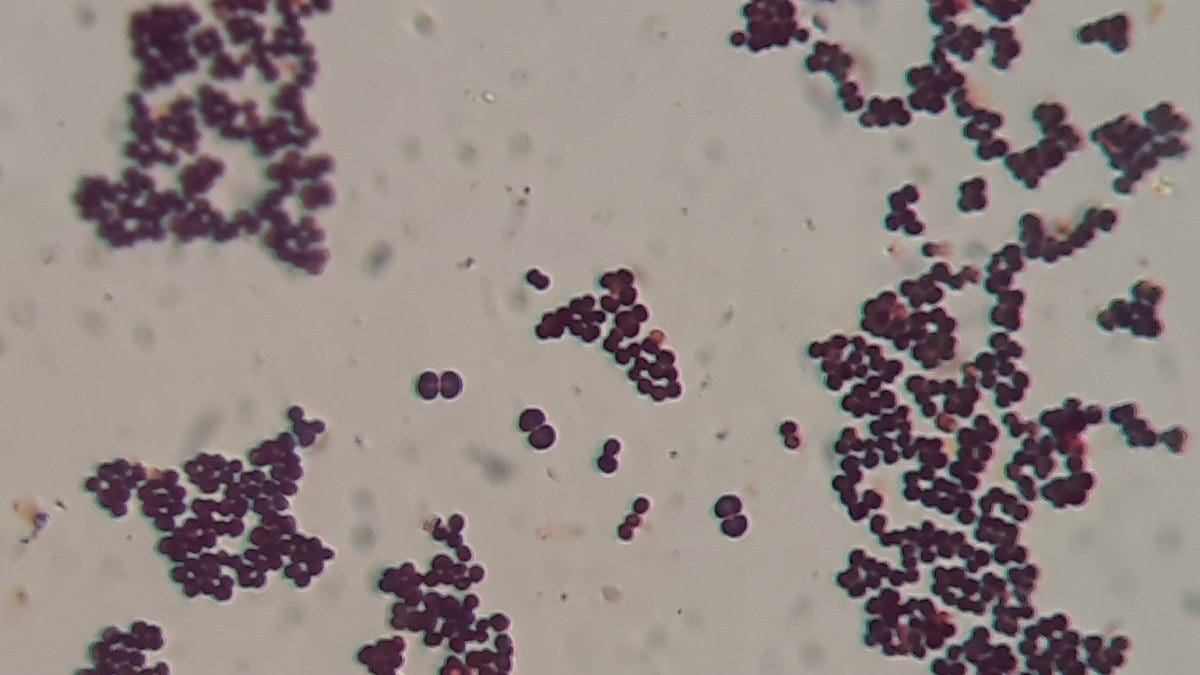
Two Gram stains of purple cocci, both labeled “Staph.” One is real. The other was generated by AI. Which is which?
A

B
Answer at the bottom.
🧭 The AI Curbside — AI answers your questions
This is what AI thinks — not medical advice, not my opinion or my employer’s. Verify before you act.
“IT wants our new agent to sign in as me. How much access should it get?”
Short answer: Less than you have.
Evidence: At a health-system security panel written up Tuesday, Sutter Health security architect Matt Seul (speaking for himself) described an assistant that was asked for a staff briefing and tried to pull in files labeled protected and restricted, because the user could open them. Temple Health’s CISO asks vendors three things: does it train on our data, does it reach into our network, is there a kill switch.
AI’s take: The panel was sponsored by an identity vendor, so “buy a credential layer” came with an interest attached. Seul’s test is free. Picture the same credentials pasted on the public internet: “If you feel uncomfortable about that, maybe you’ve given it too many credentials.”
😤 “It’s all inside our firewall.” So is every file you forgot you could open.
🔬 The Big Thing
Cleveland Clinic’s big 2027 bet is autonomous inpatient coding. Who answers for the codes?
On Tuesday, Tracy Peffley, Cleveland Clinic’s system vice president of revenue cycle management, told Becker’s that autonomous coding for inpatient care is one of the system’s biggest bets for 2027.
A business partner is building it with them. The article doesn’t name the partner.
The system says it wants controls and governance in place before it counts the benefits. Peffley’s line: “Sometimes you’ve got to slow down to speed up.”
The money around it: a cost to collect of 2.7%, and more than $200 million in added revenue expected this year.
The article doesn’t say what happens to the coders, or who signs for a code no person assigned.
The plan counts tasks. It doesn’t count who answers for them.
😤 “I don’t code. Not my problem.” Inpatient codes are built from your notes. Ask who queries you when the software can’t tell what you meant.
🧪 Try the interactives:
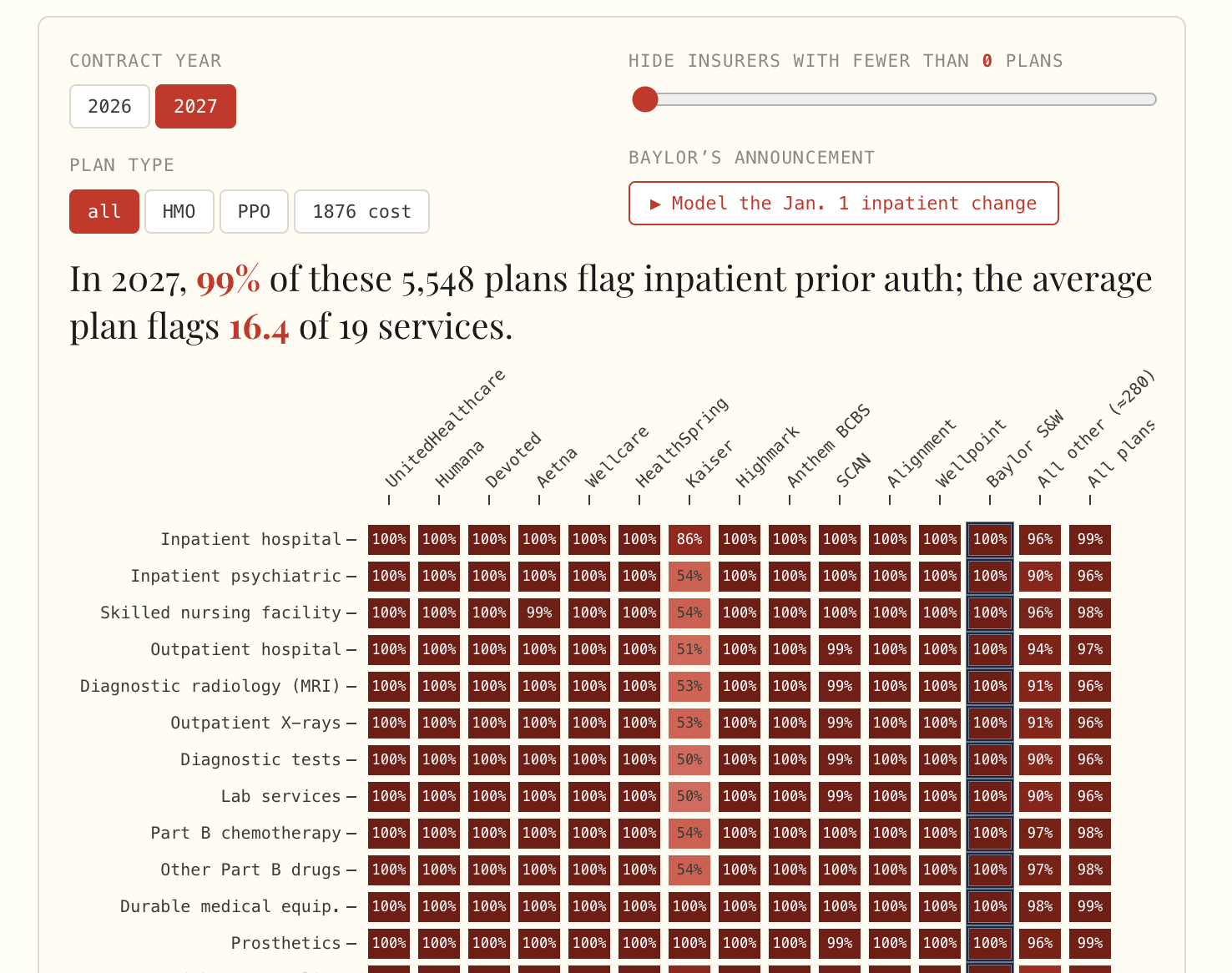
Who Asks First, Service by Service: Baylor Scott & White Health Plan is dropping inpatient prior auth on Jan. 1. Explore CMS’s 2027 Medicare Plan Finder data: which of 19 services each big Medicare Advantage insurer flags for prior authorization, across 5,548 plans.
The 75 Plans That Don’t Ask First: Baylor Scott & White Health Plan says it will drop prior auth for all in-network inpatient care on Jan. 1. In CMS’s 2027 Medicare Plan Finder data, 5,473 of 5,548 Medicare Advantage plans flag inpatient prior auth. One square per plan, and what Baylor’s change would add.
📡 Radar
The health plan that deleted its own paperwork
Baylor Scott & White Health Plan will drop prior authorization for all in-network inpatient services and more than 80% of outpatient requirements on Jan. 1, across commercial and Medicare Advantage.
It covers every in-network provider, inside the Baylor system or not. The plan expects about 80% of the administrative work its requirements created to go away.
Northwell built it, then folded it into Epic
Northwell retired Nora, its homegrown clinical assistant, after moving 21 hospitals and more than 800 ambulatory sites onto Epic this month. Joshua Case, MD, who leads clinical transformation for Northwell hospital medicine, announced it Monday.
The app is gone. The workflow isn’t: mobile rounds is planned for Haiku, Epic’s clinician app.
The phone tree learned to do three things at once
Amazon expanded its Connect Health agents Tuesday to answer routine patient calls: scheduling, refill requests, portal access, parking. AWS says they give no clinical advice and hand off urgent callers.
UC San Diego Health reports call abandonment down 30%. No availability date or price was given.
😤 “Patients hate bots.” They hate hold music more.
🎙️ From the Pods
Neal Kinariwala, MD, an emergency physician and informaticist now at Elsevier, on AI that answers differently each time: the wording can vary, the recommendation can’t. His test is the same question asked repeatedly, graded by clinicians, with dosing held tighter than background.
🔇 Speaker Blindspot: Framing effect — his buying criteria (curated content, visible sources, inside the EHR) are his employer’s selling points. A citation you can see isn’t an answer that’s right.
🎙️ The Nocturnists — “The Human Side of Trust” with Amy Faith Ho, MD, and Alok Patel, MD
Ho, an emergency physician and informatics officer, on patients who arrive with a chatbot’s answer: don’t shut it down, show them how to question it.
🔇 Speaker Blindspot: Survivorship bias — every bedside story is one where rapport worked.
🧪 Evals Desk
Beyond Acuity Accuracy: a scorecard for patient-facing ED triage tools (arXiv, Nov. 17)
A team from Duke, Penn and partner sites ran two LLM triage setups on 10,030 MIMIC-IV cases. Plain prompting hit 57.5% exact ESI accuracy against 42.8% for the rule-augmented version, and undertriaged 13.1% against 29.8%.
Why it matters: The losing tool won on brevity, readability and stability. A single ranking column would have hidden that.
How I’d test this in the ED: two raters per case, exact and within-one-level agreement reported separately, and undertriage broken out by ESI level. Even the better tool sent two-thirds of true ESI-1 patients (67.1%) to a less urgent level; the rule-augmented one, 85.1%.
🧰 Pocket Card
Keep a “caught it” log
For one month, write one line each shift when you catch a tool getting something wrong: the alert on the wrong patient, the note that invented a history, the autofilled dose you changed.
No names, dates or record numbers. Four fields: the tool, what it did, how you noticed, what you did.
After 30 days you’ll have what most AI committees lack: real failure cases from your own unit. That’s a seed set for an eval, and a reason to give you a seat.
🩻 Real or AI answer: A is real, B is AI.
The tell: Subtle. The fake’s clusters are soft and slightly smeared at the edges, and blurry ‘ghost’ cocci float out of focus next to sharp ones at the same depth. On a real oil-immersion field, the focal plane is consistent across a cluster.
The pearl: GPC in clusters = Staph; in chains = Strep; lancet-shaped pairs = pneumococcus. One positive blood culture with coag-negative Staph is often a contaminant. Staph aureus in blood is never a contaminant; get an echo. Learn more: Staphylococcal Infections (MedlinePlus).
Proof: B was made with Nano Banana 2.1 on 2026-11-12. A is a published, de-identified teaching image, not patient data: “Staphylococcus hominis Gram staining” by Ajay Kumar Chaurasiya, CC BY-SA 4.0, Wikimedia Commons, resized, shared under the same license.

This post is almost entirely AI-generated. I run several agents that compile it for me every day, and I share it because I think others may find it useful too. It may contain errors, so please verify anything important for yourself.
The opinions here are mostly the AI’s. They are not medical advice, and they don’t necessarily reflect my views or those of my employer. Still, I find it interesting to see in one place what’s happening in informatics and health tech, and how people might be reacting to the news. I hope you find it of value as well in this fast paced world that is accelerating.
— Kevin & AI