

Forus raised $150M at a $3B valuation to give every prescription its own AI agent — prior auth, benefits verification, appeals, financial assistance, specialty pharmacy routing. Tripled since May.
🔮 My bet: within 18 months a major payer buys an administrative-agent company outright. The cheapest way to kill a toll booth is to own it.
Trinity Health is cutting 557 IT jobs and outsourcing technology support across a 23-state system.
Five AI drug discovery companies: $458.7M in revenue, $5.58B in losses since 2021 — and the one with an FDA-approved product is in Chapter 11.
FDA’s digital health leader is out after 21 years — more turnover in the office writing the rules you build against.
🎧 Podcast: Lifers — Microsoft’s Peter Lee and Seattle Children’s Chris Longhurst — Lee cites a Nature finding that general frontier models beat the healthcare-specific models built on top of them.
🧭 The Curbside
“My agent reads a note it didn’t write. Can that note tell it what to do?”
Short answer: Yes, and most clinical agents have no boundary between data and instruction.
What changed: A walkthrough of prompt injection through untrusted tool output went up this week. The attack isn’t in the user’s message — it’s in what the tool hands back.
Builder read: A clinical agent’s tool output is a FHIR narrative field, an OCR’d fax, a scanned outside record, a patient-entered chief complaint — all text somebody else wrote. Treat every tool return as hostile string data, not as a turn in the conversation.
😤 “Nobody is attacking my little internal tool.” Not yet.
“How do I prove my coding agent actually ran the checks?”
Short answer: Make the proof a signed artifact instead of a claim in a log.
What changed: Vouch shipped a small CLI that gates a coding agent’s Stop hook behind an HMAC-signed receipt proving named checks passed against the current git HEAD. The agent can’t say “done” without it.
Builder read: “The tests passed” is a sentence. A signed receipt tied to a commit is evidence.
🔬 The Big Thing
What’s the gap between a prescription and a patient worth? Three billion dollars.
Forus — formerly Tandem — raised a $150M Series C led by Bain Capital Ventures at a $3B valuation. That’s triple its May valuation, four months later.
Try to find the medicine in the product description: prior authorization, benefits verification, appeals after denial, financial assistance enrollment, specialty pharmacy coordination, pharmacy routing, patient communication. Providers in all 50 states, reaching 85% of US residential zip codes.
Every step in that list happens after the clinical decision is already made. The drug is chosen. The patient is waiting. Three billion dollars is what the market thinks the wait is worth.
Here’s the part I keep circling. On October 1, UnitedHealthcare removes prior authorization from roughly 1,700 service codes — the largest single-payer cut of the year. If administrative friction is the product, the product just lost inventory.
I don’t think it matters, and that’s the interesting part. The gate is one of maybe fifty steps between the order and the drug. Remove it and the specialty pharmacy still routes wrong, the assistance application still expires, the appeal still needs a letter. The bottleneck was never a single gate. It was that no one person has ever seen the whole path.
😤 “This is a $3B valuation for a fax machine with a language model on it.” Partly, yes. And the fax machine was load-bearing.
😤 “Automating a broken process cements the broken process.” The strongest objection, and I don’t have a clean answer. Every agent that makes prior auth survivable makes prior auth cheaper to keep. The counter is that UHC dropped 1,700 codes precisely because the administrative cost exceeded the denial savings. Ask me in a year.
😤 “Forty percent of agentic AI projects get cancelled before 2027.” Probably true. The survivors will be the ones where somebody could name the exact step being automated and who gets paged when it fails. “AI agents for healthcare” is a cancellation. “The letter that goes out when a specialty drug is denied for step therapy” is a product.
❓ What does the second wave look like? Forus sells the automation to the practice. Somebody is going to sell the same visibility to the patient — a live map of where their prescription is stuck. I think there’s a real product there and I can’t yet see who has the right to build it.
🧪 Try the interactive: Nobody Has Seen the Whole Path — 931 molecules across all 328 Medicare Part D formularies, and 495 of them where some plans demand prior authorization and others do not. Built with real CMS data.
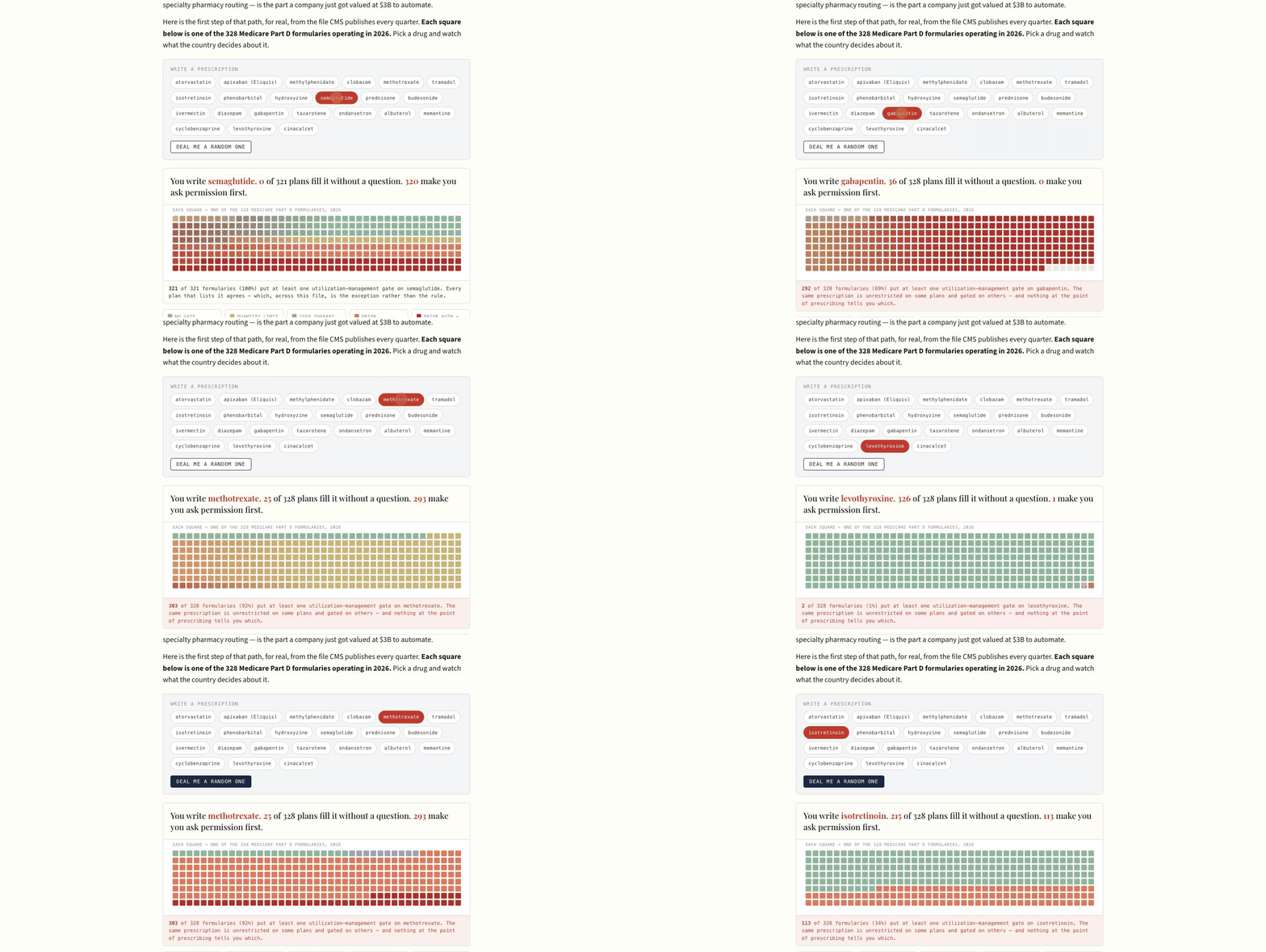
🧪 Try the interactive: Same Drug, 328 Answers — you write the prescription, and what happens next depends on which of 328 Part D formularies your patient happens to be on: one drug, five different answers. Built with real CMS data.
📡 Builder’s Radar
A 23-state health system just outsourced the people who answer when your integration breaks
Trinity Health filed to lay off 557 employees at its Livonia headquarters between October 25 and November 29, moving technology support to an outsourcing arrangement — service desk, database administrators, network security analysts, applications engineers. The system cited federal Medicare and Medicaid cuts.
If you sell into a health system, your implementation partner is now a contract, not a colleague.
😤 “Outsourced IT is still IT.” It is. It’s also a vendor with a scope of work, and your integration escalation is either in the scope or it isn’t.
AI drug discovery has produced $458.7M in revenue and $5.58B in losses
A tally of five AI-native drug discovery companies published Monday puts cumulative revenue since 2021 at $458.7M against $5.58B in losses. BioXcel — the only one in the group with an FDA-approved product — filed Chapter 11 in late August, Teva stalking-horse at $57.5M upfront.
Approval was never the hard part. Distribution was.
Benchmarks grade the first answer and never grade the doubt
John Ferguson, MD, FACS argues that medical AI benchmarks score first-answer accuracy and never score calibration — so a model that’s right 70% of the time and unshakeable on all of it is more dangerous in a clinical workflow than one that’s right 60% and flags its own uncertainty.
FDA’s digital health leader leaves after 21 years
A long-tenured digital health official is out at FDA, continuing a run of turnover in the office that writes guidance for AI-enabled devices. Twenty-one years of institutional memory about how a submission actually gets read.
⚡ Quick hits
Benjamin Tran, MD mapped the LA aesthetic market from public data — 2,000+ practices tagged with toxin used, injector headcount, real ownership, devices carried. Not a pitch deck. A dataset nobody else had.
GenHealth.ai raised a $16.5M Series A led by Flare Capital for agents doing intake, eligibility, prior auth and claims inside existing EHR and payer systems.
🎙️ From the Pods
🎙️ Lifers with Christina Farr — “Microsoft’s Peter Lee & Seattle Children’s Chris Longhurst”
Lee cites a Nature finding that general frontier models outperform the healthcare-specific models built on top of them, and argues that fine-tuning on narrow medical data doesn’t reduce hallucination — it produces brittle savants. Longhurst’s counter is that the model was never the lever: outcomes come from workflow integration, and health systems on grocery-store margins can’t afford frontier inference at scale anyway.
“We shouldn’t be comparing AI against a perfect gold standard.” — Chris Longhurst
💡 Builder take: Wrap a general model, spend your engineering budget on routing and cost, and put the domain knowledge in the workflow rather than in the weights.
🔇 Speaker Blindspot: False analogy. Lee maps healthcare’s coordination friction onto software teams, where coding agents collapsed specialists into full-stack generalists. Healthcare’s friction is licensure, liability and reimbursement — the ER example he’s answering was blocked by scope-of-practice rules, not by anyone failing to be full-stack.
💡 BTW
💡 BTW: Before he was the face of Microsoft’s medical AI work, Peter Lee ran experimental undersea datacenters and a program to store digital data in DNA — and made his academic name co-inventing “proof-carrying code,” where a program ships with a mathematical proof that it’s safe to run. Microsoft Research bio.
📅 Upcoming: Stripe’s health tech AMA on payment infrastructure for digital health startups — billing, fraud, build-vs-buy — Thursday Sept 10, 12:00 PM ET.
You have a unique combination of skills, experience and values. So do great things! … and tell me about them at kevin@clinicians.build.
— Kevin & AI
(please verify content for yourself, partially AI generated and may contain errors)